
“Expect a miracle,” reads a sign above the purple and teal doors of the Bolinas Freebox, the 8-by-10-foot shed behind the community center where locals shop sustainably by leaving what they no longer need and taking what they do. 

Over the weekend, its shelves offered a Scottish kilt, a 45 rpm record of “Santa Claus Looks Just Like Daddy,” a dog bed, a jar of sewing notions, a well-used copy of “The Art of French Cooking” (its cassoulet recipe clearly a favorite) and the usual bric-a-brac of unknown provenance.

The sign’s promise, that the right thing will show up at just the right time, has proven true for many. 

“For some time, when I was very poor, if I had a job interview, the day before I’d go to the freebox, and there would always be a clean white shirt in my size, laundered, on a hanger,” longtime Bolinas resident Howard Dillon said. “I’d say to myself, ‘There is a God!’”

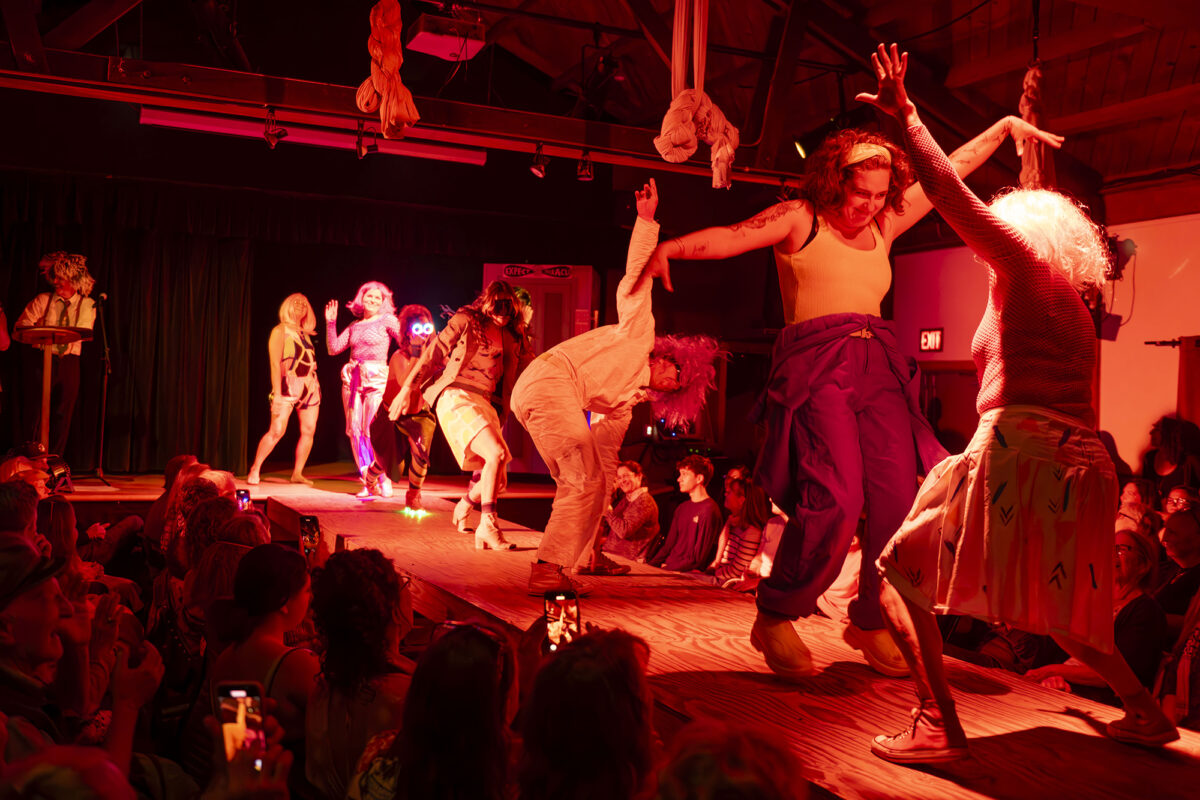
To celebrate the landmark’s 50th anniversary, locals revived the once-semiannual spectacle of the Bolinas Freebox Fashion Show, where one man’s trash becomes another’s haute couture. The show last Saturday was a thumpingly loud affair marked by glad and giddy cheering as models stomped, strutted and danced across a lit catwalk. 

The production’s artistic director, Asia Thorpe, a lifelong Bolinas resident who has overseen past freebox fashion shows, said she hadn’t planned to return. 

“I was pretty much in retirement from it,” she said. “Then Bob Dill came to me last fall saying, ‘It’s the 50th, we have to celebrate this.’”

Ms. Thorpe, an aesthetician by trade, had been recording oral histories with her father, the poet John Thorpe, and other veterans of the town’s late ’60s poetry scene. “I was thinking: What if someone 50 years from now looks at us the way I’m looking at 50 years ago? That made it feel important to do something memorable.”

Bob Dill, now 77 and living in Mendocino County, built the original freebox in 1975 while working as the community center’s caretaker. It wasn’t conceived as an anti-materialist project so much as a practical fix for the piles of clothes people kept leaving in the building’s entryway. His tool belt was the first item offered—by accident. 

Over the years, Mr. Dill has found no shortage of curiosities there. Once, a set of Mercedes-Benz keys appeared, with the car parked outside. Another time, while rummaging through the old wooden box, he grabbed “an arm that turned out to be attached to a person.” 

The freebox embodies the gift economy, one based upon a currency of reciprocity rather than scarcity and accumulation. 

Models strutted on the runway while Sasami Ashworth sang “Running up That Hill.” (David Briggs / Point Reyes Light)

“There’s whole families that get their clothes from the freebox,” Mr. Dill said. “There’s this anti-corporate ethos to it. It’s just for us, it’s just for the people. It’s alive.” 

Yet by the ’80s, the box had become a dumping ground. The community center’s board planned to shut it down, until Mr. Dill and other locals proposed a fashion show to raise both goodwill and money for maintenance. The first show mixed a catwalk with vaudeville skits and live music.

“If the Golden Gate Bridge gets a 50th birthday, so should the freebox,” Mr. Dill said. 

Ms. Thorpe last directed a show in 2006, with the theme of redemption; the theme before that was revolution. This year’s theme was rebirth, and the show was emceed by Mr. Dill and Amber Distasi, the theater teacher at Bolinas–Stinson School who, like the freebox, was born in 1975. Ms. Distasi’s first pair of heels came from the freebox, and now her 14-year-old daughter prefers it to any store over the hill. 

For this year’s production, Ms. Thorpe dreamed up a narrative of the freebox as a time machine. Artist Charlie Callahan, playing a visitor from the future, led the audience on a vision quest that charted the decades through music and fashion. The show opened in the ’70s, with models in belled trousers, caftans and technicolor prints gliding to the sounds of Fleetwood Mac and disco. Then came the headbanging of the ’80s, with its leather, corsets, fishnets and fingerless gloves. Punk gave way to the flannel layered grunge of the ’90s, then to hip-hop fashion and to Burning Man’s futurist frenzy, complete with a goth minotaur, a model with a selfie stick and another who towered above the crowd on stilts. 

Then the show turned to the grim political moment. A particularly orange Donald Trump appeared alongside Melania in her infamous “I Don’t Really Care” jacket, followed by Marie Antoinette-style aristocrats in powdered-wigs and petticoats, and two red-robed handmaids in white bonnets.

The sequence was a reminder that aesthetics are a response to complex economic realities and the social norms and moral dilemmas of the time. (Common wisdom says a downturn in the stock market sends hemlines falling.)

“Even in the darkest of days,” Ms. Distasi told the crowd, dressed in her fifth outfit of the evening, a metallic-purple jumpsuit, fanny pack and mirrored visor, “there is always a little sparkle of hope to be found.” 

The show surveyed several decades of fashion and commented on dystopian and utopian futures. (David Briggs / Point Reyes Light)

Out of the stage’s shroud of darkness came aerialist Shannon Gray, emerging from a cocoon and ascending on silk ropes, a sylph launching toward the rafters, a rebirth in motion, a dawn of utopia.

Few costumes came directly from the freebox, Ms. Thorpe admitted, but nearly all were secondhand. She designed several pieces herself, including a series of headdresses and illuminated gowns that closed the show. 

Live numbers stitched the decades together. Kim Hett sang Fleetwood Mac’s “Say You Love Me,” and Bronwen Murch crooned “Rhinestone Cowboy,” while her husband, Micky, cracked a lasso in rhythm. Molly Maguire belted Poison’s “Nothin’ but a Good Time,” Sasami Ashworth performed a bewitching “Running Up That Hill” in a wedding dress trailed by models in veils and chantilly lace, and Omar Rifkin intoned a rendition of his own composition, “Passed Out with My Shoes On.” 

Troubadour StuArt Chapman, who for years managed the freebox, performed an ode that doubled as his own Bolinas origin story. Sailing up the coast on a trimaran long ago, he was swept overboard by a rogue wave and washed ashore in the nude. He found his way into town and into the freebox, where he donned a shirt, some slacks and a tie. The song’s chorus still lingers in this writer’s head: “It’s the free box. Not a debris box. It’s a free box. Not a flea box.” 

The production came together with practically no rehearsal. “That’s how the freebox works,” Ms. Thorpe said. “It provides miracles when you need them.”