
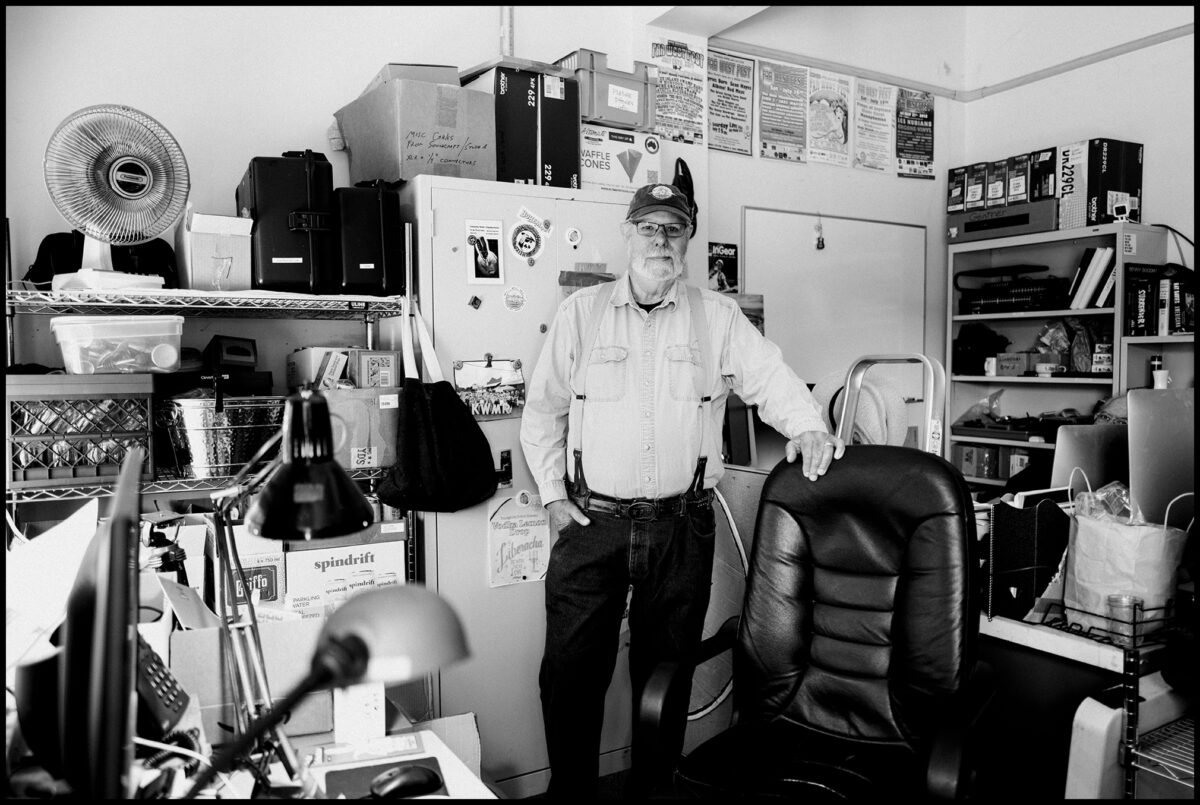
Before he could even ride a two-wheeler, Richard Dillman was fascinated by radios. He rode around his Long Island neighborhood on a tricycle with a peach basket tied to the back, salvaging old AM-FM receivers and other gadgets from the trash. He’d bring them home, take them apart, and try to put them back together again.
“My parents asked me, ‘What’s up with the peach basket?’ I told them that my career goal was to be a garbage man, because people were throwing out such great stuff.”
His radio fascination grew into a lifelong obsession—one that has benefited West Marin in myriad ways. Mr. Dillman played a lead role in building KWMR, developed the West Marin Disaster Council’s communications network, and helped resuscitate the Radio Corporation of America’s historic maritime station in the Point Reyes National Seashore. Before all that, he conducted clandestine communications for Greenpeace, where he helped disrupt Russian whaling operations and U.S. nuclear tests and became the nonprofit’s first U.S. president.
Wherever he goes, there’s something in the air: sound waves.
“He came out of the womb talking on a radio, I’m sure of it,” said Amanda Eichstaedt, KWMR’s executive director and station manager. “If there’s such a thing as a nerdy badass, he is it.”
As Mr. Dillman tells it, his obsession was predestined. “There was no choice for me; that’s just the way it was,” said Mr. Dillman, 82, who has far too many stories to squeeze into one edition of a tiny community newsweekly. One of them involves a little white dog named Luigi who taught him, very late in life, how to love.
At 16, Mr. Dillman got an amateur radio license and his first call sign: WV2BJK. He built a ham radio that could reach 1,000 miles with a Hallifcrafters receiver and a Heathkit transmitter. One night in 1957, while listening to Radio Moscow via shortwave, he heard the announcement of Sputnik’s launch and ran downstairs to tell everyone.
Nobody believed him.
In 1967, during the Summer of Love, Mr. Dillman dropped out of junior college and drove from New York to the Bay Area in a red Volkswagen microbus that he had converted into a camper. “Long Island and Nassau Community College, or San Francisco and hippie chicks?” he asked. “What are you going to do? It’s a no brainer.”
Although he did a stint selling the Berkeley Barb newspaper on Haight Street, he did not identify as a flower child. “I admit, at one point I had a ponytail, but I did not wear beads, I did not wear a funny hat, and I did not wear patchouli oil,” he said.
Hawking the counterculture tabloid was not a viable career plan, so he eventually enrolled at San Francisco State University to study broadcasting. After graduating in 1971, he worked for a time building biofeedback machines—devices that detect brainwaves and convert them to audio for meditation—for the era’s wellness crowd.
At the Fairmont Hotel, he ran the audiovisual concession, setting up microphones and amplifiers for meetings and banquets. Part of his job was maintaining the Tonga Room, the legendary tiki bar built into the hotel’s former swimming pool, where a band floated on a raft and a pipe along the ceiling simulated a rainstorm every half hour.
He once received an urgent page: “Mr. Richard! Mr. Richard! The thunder’s not working!”
No audio problem, large or small, then or now, has escaped his focused attention.
“He’s like a dog with a bone,” Ms. Eichstaedt said. “You give him a problem and he’s going to figure it out. It drives him nuts if he doesn’t.”
Among his local fixes: repairing the downtown “moo” that goes off each day at noon from the Old Western Saloon, startling tourists who aren’t prepared for the ear-splitting emanation.
Tall, rosy-cheeked, and physically imposing, Mr. Dillman seems reserved at first. But get him going about his passions, and he quickly becomes loquacious. In his tree-shrouded cottage atop Drakes View Drive, the upstairs and the basement are lined with racks of electronics—receivers, transmitters, two-way radios, and a host of other stuff with blinking lights.
If KWMR ever goes dark due to a fire, an earthquake, or some other calamity, he can operate the station from the comfort of his living room. He’s not an on-air guy, but he does have the voice for it, deep and resonant, with recognizable traces of his Long Island youth.
He can tell you anything you want to know about his equipment, including a World War II spy radio that is packed into a suitcase, James Bond-style, or his Vietnam-era C.I.A. set.
Mr. Dillman’s first opportunity to run a radio station came by chance, when he heard two men at a lunch counter talking about KPOO, a run-down San Francisco community station that was off the air and about to lose its license. He offered to get it running and, within days, he had the keys.
For two glorious years, starting in 1972, Mr. Dillman kept the makeshift equipment functioning while a band of “radio hippies” filled the D.J. slots, broadcasting from a closet-sized shack at the end of Pier 46.
They didn’t have a proper turntable, just a record changer that plopped down a stack of discs one by one. Because no one else knew how to turn it on, Mr. Dillman played the first song, which he selected from an album called “Jugs, Washboards and Kazoos.”
When the license holder transferred the station to new owners—it is still on the air, operating as Poor People’s Radio—Mr. Dillman was heartbroken. He still bears a wound from the experience, but one that was salved many years later when he found his way to West Marin and KWMR.
He and another radio-obsessed San Francisco friend, Maria Gillardin, had heard about a group of determined locals who wanted to get a station on the air but didn’t know how. They drove up to investigate and met Donna Sheehan, the late West Marin activist who was spearheading the effort.
Ms. Sheehan and her radio evangelist pals had been developing a prototype for the station, operating a sound mixer in the then-Red Barn and broadcasting sporadically on Horizon Cable. Mr. Dillman and Ms. Gillardin were impressed with their commitment, and Mr. Dillman, who knew the intricacies of the Federal Communications Commission, helped them get licensed for the airwaves.
Before they had an official launch at a packed Red Barn, Mr. Dillman and Ms. Gillardin conducted a test in the hills above Marshall. They set up a small transmitter and a cassette deck and broadcast Pavarotti to the cows. Meanwhile, Ms. Sheehan and her team drove around West Marin, reporting what they could hear and where.
“There’s nothing so orgasmically great as turning on a new radio station for the first time,” Mr. Dillman said. “There is just nothing better than that.”
There were some bumps at first. The station was interfering with radio reception across the road at Walnut Place, and a couple of residents there raised a stink. They called the F.C.C., which warned Mr. Dillman that his license was in jeopardy.
His solution—moving the transmitter to the top of Mount Vision, where it shares space with county and F.A.A. equipment—allowed the station to boost its power without disrupting other stations. He has since installed translators that allow KWMR to reach the San Geronimo Valley via Mount Barnabe, and Bolinas and Stinson Beach via the Bolinas Ridge. Last year, he activated a booster in Tomales, bringing the station’s idiosyncratic mix of music, news, and talk to the northern reaches of West Marin.
On KWMR, you might hear country and western, classical and heavy metal all in one set, depending on the peculiarities of whichever D.J. is on the air. You might hear heated conversations about linguistics one minute and a craft cocktail recipe the next. Local musicians and artists discuss their work, writers read their poems, and county officials fill your ears with municipal minutiae regarding everything from vacation-rental regulations to septic systems.
From the beginning, a key piece of KWMR’s programming was emergency broadcasting—a mission that gained urgency after a devastating 1982 storm—and Mr. Dillman was the key to making it work. Over the years, he has collaborated closely with the West Marin Disaster Council, installing a dozen repeaters—devices that extend the reach of two-way radios, allowing signals to clear West Marin’s hills and valleys. He acquired and maintains 400 two-way radios that he has distributed to the council’s network of fire departments and neighborhood liaisons.
“I can’t sing his praises enough, for what he’s done for disaster preparedness out here,” said Jim Fox, a former chief of the Inverness Volunteer Fire Department. “He sees radios as tools, not for chitchat. He has assembled binders and presentations about how to talk on the radio in a professional manner. He’s incredibly organized, and I’m not sure there’s going to be anyone to take his place.”
Mr. Dillman has settled gracefully into old age, which has slowed down his movement a bit, but not his mind. Nor has it emptied his jam-packed calendar, which includes weekly visits to KPH, the old R.C.A. ship-to-shore Morse code receiving station in the seashore. At its peak, the station employed dozens of radio telegraph operators who worked around the clock, sending news and weather reports and receiving telegrams and distress calls.
Mr. Dillman had visited at the station for years before it shut down in 1997, and he feared it would meet the same grim fate as other maritime stations that had been wiped away from California’s glorious coast.
“Every abandoned station that I’d ever been to—they’re all vandalized, spray-painted, destroyed,” he said. “I just could not face that.”
Two years after the station closed, Mr. Dillman and his fellow radio-obsessive, Tom Horsfall, approached National Park Service officials. They asked for permission to restore and operate the station, whose high-powered transmitters are located in Bolinas and whose receivers are in Point Reyes, in an Art Deco building at the end of a cypress tree tunnel.
Originally owned by the Marconi Wireless Telegraph Company of America, the station began operating in 1914, sending wireless communications across the Pacific to countries across Asia. It operated through both world wars, sending vital information to Allied ships.
It took years to clean up the station. Exposed to the elements, the Bolinas transmitters—rows of enormous machines running at 6,000 volts—had to be dried, cleaned, and coaxed back to life one by one. The work at the receiving station was just as daunting.
But the devoted members of the nonprofit Maritime Radio Historical Society—Mr. Dillman is the president—threw themselves into the task. When they started the project, a handful of similar stations remained active across the globe; now, KPH is the last one standing.
They regard the station’s historic operators as heroes and see themselves as keepers of the flame. Their messages are received on shortwave radios by a handful of Morse code enthusiasts—a shrinking pool of ham radio operators or those with vintage teletype machines.
“We’re trying to maintain the traditions and skills of these folks who came before us by doing it exactly as they did,” said Mr. Dillman, who understands the dots and dashes that ring throughout the cavernous space almost as easily as he understands spoken English.

Sometime during his early KPH years, Mr. Dillman, like many men entering their 40s, had a midlife crisis and bought a flashy set of wheels. In his case, it was a Harley-Davidson FL that he purchased at a San Francisco Police Department surplus auction. He’d never ridden a motorbike before but somehow managed to drive away without tipping over the hulking machine.
On his earliest trips to West Marin, he rolled into town on the hog, helmet laws be damned, zipping across the Golden Gate Bridge looking like Clint Eastwood in “Easy Rider.” He had a full beard and a lot of leather—the requisite jacket, of course, but also black lace-up boots that came up to his knees.
As a regular visitor to West Marin, Mr. Dillman yearned to live here permanently. His job at the Hastings College of Law, where he operated the television and video department for 15 years, allowed him to squirrel away enough savings in the U.C. retirement system to eventually make the move.
It was while he was at Hastings that he learned about Greenpeace. He had no interest in saving whales; for him, the draw was radio. He learned that the organization had ships at sea and called its newly opened San Francisco office to ask about its communication system.
“What radio system?” the woman on the phone said.
“I’ll be right there,” Mr. Dillman replied.
Mr. Dillman built the land-based communication system that allowed Greenpeace’s ships to talk to the shore. During a famous 1977 campaign, when Zodiac crews put themselves between Russian harpoon ships and gray whales off the California coast, Mr. Dillman’s equipment played a crucial role.
Perhaps the most dramatic Greenpeace operation he supported took place in 1989 in Cape Canaveral, where the U.S. Navy was conducting nuclear missile tests. Working from a dilapidated camper parked across the channel from the submarine, Mr. Dillman used a spectrum analyzer to observe when the government transmitted unencrypted radio signals.
The test was foiled after he alerted a group of activists and they tied themselves to the submarine’s periscope before it could launch.
“When the sub comes up, it’s got this tall mast on it, and our Zodiacs just go over and tie themselves on,” Mr. Dillman explained. “Suddenly you’ve got hippies attached to your periscope.”
As a result, he said, “We do have credit for stopping a weapon a mass destruction.”
At one point during the action, the Navy rammed a Greenpeace ship and put a hole in it, according to Karen Topakian, who worked on the operation with Mr. Dillman.
“In the face of anything, Richard manages to stay calm, cool, collected, and totally on point,” Ms. Topakian said. “I never heard anyone speak of him without anything other than complete reverence.”
In his early years, before he became a badass geek, Mr. Dillman was simply an introverted geek. He didn’t go to dances and had few friends. But somehow, over the years, he has transformed into an animated public speaker, telling stories to rapt audiences at high-end KWMR fundraisers. One of them is about a little white dog he inherited from an Inverness friend named Suzanne Storch.
The first time he met the pup, it nipped him on the leg, confirming his belief that the best dog was no dog at all, or at least a small one. That credo was just one of several “inviolable principles” that Mr. Dillman lived by in his early years. Among the others: Live alone, don’t own a house, and don’t get married.
Ms. Storch called the dog Louis, but Mr. Dillman claims the pup told him his name was Luigi. After a few walks, man and dog became pals. When Ms. Storch passed away, their relationship deepened. It was the first time Mr. Dillman had been responsible for anyone but himself.
“I just loved him, more than anything I’d ever loved, and he felt the same way,” Mr. Dillman said. “I just needed a little white dog to really see another aspect of life.”
Somehow, Mr. Dillman said, his friendship with Luigi opened up new possibilities, including marriage. At the ripe age of 72, he tied the knot with Katherine Williams, a longtime Inverness artist and retired computer programmer.
On the KWMR phone greeting, Mr. Dillman proclaims: “The pure flame of community radio burns with the white-hot intensity of a thousand suns.”
Now, thanks to Luigi, Mr. Dillman’s passion for the airwaves has infused other realms of his life, too.