

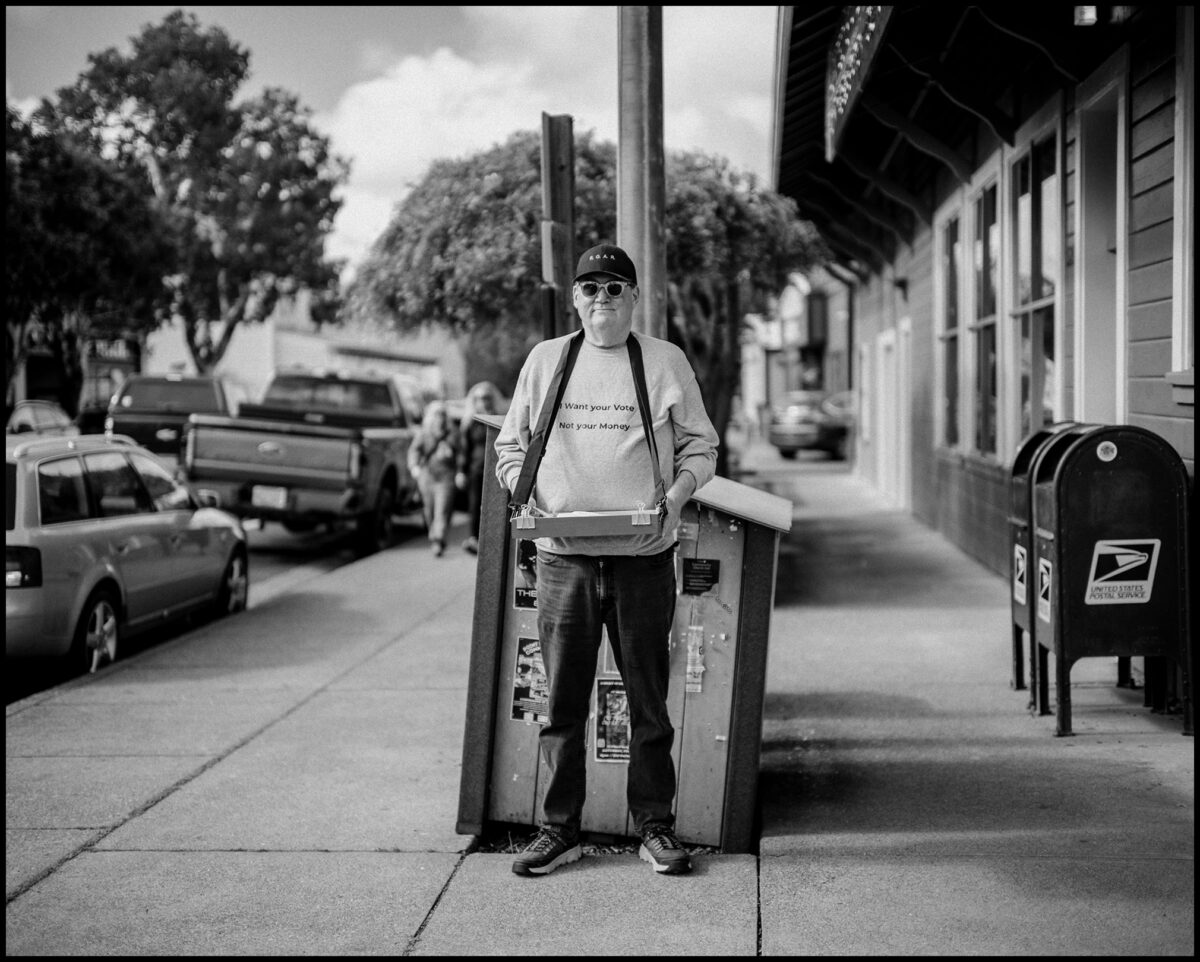
There’s a little bit of Jimmy Stewart in Greg Burgess. He has no political experience, no campaign staff and very little money. But like the protagonist of “Mr. Smith Goes to Washington,” the role that made Mr. Stewart a star, he’s not short on idealism.
His chances of ousting Rep. Jared Huffman from the U.S. Congress are remote—extremely remote—but that’s just fine with Mr. Burgess.
“You’ve got to speak out, even if no one is listening,” he told the Light on a recent afternoon, dressed in a sweatshirt he had made that reads, “I want your vote, not your money.”
While Mr. Huffman has roughly $1 million in his campaign coffers, Mr. Burgess has just $13,000, including $8,000 from his recent tax refund.
Mr. Burgess, a Marin County native who lives in San Rafael, has collected enough signatures to get himself on the primary ballot in the race for California’s redrawn Second Congressional District. He is running as a “no party preference” candidate against Mr. Huffman, a Democrat seeking his eighth term.
“I was a Democrat for a long time, but it’s just come to the point where I don’t think either party is serving our country anymore,” said Mr. Burgess, who is 61. “They’re fighting with each other so much, they don’t get anything done.”
Mr. Burgess has worked in public health, special education and technology, but he is currently unemployed. In recent months, he has become an outspoken opponent of the legal settlement that ended all dairy operations and most ranches in the Point Reyes National Seashore. The deal was negotiated by the ranchers, the National Park Service and the environmental groups that sued it. The Nature Conservancy raised the money to pay 11 ranch families a total of around $30 million to leave lands that it will manage moving forward.
The way Mr. Burgess sees it, the settlement negotiations—conducted in secret and sealed with non-disclosure agreements—were an anti-democratic affront. And he blames Mr. Huffman for facilitating the talks that pressured the ranchers to leave, even though they would have preferred to remain.
“Rep. Huffman’s role is particularly puzzling,” Mr. Burgess wrote in the first of three mass mailings sent to Point Reyes Station residents. “How did the congressman go from championing these ranches to presiding over their removal? The residents of this district deserve an answer.”
Mr. Huffman did not preside over their talks, but he reached out to an associate who brought in T.N.C. And he ultimately supported the buyout agreement—even though he had previously supported 20-year lease extensions.
Although Mr. Burgess excoriated the conservancy at the outset of his campaign, he has reassessed his position after meeting with some of its staff.
“I no longer view the Nature Conservancy as a villain in this story, but as a neutral party,” his third mailer stated. “They stepped into a role that the National Park Service and our congressman should have managed through an open process.”
In a comment sent to the Light, Mr. Huffman dismissed Mr. Burgess’s take as an “outrageous mischaracterization” of his position.
“I have supported these ranching families throughout, initially with legislation to get them a fair pathway to long-term permits, and now, through a settlement that they struck voluntarily and asked me to support,” he wrote. “The notion that I am somehow presiding over their demise is false and absurd.”
A third-generation Californian, Mr. Burgess grew up in Mill Valley. After graduating from the University of California, Santa Cruz, with a degree in English literature and religious studies, he earned a master’s degree in public health from the University of Minnesota. He worked as a quarantine officer for the Centers for Disease Control and Prevention, then spent 10 years in special education, supporting children with autism and learning disabilities.
Later, he put his statistical skills to work for the medical device company Stryker, running a data lab that analyzed samples from women who hemorrhaged during childbirth. Stryker’s A.I. software could determine how much blood they lost by examining a swab, quickly determining whether they needed a transfusion.
Mr. Burgess has had a long-term struggle with depression, which has at times been acute and disrupted his ability to work. While at Stryker, he took a medical leave for several months. He returned only to learn that his Fremont lab was moving to the company headquarters in Kalamazoo, Mich.
Mr. Burgess opted not to relocate, and his job search has become more challenging as A.I. restructures the landscape. He is the main caregiver for his 95-year-old father, a retired psychiatrist who moved in with him two years ago.
Meanwhile, Mr. Burgess says his congressional campaign has rejuvenated him. He first began toying with the idea of running after watching the 2010 Rally to Restore Sanity and/or Fear—an event hosted by Stephen Colbert and Jon Stewart that was a send-up of political extremism and a call for moderation of the nation’s overheated politics.
Mr. Burgess’s takeaway: “If I want to see change, I gotta get involved. I can’t just bitch about things and expect change to happen.”
Under Proposition 50—the redistricting effort aimed at increasing Democratic seats in Congress—District 2 is less solidly Democratic, with more rural, conservative voters in northern counties. Mr. Burgess recently traveled to Modoc and Siskiyou to familiarize himself with the region and its concerns.
“I want to work with the farmers and ranchers and not just cut them out on environmental issues,” he said.
He has drafted more than 30 bills, detailed proposals that address issues such as wildfire insurance, housing affordability, rural health care, agriculture and constitutional governance.
He has crafted these proposals with the help of A.I. He uses ChatGPT, Claude and Gemini, cross-checking citations to make sure the tools aren’t spewing nonsense.
Outside of work, Mr. Burgess’s interests are many and varied. During his 20s, he sailed to Indonesia and taught English there for a year. He is an avid Dungeons and Dragons fan and even designed his own role-playing game, which he transformed into a book called “Evolution Earth: The Ancestor.” He calls it a “science fiction space opera novel,” and you can find it on Amazon.
“Greg is very smart and incredibly creative,” said Steve Sherf, who has known Mr. Burgess since they were 11 years old and was a colleague at Stryker. “He doesn’t have a mean bone in his body and pretty much everybody loves him after they meet him. He’s had an amazing life. He’s done amazing things.”
John Hooper, an Inverness Park resident, is also impressed.
“I think ‘dark horse candidate’ is probably an understatement, but I think he’s an interesting candidate, and more power to him,” said Mr. Hooper, who shares Mr. Burgess’s skepticism of the seashore ranching settlement. “I just find his campaign refreshing.”
Mr. Burgess’s distrust of the Nature Conservancy caught the attention of Mr. Hooper, whose property abuts the nonprofit’s Bishop Pine Preserve on the Inverness Ridge. Mr. Hooper has blasted the conservancy for failing to manage the preserve and has urged it to cut fuel breaks along neighboring properties.
Mr. Hooper, who also owns a home in San Francisco, is still registered in Nancy Pelosi’s district but hasn’t ruled out registering in District 2 and voting for Mr. Burgess. “I think he’s worthy of attention,” he said.