
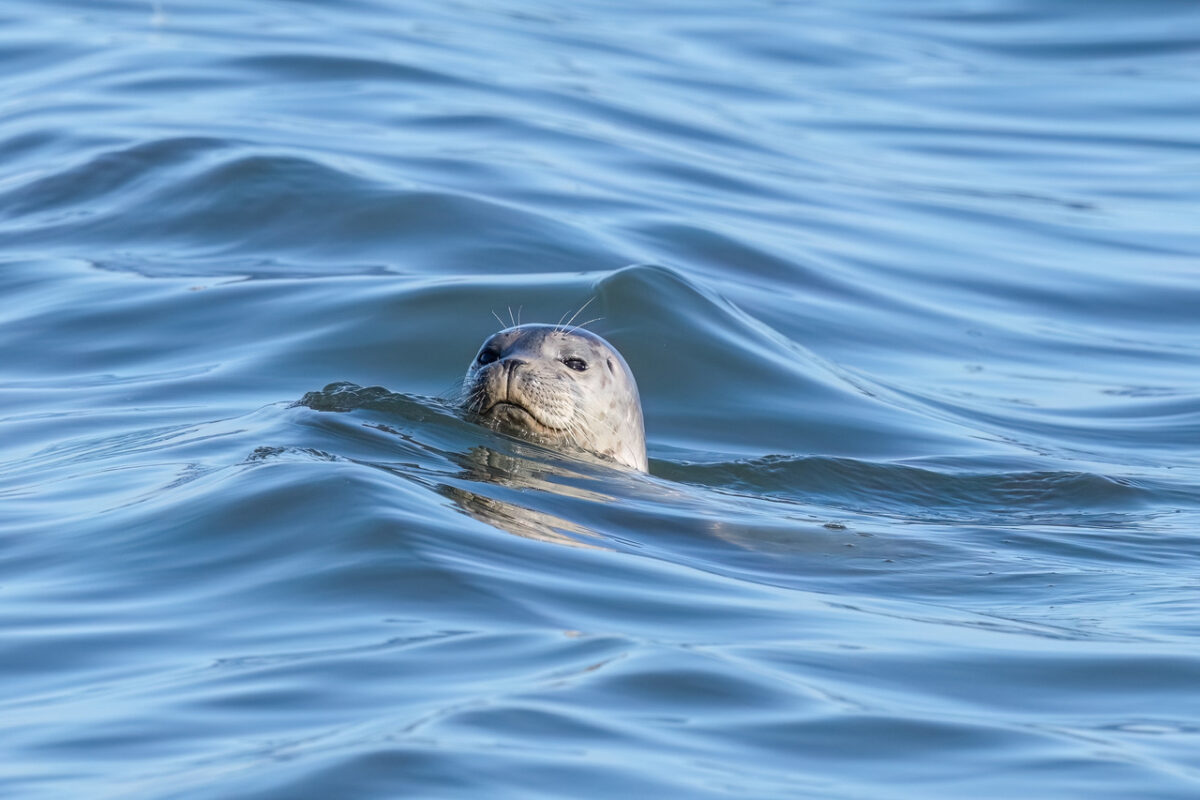
Harbor seal pups born on Point Reyes beaches numbered among the fewest in 27 years of monitoring, according to the National Park Service. Sarah Codde, a park service marine ecologist who authored a report released in July, says the decline is partially due to coyote activity, but it also reflects a statewide trend.
Every spring, harbor seals haul ashore in blubbery droves for breeding season. Sprawled out on the sand, female seals each give birth to one pup, who is nursed for about a month. During this period, the seals are easily spooked—an errant person, dog, or kayaker can send them fleeing into the sea. They have a long memory; if their preferred beach, which scientists call haul-out sites, has too many disturbances, they won’t return.
During the 2026 breeding season, volunteer surveyors counted 690 newborn seals across seven sites. This is one of the two lowest tallies in the monitoring program’s history, matched only by 2024. It’s well below the long-term average of roughly 1,040 pups.
“Our hope is that it’s just a normal cycle, but it’s been a downward pattern for more years than we’re used to,” Ms. Codde said. “Normally when we have a downward pattern, it’s only for a year or two, and then it pops back up. We’ve been seeing low counts now for about four years.”
Not all sites fared badly. Tomales Bay and Duxbury Reef came in near their long-term averages, and Bolinas Lagoon finished above its own, with 237 pups—the highest count of any Marin County site. But sites that typically host larger seal colonies—like Drakes Estero and Double Point—saw significantly fewer pups: 172 and 108.
The most visible explanation for this downturn is four-legged. Since 2021, surveyors have documented coyotes preying on harbor seal pups at Drakes Estero and Double Point with increased frequency.
“We’ve periodically seen coyotes at Double Point and Drakes Estero over the past few decades, but it’s been pretty rare,” Ms. Codde said. “Since 2021, it’s been pretty consistent—coyotes, or at least evidence of coyotes, like their tracks, are on almost every survey during the pupping season.”
The terrain is partially to blame. At Drakes Estero, several sandbars used as haul-outs by birthing seals have become attached to the mainland in recent years. This has given coyotes dry-footed access to what Ms. Codde called “aggregations of large and calorically rich prey” in a 2025 paper she co-authored on coyote hunting behavior.
Richard Vacha, who has tracked wildlife at the seashore for years and leads the Point Reyes Tracking Club, has never personally seen a coyote take a seal pup but was not surprised to hear about it.
“Coyotes are super opportunistic,” Mr. Vacha said. “They’re extremely observant and intelligent, and they’re always looking for some sort of edge or some sort of gap or something they can exploit.”
He described a recent day spent cataloguing the contents of coyote scat in the hills south of Abbotts Lagoon: insects, bird feathers, five kinds of berries, the fur of five different rodents, deer hair from what he took to be roadkill. At the lagoon’s back edge, he found the sand pocked with holes eight to 10 inches deep where coyotes had dug out clams and crunched them open.
“They have one of the widest ranges of diets of any animal there is,” he said. “Anything they can get, they’re gonna try to get.”
Coyotes, Ms. Codde cautioned, are not the whole story. “Coyotes are definitely part of the answer, but they don’t explain the entire answer.”
Other California haul-out sites, including at Goat Rock, Pacific Grove, and MacKerricher State Park, have also seen declines in pups, prompting the National Oceanic and Atmospheric Administration to carry out a statewide aerial abundance survey in 2025.
The survey results will be released soon, but Ms. Codde thinks it’s likely they will reveal a statewide decline.
Despite the diminished pup counts, the park does not plan to intervene. “We see this as a very natural progression,” Ms. Codde said. Coyotes are native; harbor seals are native.” Plus, there are early signs that seals are adapting on their own. At Drakes Estero, many have moved farther up the estuary to safer sandbars. At Double Point, some have shifted to a rocky island offshore.
For Ms. Codde, this is an argument for protected habitat. Drakes Estero and Double Point—the only two sites the park service fully controls—are both closed to the public during pupping season.
“We can’t control the coyotes. We can’t necessarily control low prey,” she said. “But having these protected areas where they can move around, they can shift, they can have other spaces to go to is really important in helping to conserve harbor seals.”