
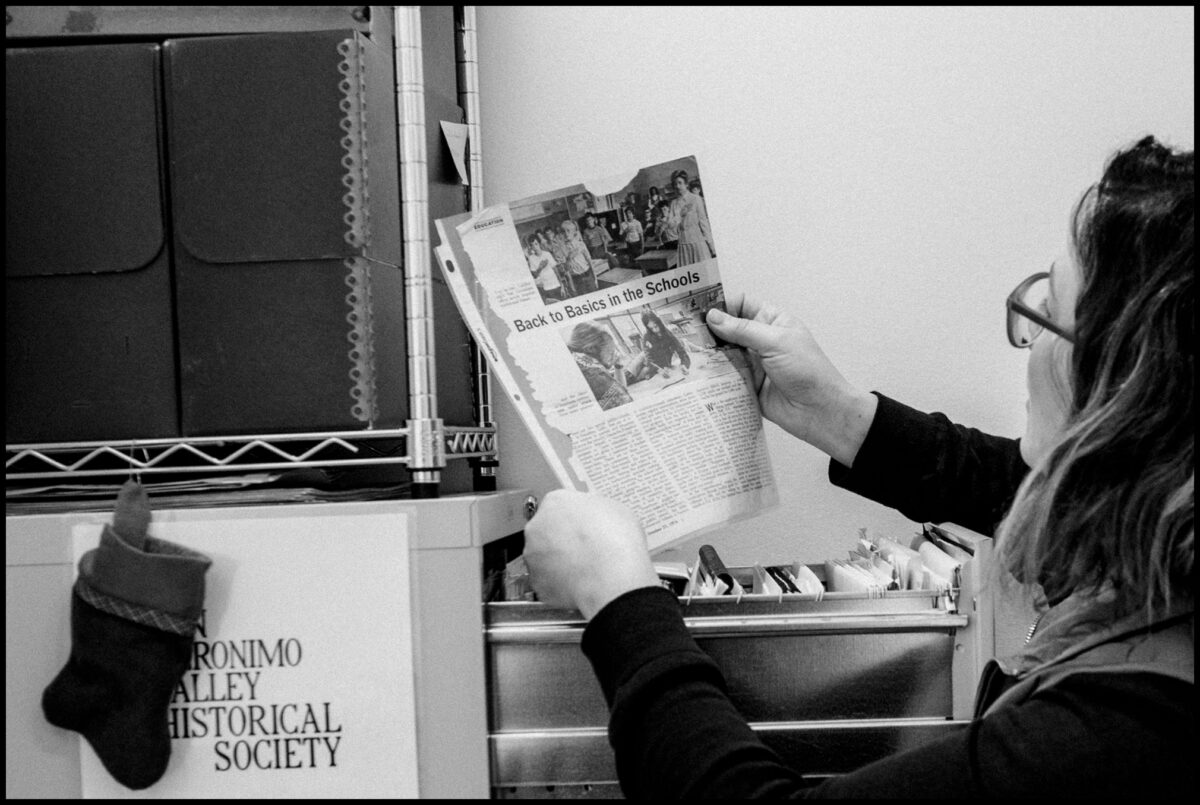
The work of an archivist is often solitary, with stretches of time spent as cloistered as the objects and ephemera one is charged with protecting. 

Not so for Carol Acquaviva, West Marin’s new regional archivist. In her first months on the job, she has been roving the county’s western reaches, helping six small historical societies bring order to their collections.

“Each one of these historical groups has different needs, but they all need help of some kind,” she said. “I’m here to provide it.” 

Ms. Acquaviva, 49, has spent decades snatching objects from oblivion in her work as a librarian and an archivist. 

She looks the part: jaunty, with a silver nose stud, shoulder-length brown hair and glasses. She hands out a business card adorned with a small silhouette of Mary Poppins, a woman who alights calmly from the sky just when she’s needed and slips just as swiftly away when her work is complete. 

Each of West Marin’s historical societies takes great care to preserve its relics, but Ms. Acquaviva is helping many of them take the next step into the digital age. 

Two years ago, the organizations formed the West Marin Historical Society Collaborative after recognizing their shared challenges: aging volunteers, understaffing, and storage systems that are either outdated or undersized. 

The idea to unite them came from Lagunitas resident Dave Cort, an amateur historian and the longtime director of the San Geronimo Valley Community Center. 

With roughly $11,000 in county grants spread over two years, the Tomales Regional History Center, the Jack Mason Museum of West Marin History, the Bolinas Museum, the Nicasio Historical Society, the Stinson Beach Historical Society and the San Geronimo Valley Historical Society began hosting a series of rotating meetings, strategizing how they could together ensure the area’s history is preserved for posterity.

“The historical societies were all siloed in their separate worlds,” Mr. Cort told the Light. “But once we came together, we found that our number one goal was to have a shared archivist. And with Carol, it’s like, ‘Where did this amazing woman even come from?’” 

Ms. Acquaviva grew up outside Rochester, N.Y. The daughter of two scientists, she spent her childhood steeped in American history; instead of going to amusement parks, her family visited the many places where George Washington supposedly slept. (“I was under the impression he slept everywhere in upstate New York,” she said.) 

After studying literature and developing a love for printed matter, Ms. Acquaviva earned a master’s degree in library science. She has worked as a rare-books librarian, a poetry librarian and a children’s librarian, and for 23 years she served as the digital archivist of the Anne T. Kent California Room at the Marin County Free Library. 

When she began digitizing materials for the library’s local-history archive in 2003, the concept was still ahead of its time. 

Colleagues say her knack for transforming a chaotic archive into a place of order verges on the supernatural.

On Monday morning, Ms. Acquaviva was stationed at the San Geronimo Valley Historical Society, an archive small enough to fit in a closet—and literally housed in one at the community center. 

She thumbed through filing cabinets and opened boxes, sifting through their contents. After cataloging a collection of student registration cards dating from the 1950s through the 1980s, complete with vaccination records and the names of long-retired teachers, she began vetting a batch of new acquisitions.

Mr. Cort arrived with several cardboard boxes, some ripping at the folds. They were filled with ephemera he had collected over the decades: newspapers, planning documents, blueprints, datebooks, yearbooks and ledgers. Ms. Acquaviva stood beside him, examining the contents, weighing what the historical society might accession. 

The goal of an archive, she said, is not to accumulate material indiscriminately but to preserve the items that both coax history out of the shadows and fit an institution’s scope.

“We aren’t just securing material,” she said. “We’re organizing it, understanding what’s in it and then disseminating the information.” 

With institutions, businesses and people constantly creating records, there is no shortage of material to preserve. The sheer volume can be anxiety inducing—it’s all too easy for pieces of the past to disappear from collective memory, leaving the historical fabric riddled with holes.

As valley residents drifted through the community center, Ms. Acquaviva was introduced to them by Mr. Cort, a loquacious man about 20 years her senior. People chatted and reminisced, while Ms. Acquaviva listened closely. 

“If you want to get into local history, it’s all about making connections with the local community,” she said. “The past and the present are indelibly intertwined.” 

Funding for her new position came from Jeff Craemer, a historian and philanthropist whose family published the Marin Independent Journal for much of the 20th century.

“Every day, you put a paper out—that was history,” he said of his newspapering roots. “If our stories aren’t passed on, they’re lost. Our interest is in digitizing history and preserving it so it’s there forever.”

With differing needs at West Marin’s historical societies, Ms. Acquaviva is triaging by urgency. 

At the Bolinas Museum, she is cataloging a collection of early-20th-century postcards. In Stinson Beach, where the historical society operates out of a temperature-controlled shipping container, she is focused on space planning and digitizing the 5,000-item archive. 

She has done the same at the Jack Mason Museum in Inverness.

“We had a backlog of museum work and archival work to do­—we needed upgrades with our computer system, we just really needed help,” said Dewey Livingston, who runs the museum and first met Ms. Acquaviva two decades ago. “She has gotten in there and done incredible work with updating and improving our system.”

At the Nicasio Historical Society, which is tucked inside an almost-dollhouse-sized, yellow false-front building, she is helping Elaine Doss, the society’s president, set up a newspaper clipping collection. She is advising on how to arrange the clippings, create standardized subject headings, and stabilize disintegrating newsprint in acid-free folders. 

“She’s our saint!” Ms. Doss said. “She leaves us with all these tidbits of wisdom. We had reams of clippings donated through the ages, and she calmly and sweetly and assuredly gave us a framework for what we should be doing.”