
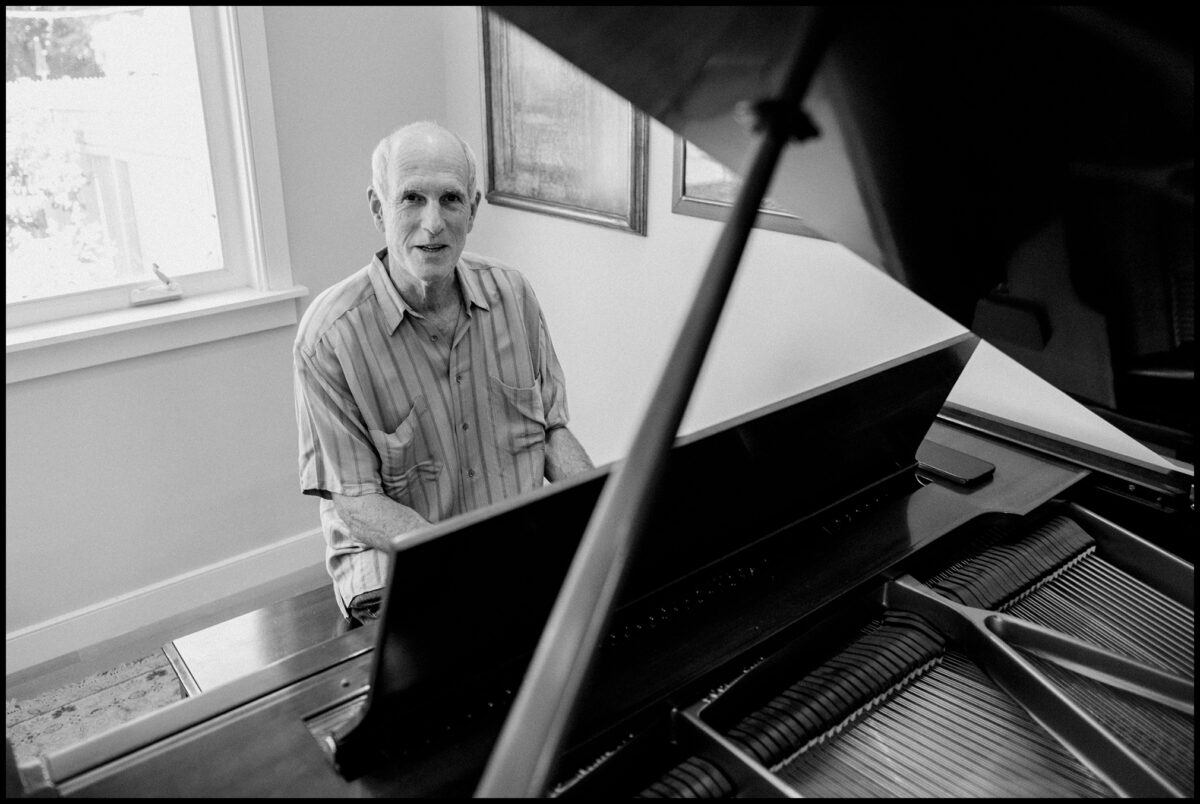
When Michael McQuilkin found out he was chosen to receive the 2026 Edie Robinson Community Service Award, he was dumbfounded.
“I didn’t think it was real for a while,” Mr. McQuilkin, a 74-year-old piano technician and musician from Woodacre, said. “There is such a glut of wonderful volunteer people in this area, and I never considered myself really part of that entourage.”
Though Mr. McQuilkin may not volunteer at the local food bank or land trust—what he considers “real” community service—he is the founder and producer of the long-running McQuilkin Family Music Hour. The valley tradition brings together families, friends, and performers of all ages and experience levels to rehearse and perform alongside a high-caliber professional band. On June 21, they will host their 24th show in the newly remodeled courtyard of the San Geronimo Valley Community Center.
“What makes the Family Music Hour so special is the months-long process behind it: rehearsals, mentorship, encouragement, confidence-building, and community connection,” said Alexa Davidson, executive director of the community center, which sponsors the award. “Through music, Michael has created a space where people feel welcomed, supported, and inspired to participate and express themselves.”
Mr. McQuilkin’s son, Alexander, who chips in at the center, received the Edie Robinson award two years ago. Now, portraits of both father and son are etched onto a paneled display in the center’s hallway, commemorating the valley’s most dedicated volunteers. Since 1999, the award has honored those who have made outstanding and long-term contributions to life in the valley, and former recipients select the winner from community nominations, which numbered 14 this year.
“Nothing else that I have ever witnessed has this kind of community spirit, but also just the showing of talent,” Ms. Davidson said of Mr. McQuilkin after a June 3 awards ceremony and volunteer appreciation barbecue. “He’s all in, driving energy forward, and it’s infectious. People get really motivated and excited alongside him. It’s not a volunteer job that just anyone can do.”
The music hour’s motto, “Music Brings Families Together,” harkens back to Mr. McQuilkin’s childhood days, growing up in a musical family in Rochester, N.Y. He describes his mother as a “community tycoon” who threw colorful parties and raised him in an atmosphere of doing for others; his father was a talented violinist, and his brothers played trumpet and percussion. There were constant jam sessions, house-party performances, and after-dinner concerts.
Mr. McQuilkin began playing piano at age 8 and recalls being invited downstairs at bedtime to entertain guests, performing in his bathrobe and slippers, his feet dangling off the bench.
“What was entertaining wasn’t my accomplished piano—I wasn’t looking at the keys, I was looking at the people,” Mr. McQuilkin said. “It was really just my calling card from a very early age. I pretty much only do it when there’s people who are listening.”
Mr. McQuilkin took lessons as a child but was not classically trained. At recitals, he drove piano teachers crazy when he would abandon the written music and just play by ear.
Later, after attending a prep boarding school in Connecticut, he jumped at the chance to head west to Colorado College. A rickety piano in a post-college band led him into his lifelong profession. “My joke is that the piano was falling apart faster than the band,” he said.
Keeping the instrument playable introduced him to the crafts of tuning and restoration. After he apprenticed with a technician in New York, a friend’s wedding brought him to Mill Valley, where he met Leonard Jared of J.B. Piano. Recognizing his ticket to advance, he packed up his bags and moved to Bolinas in 1977 to study with Jared. Mr. McQuilkin’s day job servicing pianos would soon establish him as one of Marin’s premier piano restoration experts.
These days, people throw pianos overboard—“It’s in the way, it’s too big, get rid of it, we don’t need it,” Mr. McQuilkin said. He calls himself “a lobbyist for the acoustic piano, which is not exactly a dying breed, but it’s becoming an endangered species.” One of his central purposes, he said, “is to document, just to show that the piano is still alive and well.”
The Family Music Hour was born of the old idea of singing around the piano. “We think we live in an age of connectivity because of cell phones, but actually the real connectivity was when we sang around Grandma’s piano,” he said.
The series grew organically through years of giving piano lessons, performing for family gatherings, and cultivating musical community. Mr. McQuilkin wondered: “Why should we wait for there to be a wedding, or a birthday, or bar mitzvah? Maybe we could just do something based on the same idea, but on a regular basis.”
Show preparations begin months in advance with Sunday rehearsals at Mr. McQuilkin’s house. From the start, his goals were for people to have fun but also experience success. This meant creating a safe space and pairing veteran musicians with first-time performers to help them overcome stage fright and gain confidence in a supportive environment.
Mr. McQuilkin’s wife, Catherine, said she can see the healing that can happen through the shows, where people perform in combinations ranging from father-daughter duos to sibling sync-ups.
“For some people, doing something with their son or daughter has erased years of therapy,” she said. Performing together has deepened the bond between her husband and their sons, Will and Alexander, who has Down syndrome. The three swap song ideas and talk about the show throughout the year.
Will described the connection between his father and brother as deeply symbiotic. “They bring out the best in each other,” he said. “The rapport, the relationship that they have is so beautiful, it really lifts the community up.”
Young performers, like Gracie Chavez, who first took the Family Music Hour stage at age 7, grow right in front of the community’s eyes. Now, at 21, Ms. Chavez can only show up two days before the big show because she’s so busy touring with her own band. For others, working with Mr. McQuilkin became a steppingstone to schools such as Berklee College of Music and the New School in New York City.
“The performers are all backed by this all-star band—they’re just elevated to this grand place, and the crowd goes crazy,” Danielle Fogel, the communications director at the community center, said.
The event has grown from 75 attendees at the very first show in 2012 to multigenerational sellout crowds today.
“It has this feeling of homecoming or a reunion,” Ms. Davidson said. “You want to bottle the energy that happens at the Family Music Hour, and keep it with you, because it is just such a connected, beautiful feeling.”
And although audiences may see a groovy, relaxed performance, Mr. McQuilkin takes his role backstage very seriously, she said.
Beyond the annual showcase, Mr. McQuilkin finds other ways to be in service. He volunteers his talents for benefits and with Bread & Roses Presents at senior homes and other venues, where he has witnessed music reach those with deep impairments. At one facility, a resident who had not spoken in years suddenly joined in the band’s rendition of “Figaro.”
A new generation waits in the wings. Mr. McQuilkin’s 18-month-old granddaughter, Bonnie—well-known to audiences after being held aloft Lion King-style at a Family Music Hour—drew smiles as she tried to climb onto the stage during her grandpa’s award ceremony. Mr. McQuilkin plays piano for her every week, and she already dances, sings a little, and lip-syncs to the radio. “Dad says he needs to do another 18 shows, so that he can get her in his final one,” Will said.
The McQuilkin Family Music Hour starts with dinner at 4 p.m. and an outdoor show at 6 p.m. on Sunday, June 21 in the San Geronimo Valley Community Center courtyard. For $10 to $25 sliding-scale tickets, visit
events.humanitix.com/mcqfm-hour