

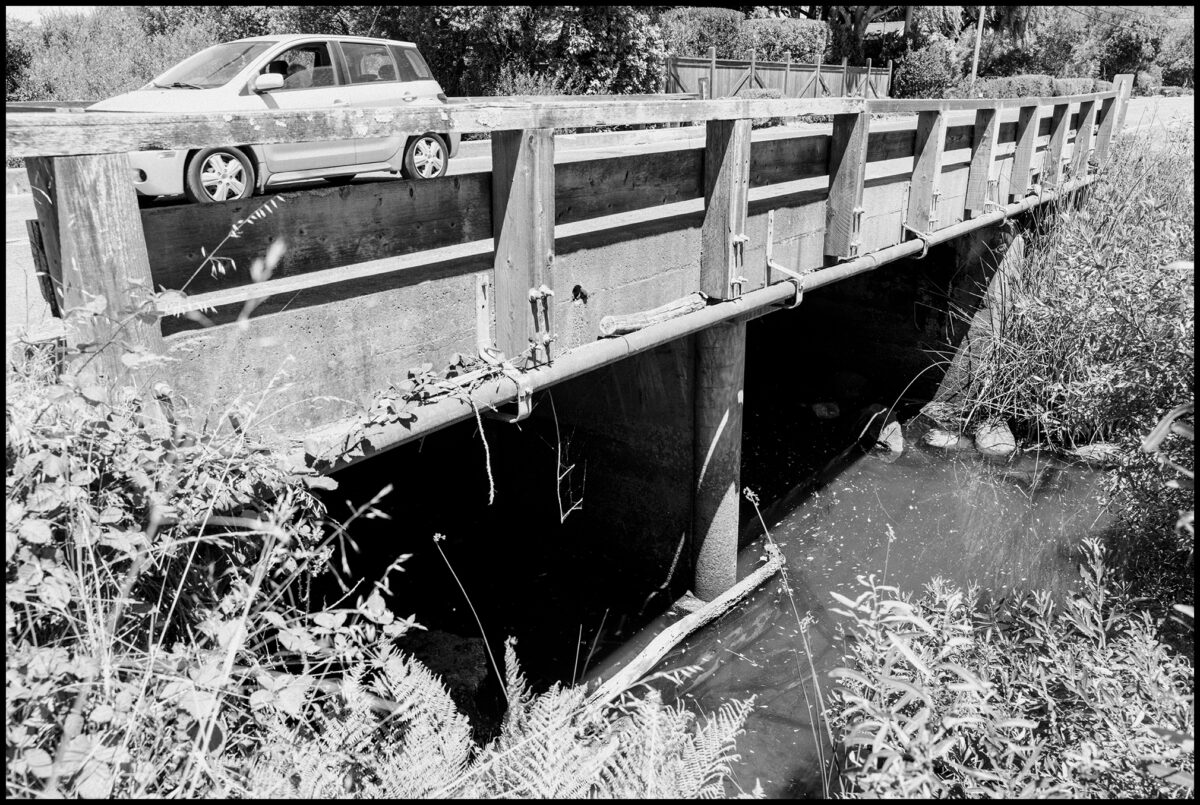
The Inverness Association has asked the county to reconsider a Levee Road bridge replacement plan that would force cars traveling between Inverness and Point Reyes Station to detour through Olema for six months.
The bridge, built in 1930, spans Olema Creek just south of its confluence with Lagunitas Creek. Engineers have concluded that it is both functionally obsolete and too low to clear flood levels during a 100-year storm. The structure scored 51 points on a 100-point scale that Caltrans uses to measure bridge adequacy.
In a draft initial study of the project, the Marin County Department of Public Works concluded that it would have insignificant environmental impacts after precautions to protect flora and fauna.
But in a letter to the department, Inverness Association president Jerry Meral called for a more comprehensive impact report to meet the requirements of the California Environmental Quality Act.
“To the best of our knowledge, the Department of Public Works never engaged with the villages that would be most directly impacted by this project, including Inverness and Inverness Park,” he wrote. “As a long-established community organization in Inverness, we were disappointed that we had to learn about this proposal from a June 24, 2026, article that appeared in the Point Reyes Light.”
The road closure would require cars traveling from Inverness to Point Reyes Station to detour through Bear Valley Road, adding an estimated four miles and 10 minutes to the trip. “The resulting air quality and energy impacts alone would require a full E.I.R.,” Mr. Meral wrote, pointing out that 2.5 million people visit the Point Reyes National Seashore each year, and many travel on Levee Road.
The association also raised concerns about the impact of the closure on emergency services. What would happen if Bear Valley Road became impassible during a disaster while Levee Road was closed?
“There are few rural towns in California at greater combined risk of flood, fire, or earthquake than Inverness and Inverness Park,” he wrote. “And there are few rural areas in California with more limited access via roadways.”
The comment period on D.P.W.’s draft initial environmental assessment ended on July 1. Just seven people submitted comments before the deadline. The agency is reviewing them and will publish responses.
Robin Bartlett, the department’s assistant director, said the agency found that shifting the road or installing a temporary bridge during construction would have significant environmental impacts. “At this location, a full closure is necessary to safely replace the bridge,” he said. “Because the entire width of the roadway must be removed to install a new, modern structure that meets current regulations, traffic cannot remain in place during construction.”
A preliminary survey found no rare or vulnerable plant species at the site, but the habitat is suitable for a variety of special-status animal species, including coho salmon and steelhead trout, red-legged frogs, California freshwater shrimp, pond turtles, yellow warblers, various bats, and dusky-footed woodrats.
Construction would not begin until Caltrans replaces the Green Bridge, a project slated to begin next summer and expected to take a year and a half. Unlike the Green Bridge replacement, which will be built off-site and installed in pieces, the new Levee Road bridge would be constructed with concrete slabs that are cast on site.
Although the Green Bridge project is of substantially larger scale, it is only expected to result in a three-week closure of two-way traffic on Highway 1. Caltrans expedited the project due to pressure from neighbors.
The Olema Creek bridge is one of three small bridges on Levee Road and the closest to the intersection of Highway 1. It is 58 feet long and 24 feet wide, with one-foot shoulders. The new bridge will be wider, longer, and higher, with a width of 38 feet and a length of 77 feet. Its two 11-foot travel lanes will be flanked by six-foot shoulders.
The $3 million project will not resolve the flooding that occurs in rainy seasons on Levee Road, and D.P.W. has no immediate plans to raise the roadway.
Barry Deutcsh, whose Levee Road home is on the Point Reyes Station side of the bridge, feels sorry for people in Inverness, who will have to go all the way around.
“It’s outrageous,” he told the Light. “To have this road closed for six months, that’s not acceptable. It’s a long way around Bear Valley.”