

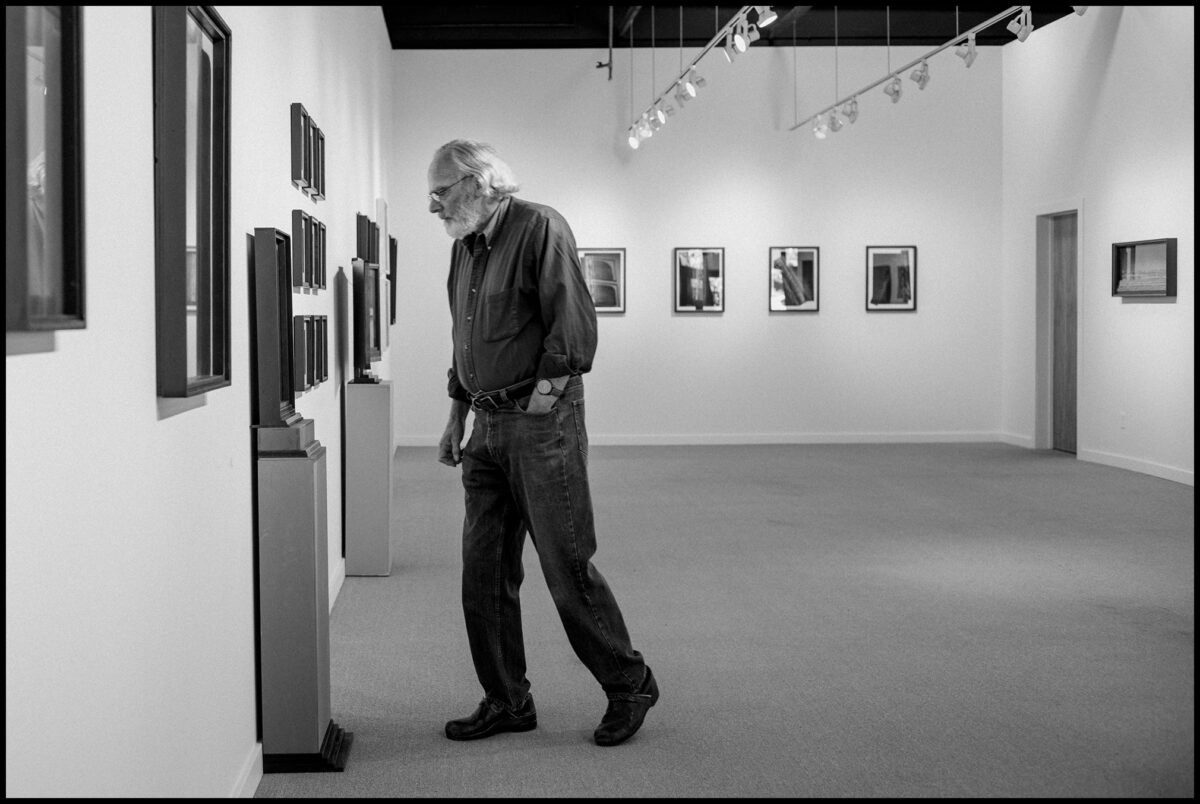
Peter de Swart is nothing if not prolific. For his “Sweepings” series, the Inverness-based multimedia artist produced 15 albums, each with 50 powder sculptures that distinctly capture light and shadow, motion and stillness, form and formlessness in shifting layers of blue. That’s 750 pieces in all, and they represent but one of many chapters in the 78-year-old’s creative life.
“He can’t help himself,” said his sister, Marlie de Swart, a textile artist who lives in Bolinas. “He’s always working.”
Mr. de Swart’s studio is a large basement space as well-suited to a carpenter as an artist. There are saws, hand tools, worktables, frames he’s built, and playful sculptures from earlier phases of his career. A cobwebbed plastic clog hangs from the wall—a reminder, like his accent and the scuffed leather clogs on his feet, of his Dutch heritage.
Each day, Mr. de Swart wakes up and heads straight to the studio, where he puts in four hours of work before breaking for lunch. He enjoys a coffee at Toby’s mid-afternoon before he goes back to the studio for several more hours.
“It lets me go back to the work I’ve done in the morning with just enough distance to see it a little freshly and to make the changes that may be needed,” said Mr. de Swart, who is bearded and bespectacled and favors jeans and work shirts.
He often ends his day by writing in a converted chicken coop, one of a half-dozen whimsical outbuildings strewn around his property. One holds nothing more than a wicker loveseat brought home one day by his wife.
“She asked me to build something around it, and that’s what I did,” he explained during a recent stroll about the yard. He created the stained glass that brightens a corner of the edifice.
Nearby, a micro-gallery allows for a view of works that his more cluttered studio does not afford.
“I’ve never met anyone who had such discipline,” said his wife, Sharon Glenn, while pulling weeds from her garden—a work of art in itself—at their home high atop Second Valley.
Mr. de Swart objected to the word “discipline,” which to him implies a constraint or an imposition. “That’s not what’s happening at all,” he said. “My work is something I’m compelled to do.”
Toni Littlejohn, the co-curator of his current show at Continuum Fine Art in Point Reyes Station, “Absence/Presence,” also reaches for the D-word to describe him. “To me, it’s not a negative word,” she said. “It’s not like the military ordering him. He wants to be doing this, and this is the way his soul works.”
The abstract works at the show capture flashes of consciousness—Mr. de Swart calls them “apparitions”—that take on a life of their own after he sets them in motion. “As I try to make something out of them, the work starts taking shape,” he said. “Something curious happens, and something essential for me. The work starts imposing itself on me. It starts telling me what needs to happen.”
The pieces are arranged in three series—sculptures, works on paper, and limited-edition prints of blue powder sculptures he built and photographed before disassembling them.
“Each inhabits a distinct world, yet all are interconnected, as if emerging from a shared field of consciousness,” said Fariba Bogzaran, a friend and fellow artist who directs the Lucid Art Foundation, where Mr. de Swart teaches. “The collection has transformed the gallery into a temple-like space.”
The works on paper are composed of chalk, pastels, graphite, and metallic powders. He begins by rubbing black Japanese chalk into the surface of heavy French watercolor paper, then layering on materials by hand or with palette knives. The works are cast in textured shades of gold; even the blacks are leavened with metallic flecks.
“I was astonished to see him working with gold,” Ms. Littlejohn said. “It’s a huge transformation, and it really brings out the sublime. I saw one of his gold pieces recently in somebody’s house, and I was gobsmacked.”
One of them—titled “Efflorescence,” will soon grace the Marshall home of Marcia Barinaga and Corey Goodman, who are among Mr. de Swart’s biggest collectors. The piece, enclosed in an arched frame shaped like a cathedral window, positively shimmers. The more you look, the more you see: It’s a flower, of course, but maybe an eye, or a keyhole.
“It strikes you on an emotional level, even if you don’t know what it is,” Ms. Barinaga said. “It is many things. It’s a gorgeous, sensual image.”
Several of Mr. de Swart’s gold works are composed of lines that conjure horizons—a concept that fascinates him. “Everything is cluttered, everything is closed off. We live in screens. We live between walls,” he said. Horizons, he said, provide an “indeterminate ever-vanishing distance” that take you outside the confines of “your own little life.”
This is the closest he will come to discussing the meaning of his works. In fact, he’ll tell you he does not know what they mean; it’s up to the viewer to decide.
See in them what you will. A gold work on paper at the gallery entry changes depending on your vantage point; from one angle, it appears to be an alms bowl, from another like a Buddha’s smile.
His “Sweepings” series begins as small installations constructed in trays on a lazy Susan so he can move them about as needed. Using carpenter’s chalk and other powders, he shapes them with palette knives, sticks, and his hands. The backgrounds are created in varying shades of blue that he scrapes and erases for texture, light, and shadow.
He photographed them in the morning, when the slant of the light was deep, and then dismantled them.
“Those works don’t actually exist, which is in perfect concert with the idea of absence and presence,” said Charles Anselmo, the gallery owner and exhibit’s co-curator. “The works are both there and not there.”
All Mr. de Swart’s pieces contain empty spaces that the artist does not regard as empty at all. “There are always stirrings of something in even what seems like the most radical absence,” he said.
Mr. de Swart began his career sculpting wood, like his uncle and mentor, Jan de Swart, whose work is in the collections of the Smithsonian and the Los Angeles County Museum of Art.
He grew up in Breda, a town in southern Holland near the Belgian border, among a family of artists. His father, Louis, was a painter and stained-glass window maker; his brother, Henk, also works in glass; and Marlie worked in ceramics before switching to textiles.
“My father was an incredible artist, and he had very high standards of work,” said Ms. de Swart, who ran the erstwhile Black Mountain Weavers shop in Point Reyes Station. “He was very critical, but from a very early age he said that Peter had an incredible talent that surpassed other artists, even as a young boy. I distinctly remember being jealous of that.”
As a young man, before moving to Los Angeles, Mr. de Swart spent a year in Paris, devouring works by French philosophers like Foucault. He studied both art and philosophy at Occidental College in Los Angeles, and his inner philosopher is ever-present.
“Everything in the world that we live in is expected to do something, to have a function, to be instrumental,” he said. “And art is the one realm where you can pull away from that. It matters because it doesn’t matter.”
Mr. de Swart spends most of his time ensconced in his Second Valley retreat, which he built with a dear friend, the late abstract-surrealist painter John Anderson. Cut flowers from Sharon’s garden are everywhere, displayed in frames he built to show them off. Outside his picture window, flights of band-tailed pigeons beat past and winds sweep across the Inverness Ridge, bending the forest of bishop pines. There’s not much of a reason to leave.
His friends believe his museum-worthy work would be more widely known if he were better at self-promotion. But he’s too busy producing art to worry what others think of it.
“He’s so unassuming,” Ms. Barinaga said. “He would never have a show if his sister didn’t goose him into doing it.”
Continuum Fine Art is open Fridays through Sundays from noon to 5 p.m. at 11101 Highway 1, in Point Reyes Station. Peter de Swart’s exhibit, “Absence/Presence,” shows through Nov. 29.