

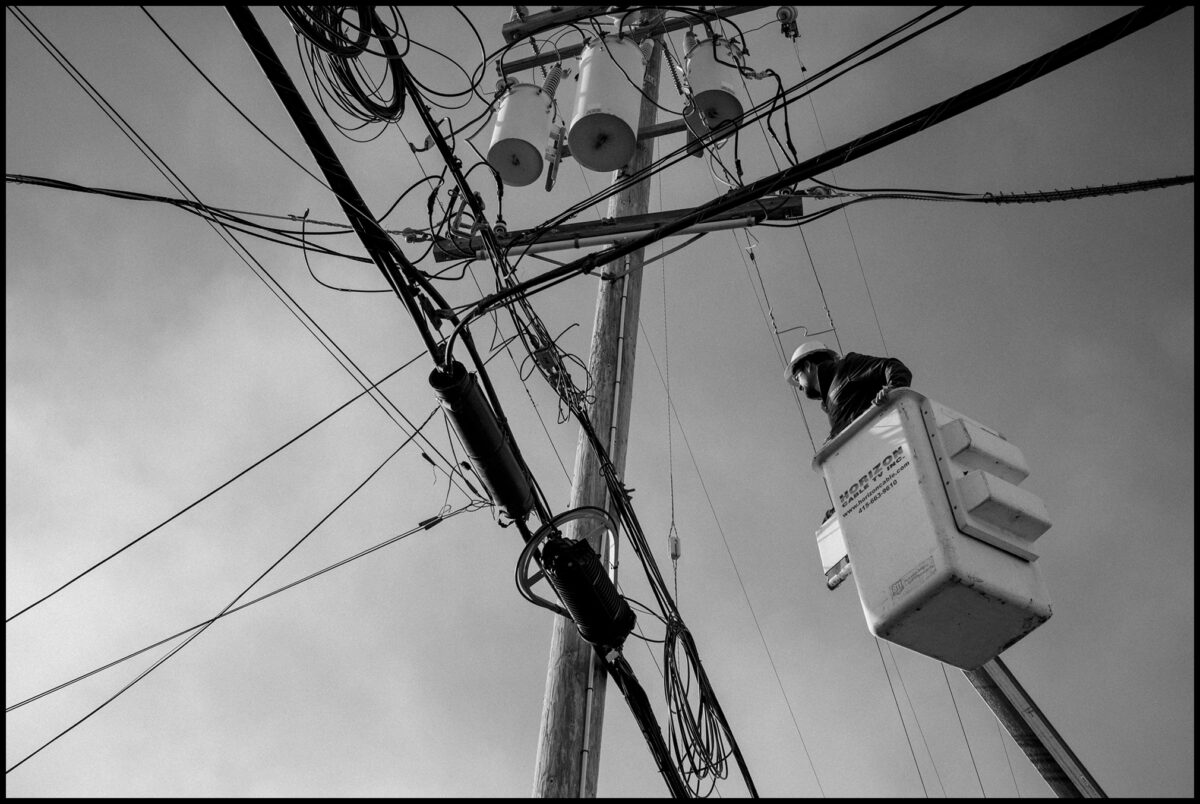
Horizon Cable has a new name befitting the service it is on the cusp of offering in Point Reyes Station, Inverness and Olema: Horizon Fiber.
The company, a David in a telecom landscape of Goliaths, has been stringing fiber-optic lines along Highway 1 and Sir Francis Drake Boulevard, building the backbone of an updated network that will offer much faster speeds and more reliable service.
The upgrade, which has been in the works for several years, picked up steam with the sale of the company in August to a new owner, James Hankins, who operates a similar rural telecom company in Gilroy.
Since Mr. Hankins took the helm, Horizon has strung nearly a mile of fiber along Highway 1 and begun hanging more along Sir Francis Drake, from Olema over to Seahaven. Those lines should be completed in the next two months and will serve as the arteries of the new system.
Earlier this year, Horizon installed fiber in Stinson Beach, where it has connected roughly half its 500 customers so far.
It expects to connect customers in downtown Point Reyes Station, near its Mesa Road headquarters, as soon as Christmas, according to Karl Winquist, who worked as the general manager of Horizon Cable for 13 years and will continue in the role at Horizon Fiber.
“We upgraded in Stinson first because it’s a smaller system,” he said. “We could do it there more quickly, and it gave us a chance to work out any problems.”
Customers in Bolinas have had fiber since Horizon Cable began serving the area in 2019.
On most of the Point Reyes mesa, secondary lines have already been installed. After the line to Seahaven is complete, the company will begin connecting houses neighborhood by neighborhood, moving back toward Point Reyes Station.
If the Highway 1 and Sir Francis Drake lines are the system’s arteries, the lines connecting individual neighborhoods and homes are its veins, said Alex Rodondi, the Horizon system technician who has been hanging most of the fiber, with help from Mr. Winquist.
In Gilroy, the network was installed underground. In West Marin, most of it will connect along utility lines, following the same path as existing cable lines.
Unlike coaxial cable, which transmits along copper lines, fiber-optics send rapid signals through glass tubes about as narrow as a strand of hair, each one scarcely 900 microns thick. Dozens of them are woven together inside lines hung from utility pole to utility pole.
“They’re basically looped together in a spiral, kind of like DNA,” said Mr. Rodondi, a San Geronimo Valley resident who began working at Horizon four years ago, lured by the promise of installing fiber.
“Fiber is one of the coolest things out there,” he said on Monday. “It’s like, freaking magic, bro. It’s just a cool technology.”
The signals that run through coaxial cables are vulnerable to interference and lose energy as they are transmitted, requiring power amplifiers installed along the system to keep them going.
Fiber signals are generated by a laser that shoots light through the glass strands, and fiber systems only require one power source. Fortunately for West Marin, they can keep running during blackouts.
“Now we have to deploy something like 10 or more generators and keep them fueled to operate them while a power outage is in effect,” Mr. Hankins said. “When we switch to the fiber, there’s going to be one location that we have to keep online, and it’s going to have a large battery bank protecting it.”
The new system will provide one gigabit-per-second downloads and uploads, vastly more than the current cable internet, which has maximum downloads of 100 megabits per second and uploads of 20 megabits per second.
When the transition to fiber is completed, Horizon will shift its television service from cable to streaming. The company is negotiating with potential streaming partners and does not expect to raise prices when it offers a new televison plan, Mr. Hankins said. He hasn’t yet settled on a price schedule for internet but hopes to keep prices as close to current cable charges as possible.
The system’s fiber arrives in large spools, each with about 5,000 to 10,000 feet of cable wrapped around them. The spools are mounted on the back of a Horizon truck, and Mr. Rodondi and Mr. Winquist drive along the service route, hoisting the line up and unspooling as they go.
“It’s kind of like hanging your laundry,” Mr. Rodondi said.
To connect each section to the next, they insert the end of each line into a small box that heats up the glass fibers and fuses them together, in the same manner that a soldering iron fuses two pieces of metal.
A few weeks ago, they had gotten as far as Woodhaven Road in Inverness, just across from Chicken Ranch Beach, when they had to pause to attend to lines in Bolinas that had been knocked down by a falling eucalyptus.
“We dropped what we were doing here to make sure that they got back online,” Mr. Hankins said.
As they make their way, they lash the fiber lines to the existing coaxial lines, which will be removed after the new system is completed. Sections of the existing lines run underground, including at North and South Dream Farm Roads in Inverness and on Commodore Webster Drive, at the old Coast Guard station.
Mr. Hankins is hoping to hire a couple more technicians to help with the work and said he plans to reach out to people who lost jobs due to the closure of ranches and dairies in the seashore.
Horizon’s lines connect to the broader internet via an AT&T junction box at B and Second Streets known in tech-speak as a central office. From there, its data flows to a larger facility in San Francisco known as an internet hotel, where the lines of many internet service providers converge and send data out to other hubs.
In West Marin, Horizon’s main high-speed internet competition is Starlink, Elon Musk’s satellite telecom company. Starlink requires the installation of a satellite dish and a clear view of the sky, so it is not an option for homes shrouded by trees. AT&T offers internet, but through a much slower DSL service, and the locally owned Tomales Bay LAN has a high-speed option that serves some homes from Tomales and Dillon Beach down to Olema, Inverness, Inverness Park and the Point Reyes National Seashore.
Mr. Hankins founded his Gilroy company, Hankins Information Technology, after yet another frustrating night of suffering through repeated buffering delays while attempting to watch Netflix with his wife, Jaime, in 2013.
High-speed internet was already widely available in urban areas, but not in sparsely populated outposts. Instead of throwing his remote at the TV, he decided to start his own service.
At the time, he had a DSL line with maximum downloads of 3 megabits per second. High-speed wireless was available in the center of town, but not in his neighborhood of pastures and farmland.
A trained engineer, Mr. Hankins knew how to route wireless internet to his home with a couple of antennas. A friend let him install one antenna on the roof of his downtown gym, where he received a high-speed signal, and he installed another on a nearby mountain and another on his house.
The point-to-point network went from the gym to the mountain to Mr. Hankins’s home, and suddenly his download speed went from 3 megabits per second to 60.
“That’s about the time the entrepreneurial spirit kicked in,” he said. “I sent out a little survey to our neighbors, asking them about speeds and price points, and we recognized there’s a business model here. We can do this. We can help our neighbors and pay for the growth at the same time.”
Mr. Hankins, who is 45, dresses in work clothes and has a long black beard. He looks more like a rockabilly hipster than a business tycoon. He has no dreams of a sprawling internet service empire, although he doesn’t rule out the possibility of eventually expanding service up to Marshall, Tomales and Dillon Beach—or even connecting Gilroy and West Marin someday.
“Most of the big internet providers have neglected the rural areas because of their low density,” he said. “We found our niche by really going after the areas that were neglected and largely ignored. We found a high degree of need, and that’s where we started focusing.”
In addition to Point Reyes Station and Olema, where it has about 1,000 customers, Horizon serves Stinson Beach and Bolinas, where it has roughly 500 and 400 customers, respectively.
“Nobody served that area, so we decided to go in and fund it and do it on our own,” Mr. Winquist said.
Mr. Hankins purchased Horizon from Susan and Kevin Daniel, who owned it for 37 years before selling it at the end of August. The transition to fiber began under their ownership, but Mr. Hankins will see it through.
“We’re really excited about bringing fiber to the area, upgrading the old plant that’s there, and just being a local resource,” he said. “We love the buy-local model. We think this a great opportunity for us to partner with the folks in the area and get the internet to where it needs to be.”