

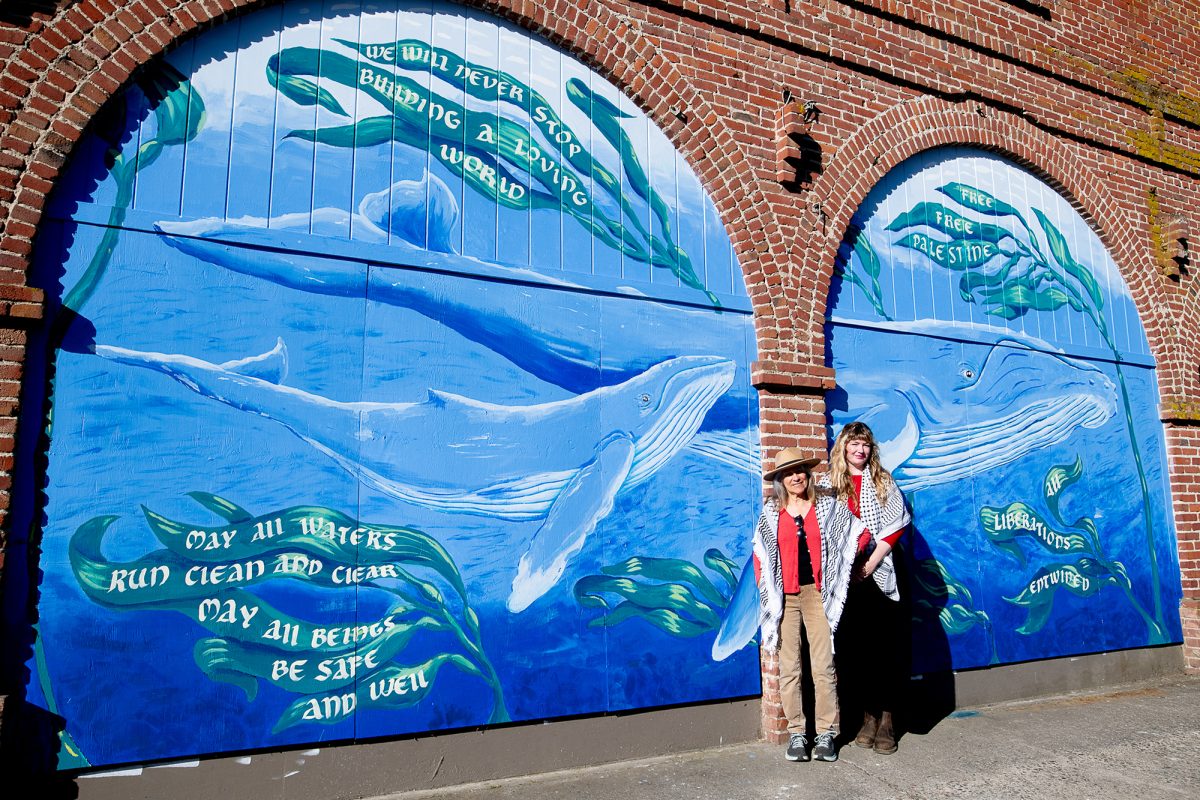
Last Wednesday night, the brick façade of the Grandi building in Point Reyes Station became a screen for the ghostly silhouette of two humpback whales, parent and calf, projected through the darkness. By the next morning, the outline had given way to color.
Under the direction of Sophie Wood Brinker, a 35-year-old artist from Bolinas, some 40 volunteers—adults and children, art-school graduates and elementary school teachers, gardeners and librarians—took up brushes. They worked from a paint-by-numbers plan, tracing the forms that Ms. Wood Brinker had already mapped in light.
“It’s really beautiful how this can be a community-building space,” she said from the scaffolding on Thursday, brushes tucked into the back pocket of her white painter’s pants. “Everyone’s gifts come out.”
Painted on plywood affixed to the vacant downtown building, the 22-foot-long, 12-foot-tall mural grew out of Ms. Wood Brinker’s years of banner-making, a form of protest art that she describes as a “a kind of poetry.”
The whales break through the frame of the building’s arched arcade, swimming alongside four lines written across strands of seaweed: We will never stop building a loving world/ May all waters run clean and clear, may all beings be safe and well/ Free free Palestine/ All liberations entwined.
The words came to her quickly, and are a refrain in Ms. Wood Brinker’s work. She conceived the semi-sanctioned piece as an act of solidarity with the population under siege in Gaza.
“As Gaza is being bombed and starved, I hope this mural can be a spark for action, to donate to mutual aid campaigns, to support families in Gaza, to attend protests, and to look deeply at our lives and ask how we can show up to this moment,” Ms. Wood Brinker said.
The piece replaces a 2011 seascape painted as part of that year’s Geography of Hope conference by Inverness Park artist Nancy Stein, who also helped paint the new mural.
“Time and tide had taken their toll, and I wanted it to pass it on to the younger generation,” Ms. Stein said last Thursday. “Our world is really in a different place than it was then—it now needed words, some level of protest.”
The two artists met last year at a banner-making workshop Ms. Wood Brinker co-led in Bolinas with activist David Solnit. Banner-making, Ms. Wood Brinker explained, is an art form with its own lexicon, one that demands distilling a message to its core.
“You learn how to capture the heart of the message in just a few words,” she said. ‘The words are an invitation into ourselves and into movement-building.”
Her work often pairs precise drawings of flora and fauna—rendered with an accuracy she honed in the science illustration program at California State University in Monterey Bay—with hand-lettered phrases. A gulp of swallows might carry the words “collective action.” A mourning dove among blooming poppies might rest beneath the phrase “for all those who should still be here with us.”
These are not shibboleths, walls built with words to enforce belonging, but statements aimed at “some deeper, inherent truth,” she said. “Sophie’s artwork is about peace,” Ms. Stein said. “Some of it borders on sorrow, but it’s always grounded in peace.”
Standing before the mural last week, Ms. Wood Brinker, who was raised as a Quaker in Santa Cruz, wore her grandmother’s black-and-white checkered kaffiyeh. Her grandparents worked in the West Bank in the early 1990s, providing eye care to Palestinian children injured by rubber bullets or shrapnel. Their example shaped her sense of social responsibility.
“We don’t know how our actions will ripple out into future generations,” she said.
For her, the whale embodies both the urgency of saving the planet and the scars of its exploitation. Nearly hunted out of existence in the 19th and 20th centuries, whales were in part saved by a collective recognition that, as activists told the United Nations in 1972, they are “the common heritage of mankind.”
That acknowledgement, Ms. Wood Brinker and Ms. Stein hope, is what the mural can evoke: a recognition of shared responsibility. “Because our government is funding what is happening in Gaza, we’re all implicated. Our hands aren’t clean,” Ms. Stein said. “This is a healing image. How could anybody disagree with that? And if you do, I feel sorry for you.”