

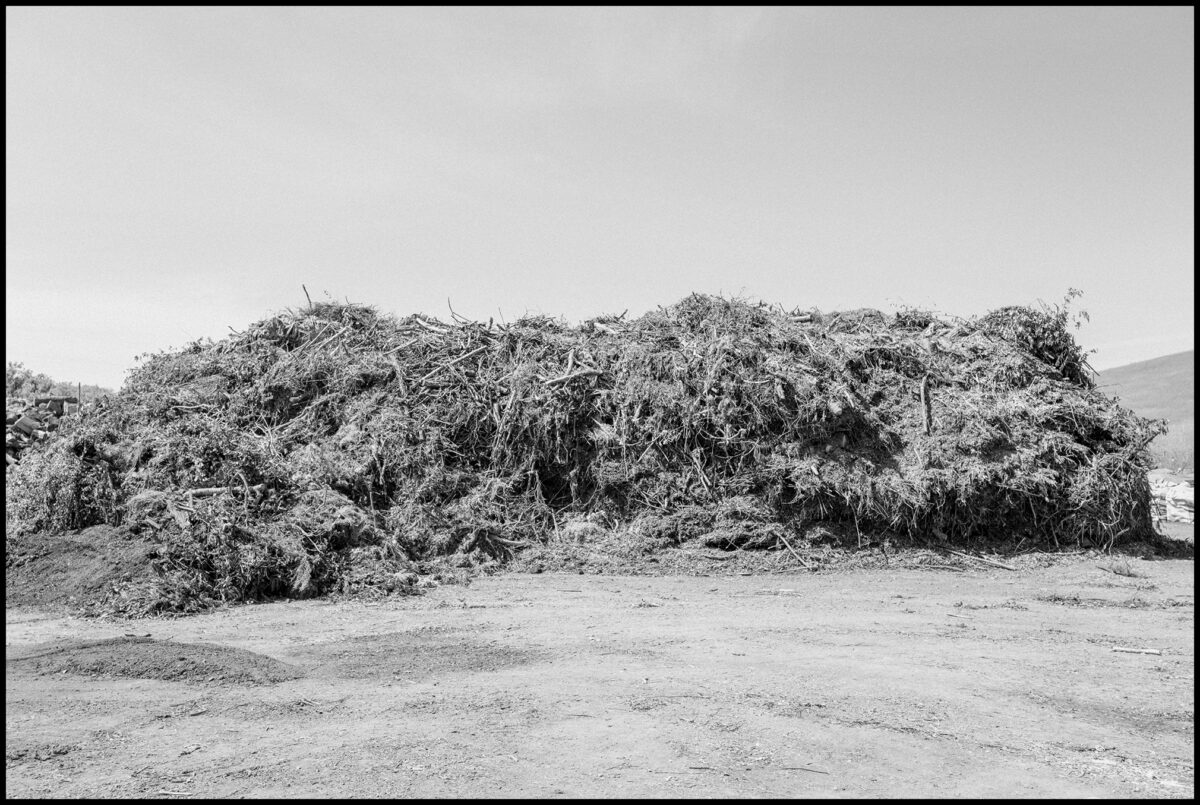
In the coming years, Marin County is expected to generate about 250,000 tons of biomass annually—the organic material from forest thinning, defensible space clearing, agriculture, yard work and food scraps. Much of it is destined for landfills, where it slowly releases greenhouse gases into the atmosphere, or is trucked across the state to the Central Valley to be burned for fuel or processed in faraway composting facilities.
A new study says that with a smarter strategy for handling that waste, the county could cut its greenhouse gas emissions by more than 31,000 metric tons a year—the equivalent of taking about 7,200 cars off the road or slashing the emissions from 3.5 million gallons of gasoline, according to the U.S. Environmental Protection Agency.
The 347-page report, produced by the Marin Resource Conservation District through a collaborative called the Marin Biomass Project, was funded by a $750,000 grant from the Governor’s Office of Land Use and Climate Innovation. It is one of five state pilot studies— from the Central Sierra to the North Coast—testing whether individual counties can build the infrastructure to manage their own organic waste locally.
“Our responsibility as a pilot is to create a model that can help accelerate the development of similar programs in other places as well,” said Belle Cole, chair of the project’s steering committee.
The biomass collaborative—consisting of about three dozen scientists, land managers, utility representatives, fire officials and environmental advocates—will spend this year and next translating the study’s recommendations into action plans with agencies, companies, and other partners, Ms. Cole said.
Climate change tends to evoke images of smokestacks, and for good reason: heat and power generation are the single largest source of carbon emissions, accounting for about a quarter of the carbon released into the atmosphere. Often overlooked, though, are landfills. The E.P.A. estimates that landfills are the third largest source of human-caused methane emissions in the U.S. and, in the Bay Area, they account for more than half of the region’s methane.
Organic waste like plant matter and food scraps can emit copious amounts of methane when it decomposes without oxygen, as it does deep inside landfills, said Jeff Creque, a rangeland ecologist on the study’s steering committee and director of rangeland and agroecosystem management at the Carbon Cycle Institute. Like carbon dioxide, the main greenhouse gas that’s warming the planet, methane acts like a blanket in the sky, trapping the sun’s heat.
Though methane lasts for a shorter time in the atmosphere than carbon dioxide, it is more potent; its warming effect is more than 80 times as powerful as the same amount of carbon dioxide over a 20-year period.
But redirecting biomass waste—by turning it into biofuel, animal feed, building material mulch or compost—could reduce emissions while keeping more of the county’s resources circulating locally, the study found. “If you get organics out of landfills and significantly reduce methane emissions that way, you have made good progress on the global warming problem,” Dr. Creque said.
The Marin Biomass Project took shape around 2020, after voters created the Marin Wildfire Prevention Authority, or the M.W.P.A., with the passage of Measure C. The agency’s annual work plans have expanded vegetation management in overgrown wildlands and on residential properties, in hopes of reducing fuels that have accumulated over more than a century of fire suppression. That work has created an enormous and growing stream of woody debris, and the biomass project formed to confront the conundrum of what to do with it.
Last year, the agency hauled away 18,700 cubic yards of chipped vegetation from homes, according to Mark Brown, executive officer of the M.W.P.A.—enough to cover a football field nearly nine feet deep. Some of it goes to local composting facilities and becomes mulch. But a portion is hauled outside the county, to power plants in places like Woodland and Stockton.
“We know we create a lot of biomass through our work, and we want to make sure that the biomass is utilized in efficient and beneficial ways,” Mr. Brown said.
Adding to the pressure is Senate Bill 1383, the 2016 state law requiring California to divert 75 percent of organic waste from landfills by 2025. Marin, like every other county, is now obligated to find somewhere else for that material to go.
The law also requires jurisdictions to procure compost; Marin is obligated to buy about 9,500 tons of it a year. Unable to source enough affordable compost locally, the county has been purchasing material from Agromin, the state’s largest recycler of organic materials, and spreading it on farmland in the Central Valley.
Between S.B. 1383 and the creation of the M.W.P.A., the county is facing mandates to move enormous amounts of organic waste, with no clear local avenue for handling it. “Marin, by enacting Measure C, created a public economy for vegetation management and biomass reduction,” said Chad White, manager of the Marin Biomass Project. “What Measure C didn’t do—and where it has the same problem as Senate Bill 1383—is it didn’t create the economy for somewhere to put that biomass.”
The study recommends a $29 million investment to build out that missing economy, with money flowing into composting, milling, co-digestion, gasification and pyrolysis, a thermal decomposition process.
One recommendation calls for investing $7.5 million to expand the county’s composting capacity. Currently, four facilities in and around Marin process about 61,000 tons of green materials a year, but over the next decade that flow is expected to grow by 20,000 tons. The study found that local operations are not prepared to absorb the increase.
Expanding a facility like West Marin Compost, the study argues, could give the county a reliable local source of compost to procure and spread on its own rangelands, keeping the climate benefits in Marin.
The advantages of growing the county’s composting capacity could be significant. Composting would account for about 11,700 tons of the projected annual emissions reduction: roughly half from the methane that would be kept out of landfills, and half from carbon sequestered when compost is spread on rangeland.
Dr. Creque thinks the study’s projections for composting may be too conservative, since they only counted one sequestration pathway. Compost applications stimulate rangeland grasses to grow more vigorously, pulling extra carbon dioxide from the air for decades. But there is also carbon contained in the compost itself, which is deposited into the soil when compost is spread on land and can remain there for years rather than becoming a greenhouse gas. “I think there’s much, much more sequestration potential than the report suggests,” he said.
A second recommendation calls for a $16 million gasification plant that would convert woody debris into electricity for the local grid. The study estimates that approach would eliminate more than 11,300 metric tons of carbon dioxide a year, calculated by comparing emissions from local gasification against the status quo of shipping to the Central Valley.
The study’s analysis shows that a local gasification facility would emit roughly as much greenhouse gas during operation as the Central Valley combustion it is designed to replace. The net climate benefit would come mainly from eliminating more than 300,000 miles of annual hauling.
“Right now, Marin is exporting its problem,” Dr. White said. “It’s sending material someplace else to be burned. I don’t know how we can feel good about that. It’s costing a lot, both in real dollars and greenhouse gases, to truck it that far. So a local gasification plant is, in some ways, a solution to a problem that Marin already has but is just not facing head on.”
The study also recommends investing $5 million in a co-pyrolysis facility, which would convert wastewater digestate from Marin’s six treatment plants and woody biomass from fuel treatments into biochar. The charcoal-like soil additive, which sequesters carbon in the ground, is created by heating organic matter at high temperatures in the absence of oxygen. Another $500,000 would restart the small-scale sawmill at West Marin Compost that previously cut logs from local tree removal into slabs for furniture and architectural use before land-use concerns forced it to close.
Taken together, Dr. White said, the recommendations offer the county a path to “stop exporting or dumping its organic waste” and begin using that material to build “a more circular, a more low-carbon, a more regenerative economy.”
Correction: Jeff Creque is a director at the Carbon Cycle Institute, not the Marin Carbon Project.