
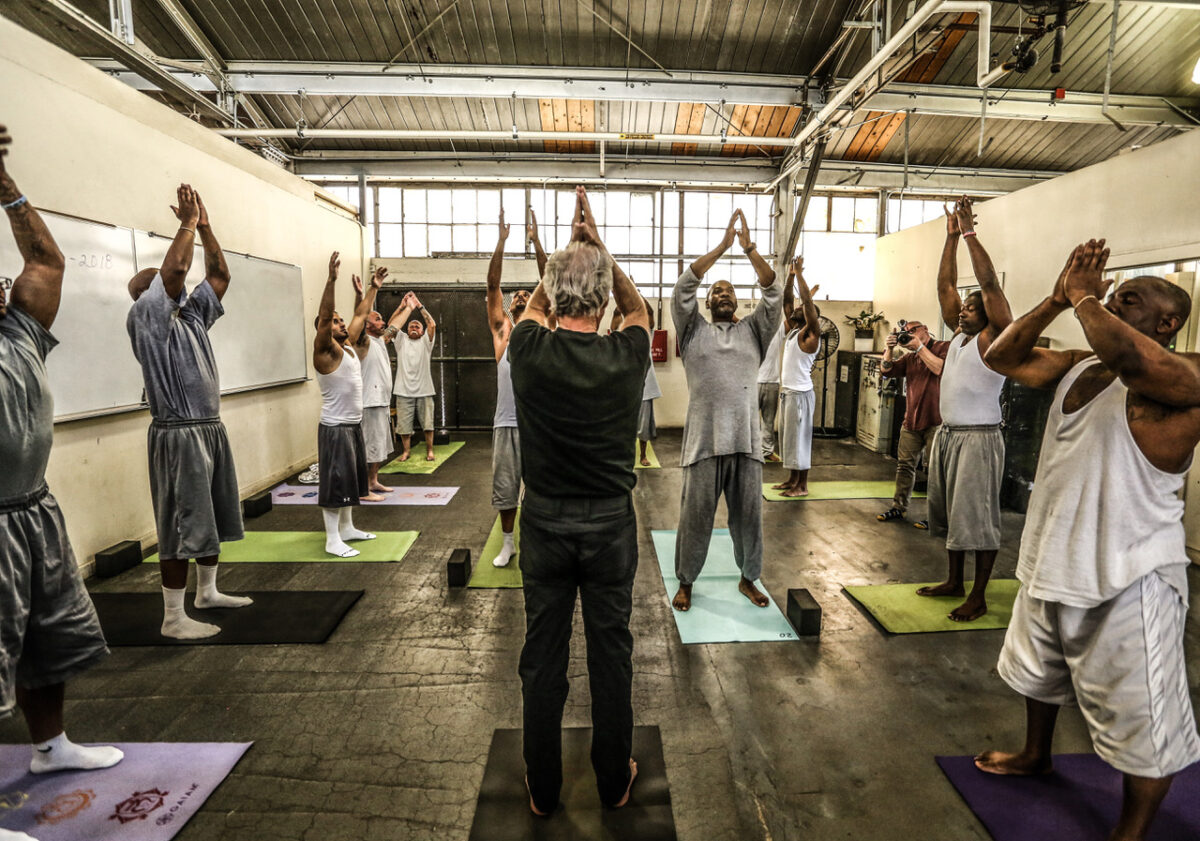
Before he walked into his first yoga class at the San Quentin Rehabilitation Center, Darnell “Moe” Washington imagined the instructor would look like Richard Simmons—the short, boisterous television fitness guru who wore tight red-white-and-blue athletic shorts.
Instead, he found James Fox, a tall, thoughtful man who commanded the room with his calm demeanor. Mr. Washington, who was serving a life sentence for murder, knew nothing about yoga but figured he could match Mr. Fox pose by pose.
“I wasn’t going to let this old, slim white guy outdo me,” said Mr. Washington, who was buff from working out in the prison yard. “But he held his position, and I ended up collapsing on the floor in a puddle of sweat.”
Thirteen years later, Mr. Washington has been paroled and has started his own nonprofit that offers free yoga classes to people in the same South Central L.A. neighborhood where he used to run with a gang. It took a lot of downward dogs, deep breathing and meditation to bring him home.
On Nov. 9, Mr. Fox and Mr. Washington will appear together at a fundraiser for the Prison Yoga Project, which Mr. Fox founded at San Quentin in 2002. It has since expanded its reach to more than 200 prisons and jails in 28 states and 14 countries.
The event takes place at the community center in Bolinas, where Mr. Fox has lived for 31 years and where he first began teaching trauma-informed yoga to teenagers.
At the program’s core is the idea that trauma lodges itself in the body, and that the most effective way to master it is through physical awareness, deep breathing and meditation.
“The more I got into yoga, the more I experienced the emotional benefits of the practice,” Mr. Fox said. “I felt like I was healing what I’ve come to understand much more clearly was a lot of childhood trauma.”
Most prisoners come from backgrounds where trauma is part of the ether, fueled by family dysfunction, violence, abandonment and social injustice, Mr. Fox said. All this is compounded by life inside, where trauma is on perpetual simmer.
People on the outside who practice trauma-informed yoga can go for a walk on the beach after working through a few asanas. But for prisoners, trauma is omnipresent.
“I never thought yoga would entail working with me mentally or that the trauma I’ve been through would come up from inside from doing yoga, but it actually did,” said Mr. Washington, who used to give his $20 monthly prison salary to any young guy inside who finished his G.E.D.
So many took up the offer that he couldn’t keep paying them. Instead, Mr. Washington, who finished a semester of college before going to prison, cooked them a free meal and tossed in a pint of ice cream. “They didn’t mind that I changed the arrangement, because it was about me believing in them. They were just happy that somebody believed in them.”
Like Mr. Washington, Stephen Liebb, another San Quentin lifer, credits yoga with helping to change the trajectory of his life. Hoping to reduce his sentence, Mr. Liebb worked every prison program he could, taking victim-offender education classes, joining the running club, finishing a marathon on the prison track.
“Other programs helped me gain insight into myself, but the yoga program was the most impactful,” he said. “I was in love with it.”
Mr. Fox won his students’ confidence by treating them with respect. “He wasn’t condescending,” Mr. Liebb said. “He was teaching us yoga the way it would be taught to anybody on the street.”
Mr. Liebb said the class is the only good memory he has from his 32 years of incarceration. “At the end of each class, by the time we got to shavasana, I didn’t know I was in prison,” he said. “I had this sense of peace. It was amazing.”
Released in 2013, he now works as a paralegal for the San Francisco Public Defender as a member of the Freedom Project, which advocates for prisoners seeking parole.
Before founding the Prison Yoga Project, Mr. Fox had a successful career doing marketing for a wine cooperative that sold major brands. “A voice inside me said, ‘Man, you’ve got other work to do than turning people on to wine. This is not going to be your legacy.’”
The son of a surgeon, Mr. Fox, 75, grew up in an affluent Chicago suburb that was close to a tough inner-city neighborhood where he often played basketball—and got into fights. On the court, as in prison, the racial tensions were palpable.
Like many of the incarcerated people Mr. Fox has since worked with, he had hyper-masculine notions of manhood. His dad considered him soft, and he was driven to prove him wrong.
Anger-management was not his forte. One day, while on his way to work in a Brooks Brothers suit, he got into a fistfight with a guy who cut him off at a Brooklyn subway turnstile.
Eventually, through yoga, he learned to tame his testosterone. He practiced at Spirit Rock, the meditation retreat in Woodacre, and was eventually certified as a yoga instructor. He taught his first classes to young men at a halfway house around the corner from his Bolinas home.
A friend from Spirit Rock had begun teaching meditation at Marin County Juvenile Hall. It wasn’t going well, and he asked Mr. Fox to help him out.
“You’re really having a hard time asking 14-, 15- and 16-year-old kids to sit down, close their eyes and meditate?” he asked. Thinking that holding yoga poses might exhaust them enough to ruminate, Mr. Fox agreed.
The friend, Jacques Verdun of Woodacre, later began the Insight Prison Project, a restorative justice program at San Quentin, and invited Mr. Fox to participate, leading sessions on violence prevention and mind-body work. From there, the Prison Yoga Project was born.
On his way to his first class, walking through the prison yard with a yoga mat, Mr. Fox heard a lot of whistles and catcalls: “Hey, sweetheart, what’s that under your arm?”
But with few exceptions, his students are respectful and take the class seriously. There was just one stressful moment early on, when two guys barged into the room with a box of Ritz Crackers, raising their voices, stuffing their mouths and spilling crumbs all over the place. They startled the students on their mats in a room they considered a sanctuary.
“Hey, take it out of here!” Mr. Fox snapped, sounding momentarily like the Chicago kid on the basketball court.
The men left and returned without their repast. But when class began, one of them adopted an aggressive stance and snapped back: “Hey, man, I don’t like how you talked to me there. I don’t like how you addressed me.”
Mr. Fox collected himself and replied: “Let me explain. This is a safe space in this unit and I’m the guy who’s in charge of keeping it safe. But you’re right. I could have handled it better.”
There were no guards monitoring the class, and Mr. Fox had been instructed to blow a whistle when anything threatening occurred. He chose not to—and won credibility among his students.
On the same day as his conversation with Mr. Washington in Bolinas, Mr. Fox will screen a 10-minute trailer about the Prison Yoga Project, most of it filmed at San Quentin, over in Stinson Beach.
In the film, a procession of prisoners, guards and administrators testify to the program’s effectiveness, including Kevin Neang, a former San Quentin prisoner, who tells the camera: “If everyone had a James Fox in their life, I think there would be a lot less stressed-out people, a lot less depressed people, and I would go so far as to say, a lot less violent people.”
See our calendar for details about the Nov. 9 events in Bolinas and Stinson Beach.