

In the roughly 4,200 years since their domestication, horses have been devoted companions—charging into battle, racing chariots, hunting buffalo, logging timber, carrying the mail, and running and leaping at our bidding. Despite this long and intimate association, interspecies communication can be fraught. Horses can shy or bolt, buck or bite, or they can simply plant their feet and refuse to go forward.
That’s where someone like Sally Peacock comes in.
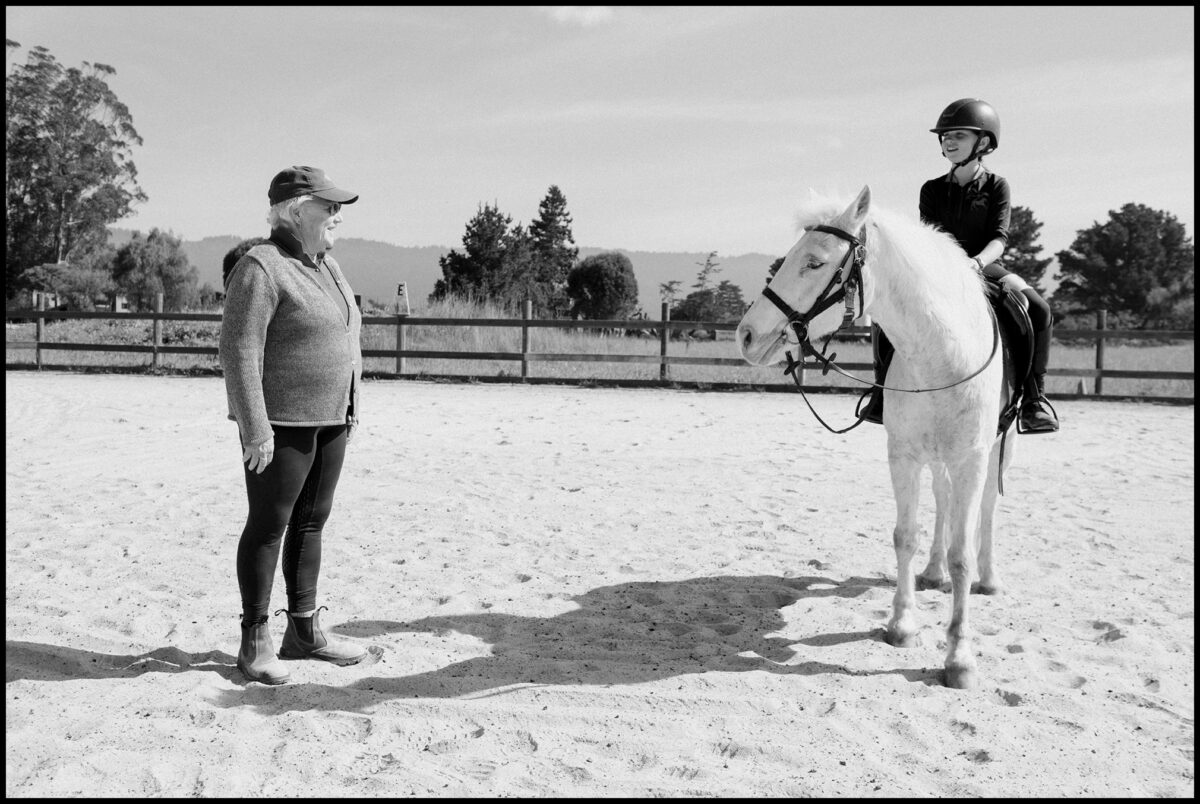
On a recent Sunday morning, Ms. Peacock, an energetic 70-something, stood at the center of her riding ring, arms akimbo. She led a group of tweens and teens through a series of drills on her Bolinas ranch, her voice carrying a gentle firmness, never suggesting hurry or worry.
“Pick up your trot and track left,” she called, and the girls followed, promenading in circles around her.
Ms. Peacock is the type of trainer who keeps a sugar cube or a carrot in her pocket at all times. She’s affectionate with every horse she encounters, offering a “Hello there!” when they reach out a nose to investigate her hand.
On a clear day, the Farallon Islands are visible from her riding ring, part of a rambling 70-acre property she bought in bits and pieces starting in 1983. She calls it Vanishing Point Ranch, after the 1971 psychedelic movie whose desert highways seemed to stretch on forever.
Ms. Peacock is a co-founder of the Bolinas chapter of the Pony Club, a national organization that is the equestrian analogue to 4-H, along with Aggie Murch and Susie Whaley. The club has met every other week for nearly half a century, making it one of the longest-running chapters in Northern California.
Ms. Peacock has taught generations of West Marin children the principles of clear communication between horse and human. She teaches rhythm and balance, and the workings of equine nervous and skeletal systems. Central to her approach is building trust and understanding across the species divide.
Over the years, she has thought carefully about her profound connection to horses, and about why they mean so much to young people.
“You’re in an environment where you don’t have much control over your life, and then if you’re a girl, it’s even worse,” she said. “And then there is this creature that weighs more than 1,000 pounds that you can communicate with. It’s incredibly empowering.”
Ms. Peacock grew up in Menlo Park, where her father was an executive at Varian Associates, one of the original electronics companies that helped build what became Silicon Valley. A passion for horses struck early, and she convinced her parents to buy her a 28-year-old pony named Puddle Jumper. Sally spent every Saturday at Pony Club on a ranch belonging to the western crooner Tennessee Ernie Ford.
The students who participate in Ms. Peacock’s club and her afterschool programming don’t merely show up ready to ride.
Every day, they come to “brush the horses, exercise them, feed them, and make sure their stall is clean,” said 11-year-old Marla Mora, who rode a white-and-chestnut pony named Teddy, his mane tied into rows of braids. Proper care is time-intensive; horses are designed to walk more than 20 miles a day, yet many spend much of their life in confined spaces.
“Horses provide absolute purpose in your life because they are so energy-intensive,” said Marla’s mother, Jennifer Tiscornia, who now runs much of the boarding, teaching and training at Vanishing Point. “I’ve gone out and fed and cleaned horse paddocks when I’ve had a fever of 104. You have to show up for them.”
Ms. Tiscornia, who participated in Pony Club under Ms. Peacock’s watch as a girl, grew up at Rancho Baulines, a ranch now owned by the National Park Service. Her family was its last tenant before they were evicted in the late ’90s.
Among Marla’s peers that morning was 13-year-old Elsa Miottel, who has been taking lessons at the ranch since she was 8. Romy, the palomino Haflinger she rode, progressed from a steady walk to a balletic trot and then a speedy canter across the ring. “I like that I get to not only ride the horse but also learn about the horse and how to take care of it,” she said.
Elsa’s mother, Anna O’Malley, a Bolinas physician, has watched her daughter’s character develop at the ranch. “It’s amazing for kids to be around these big powerful creatures,” she said. “To interact with horses, you have to be present and calm—all the things that make you a good human as well.”
As prey animals, horses are hyper-attuned to their environment. They can see nearly 360 degrees and can focus on two objects at once, one from each eye. Their hide is so sensitive to touch that they can feel a single fly land on their body and flex the skin underneath to send it aloft. They sense energy and body language, and the slightest stimulus from a rider’s body, like the shifting of weight or the pressure of a heel, can tell them to turn or trot on.
These days, Vanishing Point boards 13 horses, while two dozen children participate in its afterschool program and around a dozen attend Pony Club. Though riders progress through nine levels of proficiency, from D-1 to A, Ms. Peacock is quick to explain that competition is secondary. The point is to develop equestrian skills, learn to understand a fellow sentient being, and guide their beguiling power.
“The biggest thing you learn here is what it means to effectively communicate and be responsible for another living creature—the respect that entails and the work that it takes,” said Danielle Katz, who took lessons from Ms. Peacock at age 5 and is now in her 40s.
As a teenager, Ms. Katz got her first job at the ranch, mucking paddocks.
“It’s remarkable how many lives Sally’s touched,” she said. “She gave us this incredible opportunity to be around horses, but also to connect with other people.”
Ms. Peacock teachers her students that careful attention makes for better horsemanship. But that heightened awareness, Ms. Katz said, also helps make a better person—better at communicating, better at listening, better at being present.
Back in the ring, Ms. Peacock called out another direction and the young riders responded, navigating obstacles and turning their horses in smooth arcs. Forty-some years of Sunday mornings have passed this way—a woman at the center of the ring, children moving around her, horses doing what horses do when they trust the people on their backs.