
One foggy morning in August, photographer Ilka Hartmann traveled from her home in Bolinas to Pier 33, the gateway to Alcatraz. Among the first to board the ferry, she secured a spot at the vessel’s bow. Braced against the railing, Ms. Hartmann leaned into the spray, her gaze fixed upwind as a craggy outcropping materialized through the miasma: the notorious penitentiary, lying like a black island in a white sea.
While tourists murmured about Al Capone, Machine Gun Kelly and the Birdman of Alcatraz and wrinkled their noses at the overwhelming stench of guano, Ms. Hartmann paid no mind. She pointed toward red-painted words proclaiming, “INDIAN LAND,” left half a century ago when Indigenous activists commandeered the island and claimed it as their own.
Alcatraz was back in the headlines this summer. In July, Donald Trump dispatched Attorney General Pam Bondi and Interior Secretary Doug Burgum to assess whether the island could once again serve as a high-security prison. “Alcatraz could hold the worst of the worst,” Bondi told Fox News, standing outside a rusting cell. “It could hold illegal aliens. It could hold anything.”
As Ms. Hartmann and the other passengers disembarked, a park ranger spoke into a bullhorn with the enthusiasm of a camp counselor. “Some of you might be wondering about this political graffiti behind me,” she told them, as she tells Alcatraz’s 1.4 million annual visitors. Normally, the federal government does not preserve graffiti, she explained. But on Alcatraz, visitors should understand the significance of those words written in red.
In the spring of 1970, Ms. Hartmann, then in her 20s, answered a call for water and supplies and climbed into a small boat bound for the island. She came to capture the moment with a Leica gifted by a Berkeley professor and a Pentax lent by her boyfriend, Orville Schell.
Ms. Hartmann is something of a Zelig of history, present with camera in hand whenever the ground seemed to shift: during the civil rights, Black Power and Red Power movements, antiwar demonstrations, women’s and gay liberation, the back-to-the-land movement and the post-’60s hangovers in the 1970s. “I never remember how I got to these places,” she said. “I just did.”
Her images of sit-ins and drop-outs, marches and vigils document movements from the inside out, capturing political idealists, social activists, counter-culturalists and avowed revolutionaries.
“I viewed the work like a service, a record for the people in it, for history,” she said. “We wouldn’t have all these pictures otherwise. I was there so others could see.”
Now 83, Ms. Hartmann wears her silver-brown hair long and parted in the middle. She has angular cheekbones and her heavy-lidded eyes frequently narrow in contemplation or bemusement. After hundreds of visits to the island, she greets rangers by name and is quick to offer a lost tourist directions.
Alcatraz began as a military fort in the 19th century before becoming a federal prison in 1933. Too costly to maintain, it shut down three decades later. Speculation about its future ran wild at the time: a casino, a monument to rival the Statue of Liberty, a space museum. But in November 1969, a group calling itself Indians of All Tribes seized it instead.
“We will purchase said Alcatraz Island for $24 in glass beads and red cloth, a precedent set by the white man’s purchase of a similar island about 300 years ago,” the group proclaimed. That other island, of course, was Manhattan, bought by the Dutch from Native Americans in 1626.
Hundreds of occupiers from dozens of tribes spent time on Alcatraz during the 19-month occupation. They started a school, cooked and cleaned communally, launched a pirate radio station, drummed, told stories and planned the future.

The island, bleak and barren, became a metaphor for the reservations to which Indigenous peoples had been forcibly moved. Buckets of terracotta paint believed to be left over from the Golden Gate Bridge were used to spell out declarations of native sovereignty on the dilapidated prison buildings.
By the time U.S. marshals removed the final 15 occupiers in June 1971, a moment Ms. Hartmann captured, the protest had catalyzed a new era of Indigenous activism known as Red Power.
In the years that followed, the National Park Service, which assumed control of Alcatraz in 1972, either ignored or painted over the remnants. “They whitewashed our existence there,” said Eloy Martinez, who arrived on the first night of the occupation.
Only in the past 15 years has the agency reversed course, working to preserve evidence of the takeover. After years of lobbying, activists won permission in 2011 to restore the original graffiti. By 2013, the water tower once again proclaimed “INDIAN LAND,” and in 2016 the dock greeted visitors with “INDIANS WELCOME,” repainted by the children of the original occupiers.
“Back then nobody had cameras,” Mr. Martinez said. “We needed others like Ilka to come in to document so all these stories don’t get forgotten.”
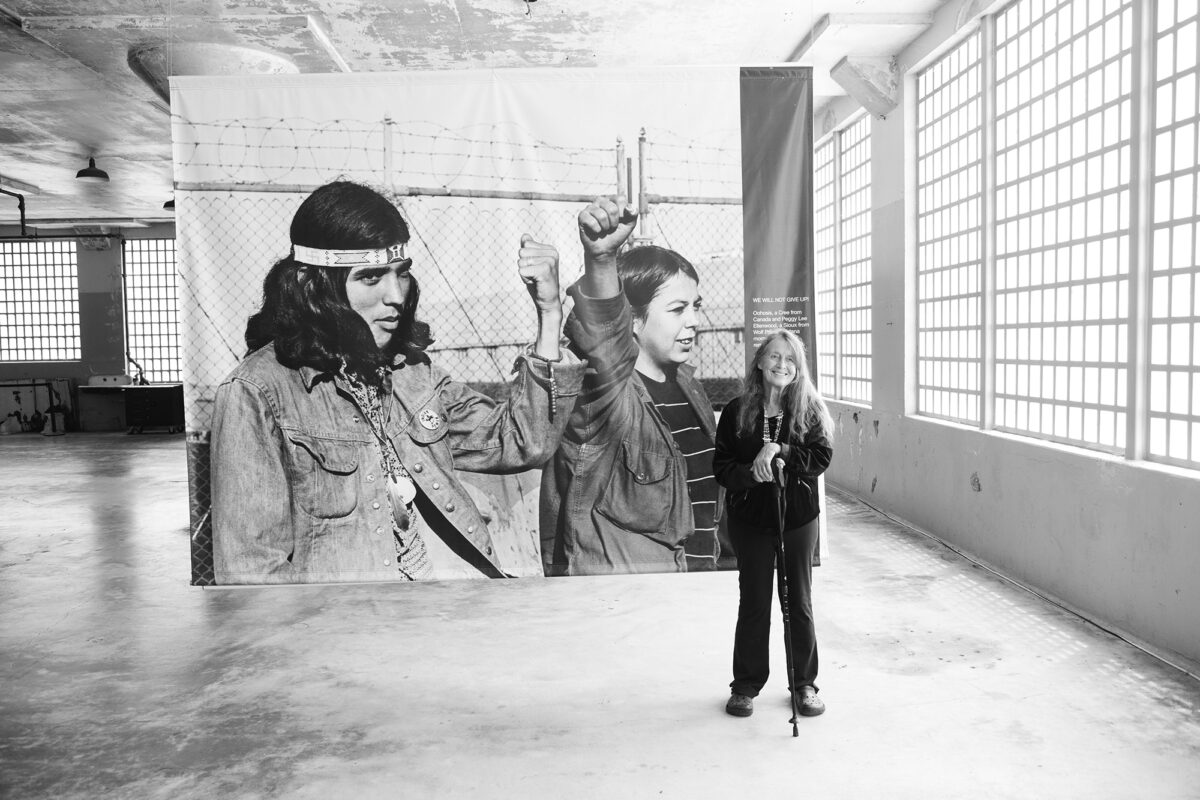
Ms. Hartmann’s photographs of the occupation have appeared in books, articles and documentaries, and since 2019, they’ve been a centerpiece of the exhibit “Red Power on Alcatraz: Perspectives 50 Years Later.”
In the New Industries Building—a cavernous, light-filled, splendidly dilapidated warehouse where prisoners once made mats from old tires, assembled furniture, and turned out brushes and gloves—her prints are so immense they had to be ferried over by barge. This fall, a permanent exhibition, curated in collaboration with surviving occupiers and their descendants, will open near the main docks.
Shows like this feel increasingly precarious in today’s climate. The White House is on a crusade to remake the nation’s cultural institutions in its own image, purging what it derides as improper ideology, which includes exhibitions about slavery, gay rights and immigrants.
Ms. Hartmann’s earliest image of the occupation, taken through a rusted barbed-wire fence, captured the bay beyond. The island was already a deteriorating relic, and she recalled being transfixed by the sound of loose wire humming in the wind.

Her lens captured quotidian portraits of occupiers, children playing on abandoned equipment and a lone man sitting on a vast blacktop with guard barracks rising behind him. In one portrait, Rosebud Sioux activist Belva Cottier, an architect of the occupation, looks into the camera with the monumentality of a classical sculpture. Published in the now-defunct Berkeley Barb, it was Ms. Hartmann’s first photograph to appear in print.
“I always try to capture the way a person holds themselves, their dignity, their humanity,” she said.
Another beguiling image features Sage Road Traveler Longoria, a member of the Caddo Nation of Oklahoma, standing in a crowd, her eyes boring into the lens.
Ms. Hartmann’s work seems to capture both the grand sweep of history and the singular humanity of the individuals making it. And despite the intrinsic distance of her medium, she sees her practice not as observation but participation.
Ms. Hartmann was born in Hamburg in 1942, and, despite living much her life in California, she has never fully lost her accent. When she was 18 months old, Allied bombs destroyed her neighborhood, forcing the family to flee. They walked for a day through a burning city to reach a sailboat that carried them down the Elbe River to Altes Land, a region of cherry and apple orchards where they lived on the second story of a thatched farmhouse above a pub.
Her father, a physician, was conscripted in the final months of the Third Reich, when the regime formed Volkssturm—the “People’s Storm”—drafting the wounded, the elderly and children. In September 1944, he was sent to the Russian front; by February 1945, he was declared missing. Nearly every child in her class lost a father. “Only one girl still had both parents,” she recalled. “It was totally amazing to me.”
In postwar Germany, where children were encouraged to confront the darkest parts of the past, they learned about the atrocities of the war within a decade. One image from a textbook has never left Ms. Hartmann: a photograph of naked corpses heaped in a pile at a death camp. It was her first recognition of a photograph’s ability to bear witness, to “pierce the haziness” with uncompromising candor.
At 22, she followed her mother, a historian and translator, and her sister to Stockton. Touring the state’s Spanish missions, she learned of the brutality inflicted upon Native peoples and swiftly drew parallels to Germany’s past. “I saw what had happened here as genocide long before they were using that word,” she said.
As a young woman she had studied theology and aspired to become a Lutheran minister. In the United States, that longing took a new form. She enrolled in a photography class and discovered the work of Dorothea Lange, whose images bore witness with empathy but not exploitation, and W. Eugene Smith, whose gripping photo essays for Life magazine redefined the medium.
At U.C. Berkeley, she taught German, joined protests and photographed them, spending nights in the darkroom so her images could run the next morning in the Daily Californian. At a Black Power demonstration she met Mr. Schell, with whom she would later have a son.
By 1969, the couple had settled in Bolinas. In 1976, they published “The Town That Fought to Save Itself,” chronicling the community’s effort to chart its own course. Ms. Hartmann’s Bolinas photographs are light, energetic, uninhibitedly beautiful, sometimes mundane and sometimes otherworldly, as in her hallucinatory images of the Bolinas Sun Festival, a once-annual tradition of giant puppets and handmade costumes.
“Ilka, more than anyone else, captured the spirit of experimentation—of organic farming, alternative agriculture, art and poetry, of this playful, ludic way of reimagining how to live together in a place,” said Perry Shimon, who has helped her assemble and digitize her archive.
Few photographers chronicled both the protest movements of the 1960s and 1970s and the counterculture’s migration to rural enclaves with such immediacy, offering not a cold ethnography but a living record: how people worked and ate and played, the rituals and ceremonies through which they forged a collective identity.
“In Bolinas, I was like a child again,” Ms. Hartmann said. “In Germany, it was heavy after the war. It was sad and gray and rainy, and we were always thinking about our dad. In Bolinas, we were happy and joyous and laughing and dancing—kind of forgetting our past.”
