
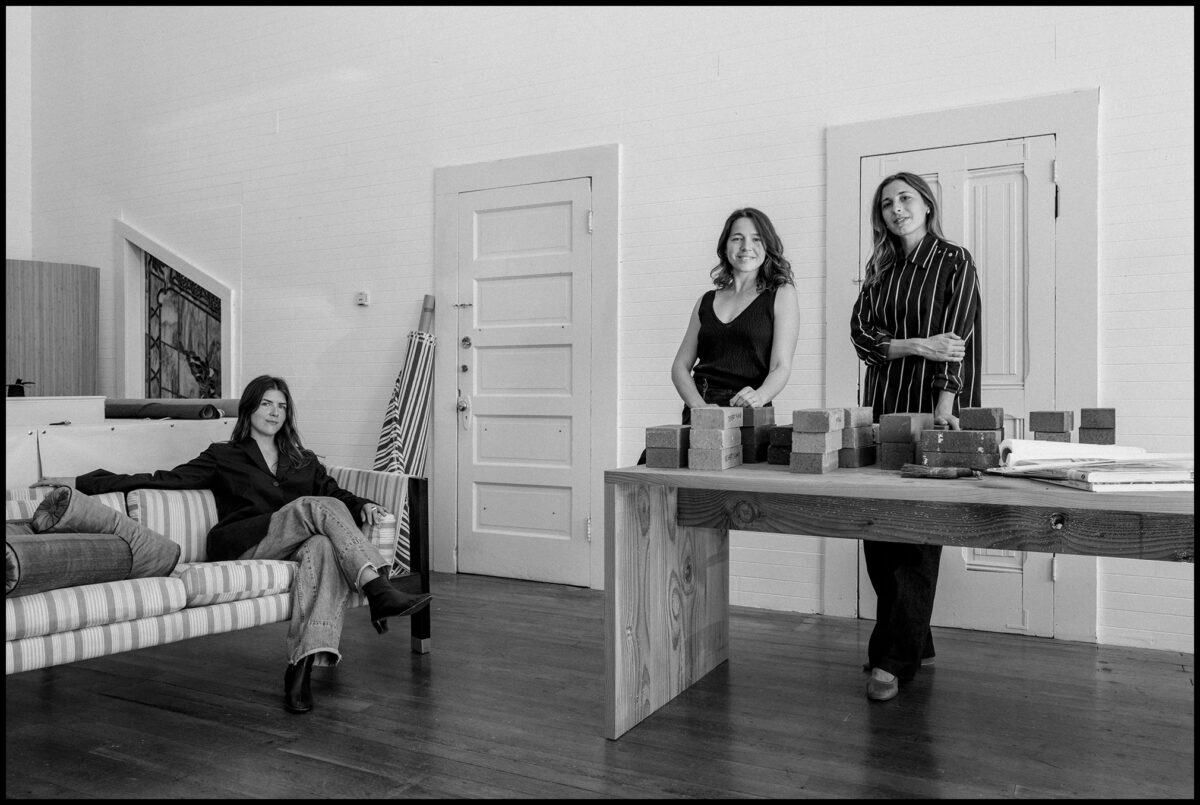
Artists are notoriously difficult people to share a space with, finicky and requiring stretches of solitude. Not so for three women working in close quarters in one of the few buildings in Olema: Lauren Goodell, who runs a newly opened upholstery business called Half Sky Studio, and Taylor Palmer and Anastasia Sonkin, the duo behind the landscape design firm Talc Studio.
The trio share an ethos of breathing new life into old things, whether it’s a backyard or a well-worn armchair. “We all want to create beautiful spaces and worlds,” Ms. Palmer said. “There’s this shared appreciation for beauty, and for bringing it into other people’s homes and gardens.”
All three are well-dressed women in their 30s with an abiding belief that surrounding oneself with aesthetically pleasing things is among life’s central purposes. They have a deeply grooved sense of taste, one that could take a lifetime to cultivate, and one that now defines their young brands.
Inside the sunlit, airy space—a grocery for much of the 20th century—bolts of fabric lean against a wall beside a row of sewing machines. Redwood tables are crowded with half-finished drawings, and shelves are stocked with raw materials arranged less like samples in a showroom than objets d’art.
Olema, a one-stoplight town, has in recent years become something of a creative corridor. Along the same stretch are the studios of artist John Gnorski, designer Nicole Lavelle and painter Rob Moss Wilson, and the gallery Tama One.
Ms. Palmer and Ms. Sonkin’s naturalistic gardens and landscapes can be found in homes from Los Angeles to Palo Alto and Bolinas. Their plantings draw on native species and those from other Mediterranean climates, resulting in gardens that feel at once cultivated and wildish—grassy and lush, a textural mosaic of muted greens and silvers that echo the region’s rolling meadows.
“We design gardens that are very site-specific,” Ms. Sonkin said. “We’re inspired by where we live and by being outside, and we try to bring what we see around us into people’s homes. We want our gardens to feel really natural in that sense.”
If the formal gardens of Versailles represent one pole of landscape design, Talc’s work sits firmly at the other. Like the 20th-century English tradition, it is looser and more abundant, with movement and irregularity a part of the design.
The plants they favor lend themselves to that sensibility: sesleria, a moor grass with a blue-gray cast; Pennisetum spathiolatum, which rises in a fountain-like arc; banksia, known for its long, cylindrical flower; and native buckwheat, which “feels like the essence of California,” Ms. Palmer said.
Increasingly, their work overlaps with Ms. Goodell’s. Cushions she upholsters for outdoor seating now appear in Talc’s gardens.
Ms. Palmer, originally from Maryland and now based in Inverness, and Ms. Sonkin, an L.A. native living in Fairfax, started their business a decade ago in San Francisco. Their new workspace grew out of a friendship with Ms. Goodall, who moved to Inverness five years ago.
Before turning to upholstery, Ms. Goodell worked as a ceramicist and managed the Blunk Space. But she felt compelled to make a change. “I was selling art, and I wanted to be making the art,” she said.
She apprenticed under a master upholsterer in London; back home, she sought out Mara Nelson, who has practiced upholstery in Point Reyes Station for half a century, including for a time in the Olema studio the three women now share. “She helped shepherd me into this and was very supportive,” Ms. Goodell said of Ms. Nelson. “It feels sweet to be in her lineage.”
Growing up in Toledo, Ohio, Ms. Goodell was her father’s shadow. He took her on old-house tours and to flea markets and estate sales where she developed an early fascination with found furniture. Today, she works on everything from curtains and cushions to swivel chairs. It makes perfect sense to her that her livelihood would come to revolve around the resurrection of old things.
In an era of disposable goods, she sees upholstery as a kind of corrective.
“I get to give furniture new life,” she said. “There’s a regenerative nature to upholstery that I really like, given that we live in this fast-fashion, throwaway culture. It feels like meaningful work to make something new again.”