

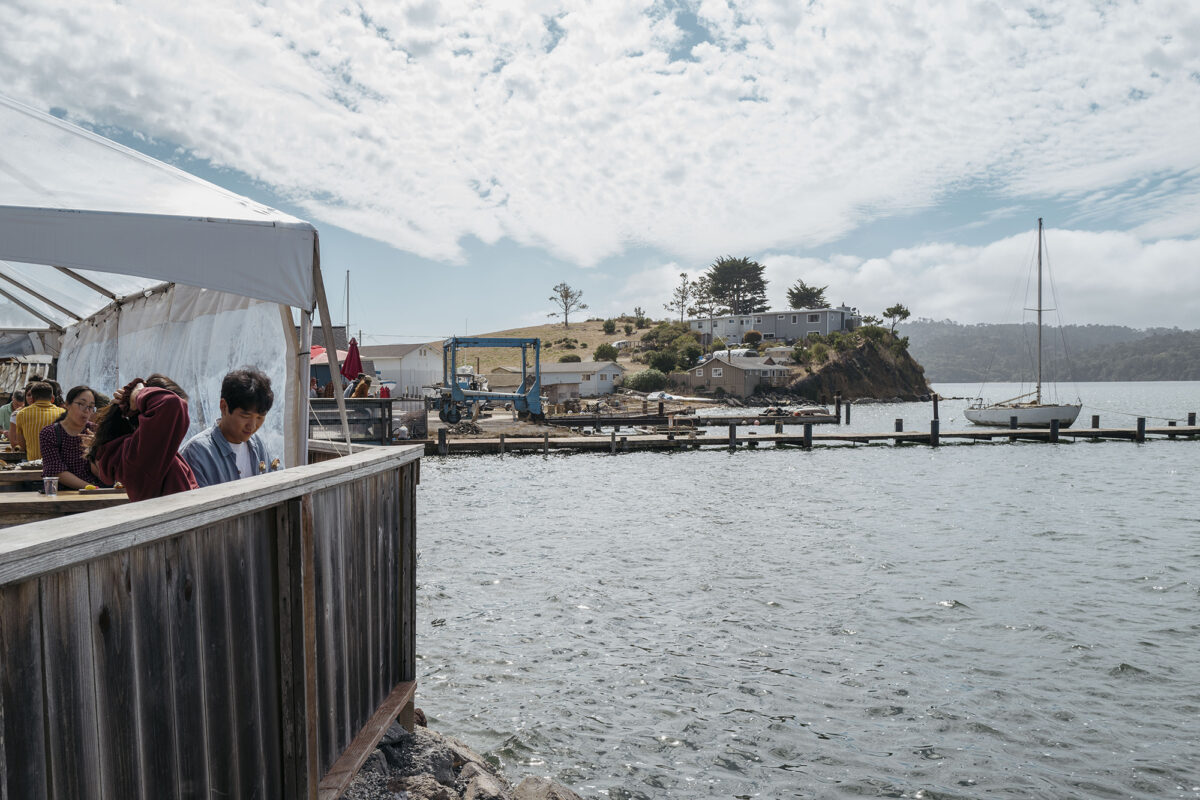
A 17-acre property that hosts three landmark establishments on the eastern shore of Tomales Bay has been put on the market for $13 million.
Its sale will mark the end of a century of ownership by a Croation émigré family—and a turning point for the town of Marshall.
The site is home to the post office, an oyster company, a restaurant with a national reputation, and the Marshall Boatworks, the only place between San Francisco and Fort Bragg with a moveable boat lift to raise heavy, deep-keeled vessels from the water.
Any substantial alterations to the businesses that operate on the property’s four parcels will require the new owner to navigate a tangle of state and county development rules that place a premium on environmental protection and public access to the coast.
No one can predict what changes a new owner might seek, but Joe Morrison, one of four realtors marketing the property, said the current tenants provide an appealing income stream that any potential buyer would welcome.
“I don’t think the restaurant or any of the other tenants are likely to leave after a sale,” he said.
Shannon Gregory, who owns the Marshall Store—which the New York Times once named one of the nation’s top 50 restaurants—said he hopes to remain.
“We generate a lot of the income for the property, and I think we’re a benefit to the sale,” he said.
The property is also home to the Point Reyes Oyster Company, a wholesale operation run by Martin Strain, and four houses, three of them perched on a bluff above the shore and the fourth on the other side of Highway 1.
Three of the homes are rentals, and the fourth is occupied by Ed and Bernadette Vilicich, who, like the other four elderly family members who own the property, are ready to pass it on to younger owner-operators.
The oyster company has been there for 35 years and would like to continue, Mr. Morrison said. The Marshall Store’s lease runs through 2027, and the post office lease runs through 2028. The United States Postal Service owns the modular post office building and leases the ground below it, so the new owner will become its landlord.
The property includes 2,500 feet of Tomales Bay shoreline.
“It’s an epic opportunity,” said Sarah Kowalczyk, one of the residential realtors handling the sale. “It’s a legacy Tomales Bay waterfront property with commercial, hospitality, and residential potential.”
Most of the land is zoned as village commercial-residential, a mixed-use designation that is intended to maintain historical village character and community scale while allowing for new businesses that serve both locals and tourists. It also provides for light industrial uses like the boat works, according to county planner Immanuel Bereket.
A single 1.5-acre parcel across Highway 1 is zoned as agricultural, a designation that allows both agricultural activities and farmworker housing.
A 2017 county assessment of possible uses of the property, prepared at the request of the Vilicich family, strongly endorsed the continued operation of the boat works but also noted other potential uses, including a small bed and breakfast and an outdoor education center. Another county planning document suggested adding a community center at the site.
But before any of that can happen, the report said, a section of soil in the boatyard—contaminated with arsenic, copper, lead, and mercury from years of ship repairs and painting—needs to be remediated. The buyer will likely have to commission an environmental assessment to determine the scope of the problem and offer proposals for removing contaminants.
Though residents are awaiting the outcome of the sale with some anxiety, they are also hopeful it will result in substantial improvements. With ramshackle sheds, storage containers, and boats undergoing repair scattered across the property, the industrial nature of the place can feel to some out of keeping with the landscape.
A new owner with financial resources could give it an aesthetic overhaul, said Dana Capiello, a Marshall real estate agent.
“I honestly think it can be a jewel, something the owner can take pride in,” said Ms. Capiello, who also sits on the board of the East Shore Planning Group.
The property’s current owners—three sisters, a brother and a cousin, Skip Vilicich, who runs the boat works and maintains buoys in the bay—are the third generation of the Vilicich clan, one of several Croatian families that came to West Marin at the turn of the 20th century.
The first to arrive was Nicolo “Nick” Vilicich, one of several Croatians who settled in a small fishing village on the opposite side of the bay, just south of White Gulch, on Tomales Point, according to an account by historian Dewey Livingston.
The family moved across the bay to Marshall in 1927, gaining easier access to markets in San Francisco, first by train, later by truck.
Moving on will be difficult, said Bernadette, whose husband has lived on the property since he was born, but it’s time.
“It’s getting harder for us to be here,” she said. “It’s been Ed’s life for 77 years, and we raised our children here. There’s just a lot of emotions.”
Ed’s cousin Skip, who is approaching his 77th birthday, shared Ms. Vilicich ’s sentiment. “I think this is the end of the line,” he said. “I’ve got a boat here that I’d like to fix before I keel over. If I can do that, that’s good enough.”
He inherited the Blue Sea from his father when he was a high school senior.
“When Ed and I got back from the Coast Guard, I tore it apart, and I haven’t gotten it back together yet,” he said. “There’s been a few other projects along the way. I built a house, got married, and then the three of us—Ed, his dad, and me—put a herring fishing boat together.”
With his friend Gene Maffucci, Skip has been running the boat works since the departure of longtime manager Jeremy Fisher-Smith last year. He plans to retire after the sale, and he’s hoping someone else will take over.
“It’s hard to find anybody to do this kind of work anymore,” he said. “Everybody likes to play with a computer and a cell phone, and this is not the place for that.”