

The Point Reyes Good Luck Fund wants you to own a piece of your town, and it is setting up a real estate investment fund to let you do just that.
Established two years ago by tech entrepreneur and Point Reyes native Chris Hulls, the fund plans to start a for-profit entity it hopes will generate stable, modest returns for qualified investors while injecting life downtown and preserving West Marin’s soul.
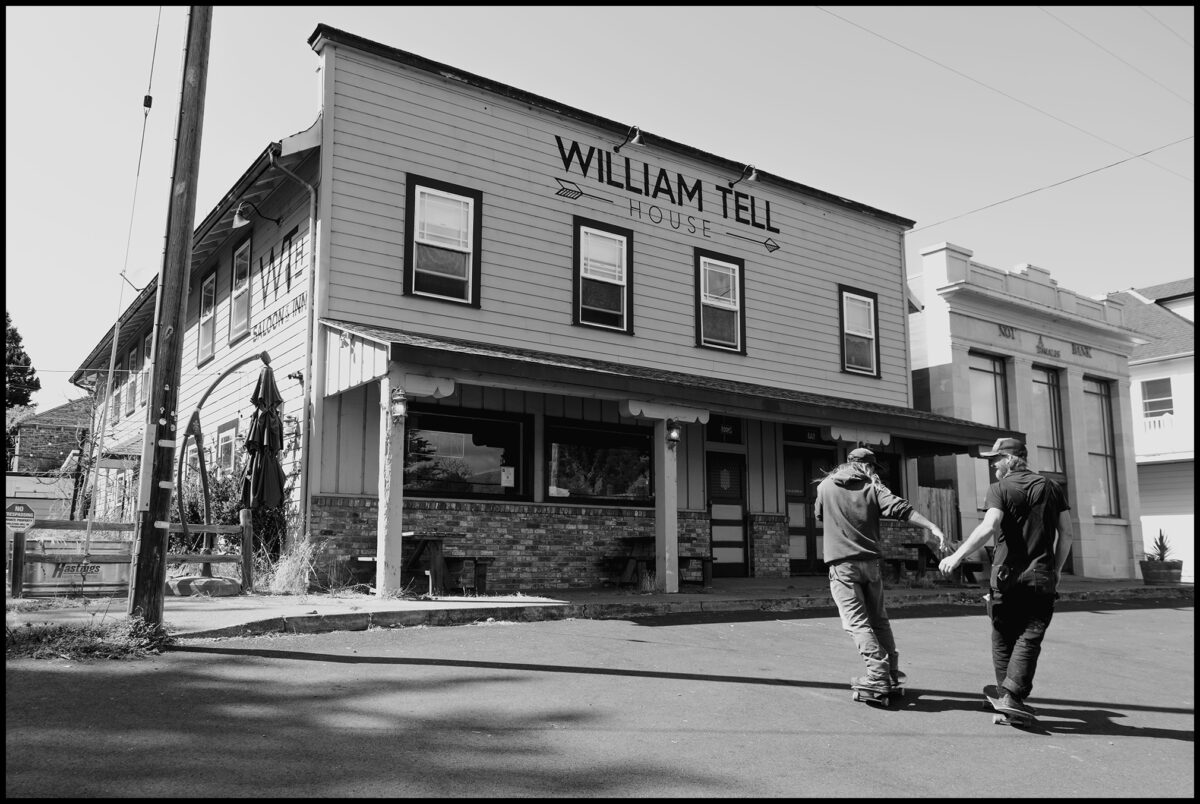
The fund’s mission remains unchanged: preserving landmark West Marin buildings in perpetuity and renting them to viable local businesses that provide essential services. Good Luck has already acquired the Old Western Saloon and the former Station House Café buildings and Vladimir’s in Inverness. It is closing a deal for the William Tell, a once-thriving Tomales bar and hotel that has stood vacant since the pandemic. It has also partnered with the Petaluma Health Center to sustain the local pharmacy.
Under the nonprofit/for-profit hybrid the fund envisions, the nonprofit would acquire buildings, renovate them, transform them into L.L.C.s and recruit tenants. It would then sell the buildings to its for-profit fund, which would offer shares in its real estate portfolio to private investors. Any returns would depend on how much rent the properties generate.
“You can be an owner of the buildings you drive by every day, home to the businesses you frequent, in addition to holding an appreciating asset with a quarterly cash distribution,” said John Josi, Good Luck’s finance director.
The fund’s returns would be shared among 150 accredited investors who earn at least $200,000 a year or have a net worth of $1 million—an I.R.S. requirement for the investment model the fund is adopting. Eventually, Mr. Josi said, the fund hopes to establish a crowdfunding mechanism that allows small investors to join by pitching in from $500 to $1,000.
The investment fund, which is expected to sopen before the end of the year, is hoping to attract $5 million from accredited investors by the end of 2027. It is looking for mission-driven investors who won’t depend on its returns as the linchpin of their retirement.
“You’re not looking for a retire-in-10-years return, but a safe and attractive place to put at least some of your portfolio,” Mr. Josi said.
Mr. Hulls, the 46-year-old founder and C.E.O. of the Life360 location sharing app, launched the Good Luck Fund with $15 million of his own money in 2024. It began as a family foundation but transitioned this year to a public charity, with a board of directors chaired by Mr. Hulls. To maintain that status, it needs to raise an additional $3 million or it will revert to a private foundation, as I.R.S. rules require at least 20 percent of its funds to come from outside donors. The deadline for hitting that target is 2029.
In all, Good Luck is seeking a total of $8 million from donors and investors.
Mr. Hulls and Mr. Josi sketched out their plans at a recent invitation-only dinner at Bar Auklet, in the former Station House building downtown.
Not all the nonprofit’s properties will be sold to the investment fund—only those that have been fully renovated and established as dependable sources of income. They would be sold with permanent deed restrictions requiring them to remain in local hands and ensuring that their footprint, façade, and community-serving mission be preserved.
“The Old Western could only ever be the country dive bar, honky-tonk living room that it has always been,” Mr. Josi said.
The first property the investment fund plans to acquire from the nonprofit is Bar Auklet, which opened this summer. In Shannon Gregory, the restaurant has a seasoned owner with a track record of success and West Marin roots—precisely the sort of tenant the fund wishes to attract for its other properties.
The Old Western, which still requires significant deferred maintenance, would not be included in the portfolio, nor would Vladimir’s, whose septic upgrade won’t be complete for another year.
Each time the investment fund purchases a building, the profits would return to the nonprofit, providing it with capital for its next acquisition. “It’s a flywheel, basically—a very positive feedback loop,” Mr. Josi said.
The fund will have a three- to five-year lockup period during which investors could not sell their shares. And if they do decide to leave, they could only sell to other accredited members of the fund.
“People should think of this as a permanent investment in the community that they don’t need to get back,” said Pamela Wright, a real estate investment advisor who is following the project with interest. “It only makes sense for people with extra money they can afford to invest for the very long term.”
To pay a 3 percent return on $5 million, the fund would have to take in a total of $12,500 a month in rent—a high target but not impossible, said Marshall Livingston, a local commercial real estate owner.
He was cautiously optimistic that the fund could succeed, provided it finds the right properties and the right tenants to occupy them. “I think it’s a good thing that they’re doing,” Mr. Livingston said.
Luc Chamberland, who leased space from Mr. Livingston for his former Saltwater Oyster Depot, paid $7,000 a month in rent—about $3 a square foot—and roughly $4,000 more a month for utilities and other operating expenses. The challenges of running a restaurant, he stressed, are daunting.
“If I had $1,000 to bet on Kalshi versus $1,000 to own a building with the Good Luck Fund, I’d do Kalshi,” he said, referring to the online platform that allows people to wager on virtually anything.
But guests who attended the information session came away optimistic.
“This is a way for people to really demonstrate their investment in Point Reyes, not just from a financial perspective, but from an emotional and psychological perspective,” said Chris Desser, a Point Reyes Station resident. “We’re trying to be masters of our own fate out here, and we don’t want the county or investors coming from outside whose view isn’t really consistent with the ethos of West Marin.”
Still, the fund will need to develop a more detailed prospectus to attract seasoned investors, Ms. Desser said.
Francesca Vietor, a Bolinas resident and a former environmental advisor at the San Francisco Foundation, attended the info session with a contingent of Bolinas residents. Some suggested creating a Bolinas fund, but Ms. Vietor is urging them to rally behind Good Luck.
“I would caution against starting something new without seeing where this is going and whether there’s an opportunity to jump on board,” she said, adding that the nonprofit/for-profit model is increasingly common in the philanthropy world.
The Bolinas Store, whose aging building needs serious attention, provides an essential service and could benefit from the fund’s support, she said.
Mr. Hulls sees the fund’s geographic reach eventually extending to all corners of West Marin. “I hope we could get our key downtown buildings across Point Reyes, Inverness, Marshall, Tomales, all the way down to Bolinas, and into the San Geronimo Valley, too,” he said.
He also stressed his preference for the public charity model, where decision making is shared with a board and the nonprofit has a more transparent governing structure. He’s concerned about being perceived as a power-hungry rich guy who wants to be mayor of Point Reyes—or, worse yet, its king.
For information about supporting the fund, email [email protected].