

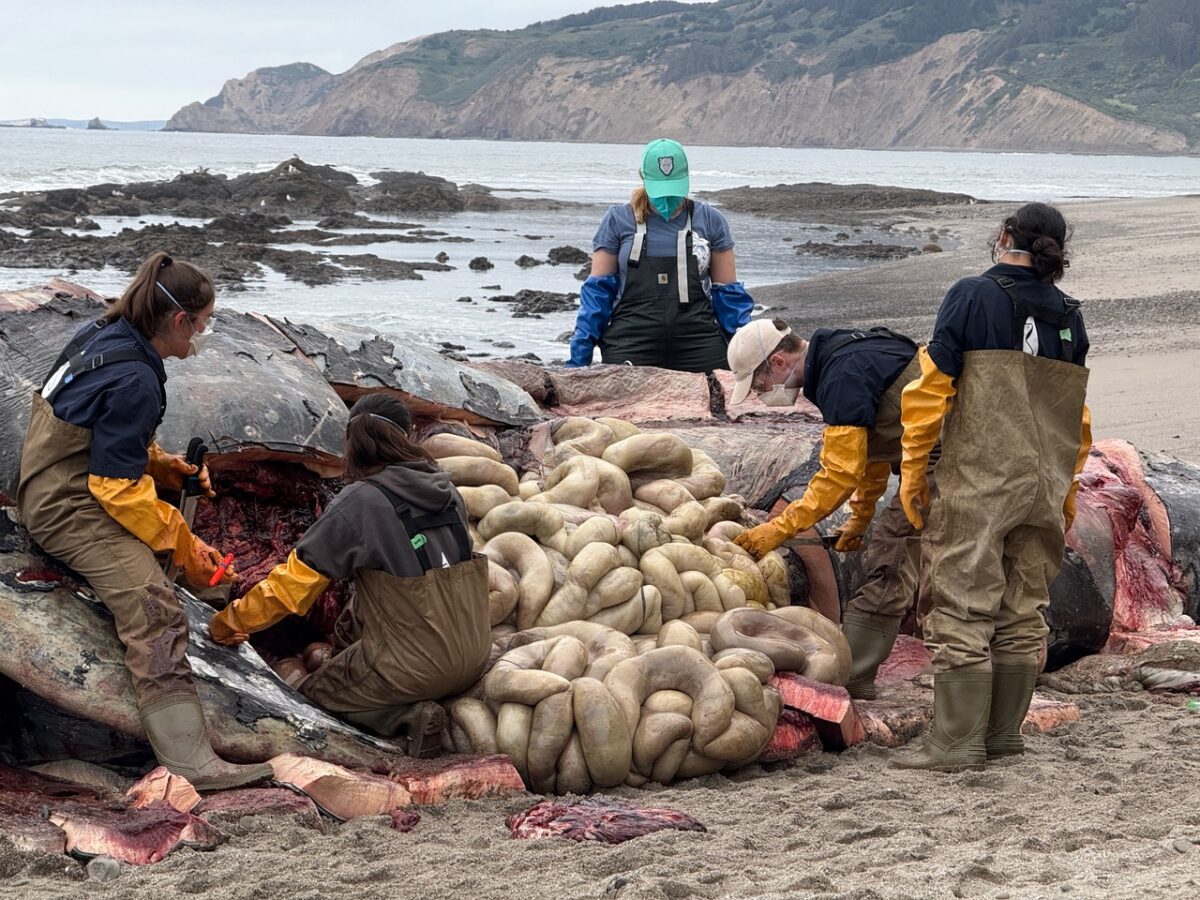
One bright-blue afternoon earlier this month at R.C.A. Beach in Bolinas, a team of researchers in waders and elbow-length rubber gloves toiled about a colossal creature from the sea. They cut, pulled and prodded it, deciphering how it died.
The 40-foot male gray whale had washed ashore the night before, on April 1, and it lay splayed across the sand, giving off the foul stench of a refrigerator left for weeks without power.
Researchers from the California Academy of Sciences and the Marine Mammal Center, several hours into the necropsy, moved deliberately through the mass of blubber, cartilage and bones with meat hooks, bone saws and long, saber-like knives. They were racing against the sunset and the tide.
“We’re taking the whale apart layer by layer, trying to figure out its particular story,” said Giancarlo Rulli, the Marine Mammal Center’s associate director of public relations. “We’re looking for clues of hemorrhaging due to blunt-force trauma or signs of entanglement. We’re looking at blubber and tissue depth to try to understand what the body condition of this animal is.”
While Mr. Rulli stood by, a rope of intestine was eased onto the sand, and one researcher, kneeling beside it, milked a section of it, pressing partially digested sludge into a test tube as if squeezing sausage from its casing. Two others worked in tandem to slice through more than six inches of blubber and a thin layer of fascia to expose rolls of dark purple muscle draped in white, translucent fat. Another team member reached an arm deep into the towering chest cavity; when a chunk of liver came free, a colleague carried it gingerly to a waiting plastic bag.
The body of the whale was first spotted on March 28, floating near Tiburon. Strong tides carried it toward the Golden Gate Bridge, and a couple of days later it had landed in Bolinas. The cause of death has yet to be determined, but researchers have reason to suspect a boat strike.
It is one of at least eight gray whales found dead in the waters near San Francisco Bay in the past month, according to researchers who say the deaths might be part of a broader decline of the species. Last year, 26 whales stranded in the Bay Area, including 21 grays. Nine of those deaths were classified as suspected or probable vessel strikes.
A study released last week suggests that the toll may be significantly higher than previously understood. From 2018 to 2025, 18 percent of the gray whales that swam into San Francisco Bay died there, largely from collisions.
But because carcasses often sink or drift out to sea, and because decomposition can obscure identifying features, the true mortality rate is likely higher, said Josephine Slaathaug, the study’s lead researcher and a graduate student at Sonoma State University. “The 18 percent mortality rate that we found is a minimum,” she said. “There’s evidence to support a mortality rate between 40 and 50 percent, and that may still be on the lower end.”
To conduct the study, Ms. Slaathaug reviewed tens of thousands of photographs of living and dead whales spotted in the area, creating a catalogue that linked individual whales to carcasses found nearby. Using that method, she was able to match the whale at R.C.A. to one seen alive in the San Francisco Bay.
“The data from the necropsy is so much more meaningful when you have the whale’s living history,” Ms. Slaathaug said. “It’s very rare that you have that connection between data that you were able to collect while a large whale was alive and data that you can collect when they die. It improves the conclusions you can draw on both sides.”
Gray whales in the Pacific undertake one of the longest migrations of any marine mammal, traveling more than 10,000 miles each year from the Baja Peninsula, where calves are born, to feeding grounds in the Arctic. Historically, they seldom stopped in the San Francisco Bay.
The population has dropped by more than half since 2016, from roughly 27,000 animals to about 12,900. Scientists do not know exactly what is driving the increase in deaths, or why the whales have begun detouring into the bay. The leading theory is that their food supply is diminishing, sending them in search of nourishment elsewhere.
In the Arctic, whales feed on krill and other small invertebrates on the ocean floor, which in turn depend on seasonal phytoplankton blooms. But as the planet warms and Arctic sea ice melts, the delicate dynamics of that food web are shifting. Ecologists have warned that the dramatic shifts associated with climate change could subject even relatively large whale populations to sudden extinction.
By the late 19th century, the whales of the American Pacific were nearly hunted to oblivion by the commercial whaling industry. Yet protections enacted over decades, beginning in the 1930s and culminating in laws such as the 1972 Clean Water Act, helped improve water quality and revive whale populations. Coastal waters once fouled by industry could again sustain marine life, rebuilding the food webs that make them a hospitable place.
Whales are again traveling close to the continental shelf, but the ocean is no longer the same. Waters are warmer and busier than ever. Shipping in and around the Port of San Francisco has increased, crowding a relatively confined waterway with major container terminals, public marinas and ferry routes—and with them, large, fast-moving vessels.
There are some speed limits in California’s coastal areas, but they vary based on vessel type and many are voluntary. In the bay, tankers typically travel at around 15 knots, large cargo ships between 12 to 20 knots and high-speed ferries around 30 knots. (One knot is 1.15 miles per hour.)
Starting this week, a voluntary speed-reduction program will ask shipping companies to slow vessels to 10 knots or less along most of the state’s coast. (California does not have the authority to mandate speed limits for seafaring ships, which are governed at federal and international levels.)
Back at R.C.A. Beach, researchers let out a celebratory yelp: they had located the ear plug, a waxy deposit in the ear canal that can be used to determine the whale’s age. During a necropsy, specific samples—baleen, gastrointestinal contents, tissue, muscle and more—help explain not only how the whale died but how it had been living.
Maggie Martinez, a veterinary pathologist who lacks a sense of smell—an occupational advantage in this line of work—was focused on securing gastrointestinal samples. “They tell us what and how much they are eating and if they’ve been exposed to any algal bloom toxins. I’m also grabbing a couple of tissues, like blubber and muscle, to try to look for trauma.”
Those signs were already beginning to emerge. “We’re seeing some subcutaneous and muscle hemorrhage consistent with bruising, so we are suspicious of trauma,” Dr. Martinez said. “But we’re not entirely sure of the source yet.”
Bleeding in the muscle and connective tissue suggests the whale was injured while still alive because blood must be circulating for bruising to occur. The next step is to determine what caused the blow. Investigators look for telltale patterns such as parallel cuts from a propeller or bone fractures consistent with a collision.
As the sun began to set, the work on the beach was winding down. Whales that wash ashore can be buried in the sand, hauled to landfills, or pushed back into the water. The Marine Mammal Center and the Academy of Sciences prefer to leave a carcass to decompose and feed the creatures of land, air and sea for whom a dead whale is something like an all-you-can-eat buffet.
“There’s been a lot of research about what a whale contributes to a plethora of marine life when it dies in the ocean and sinks to the seafloor,” Mr. Rulli said. “The same goes onshore. It’s releasing nitrogen back into the ecosystem. It’s providing food for crustaceans, birds and other wildlife.”