

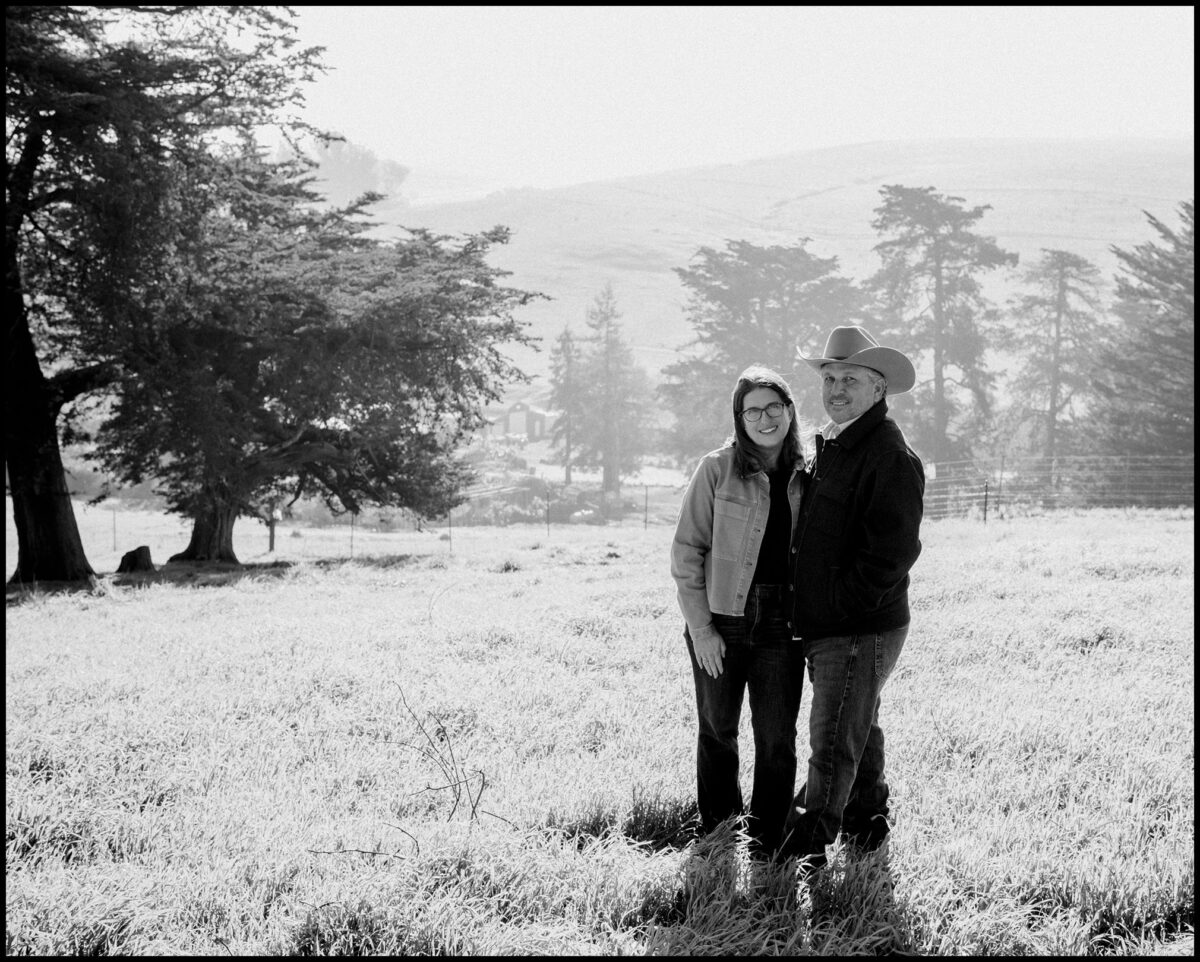
Loren Poncia’s father, a third-generation dairyman, was one of the first in West Marin to embrace environmentally friendly ranching techniques. Now Loren and his wife, Lisa, have won the farming equivalent of an Oscar for expanding on that legacy at their Stemple Creek Ranch.
Although it does not come with a golden statuette, the Leopold Conservation Award is coveted by agriculturalists who have embraced regenerative farming techniques that promote soil health, protect water quality and capture carbon, among other environmental benefits. The prize, which comes with $10,000, is granted annually by the Sand County Foundation, a Wisconsin-based national conservation nonprofit, to a single farmer in each of 28 states.
“This is like the Holy Grail for the work we have been doing,” Loren said. “I’ve always dreamed about this award, and now we’ve actually received it. It’s pretty cool.”
Under the Stemple Creek label, the 600-acre Tomales home ranch has been producing grass-fed beef and lamb for nearly 17 years now. Their products have been embraced by some of the Bay Area’s finest chefs, including Alice Waters of Chez Panisse and Michael Tusk of Quince.
Becoming stars of the organic farming scene was not something either of them expected when they graduated from Cal Poly, San Luis Obispo, back in 1998. Lisa had embarked on a law career, and Loren had taken a job selling veterinary pharmaceuticals for Monsanto.
“That was the exact opposite end of the bell curve from what I’m doing now,” said Loren, who began organic ranching after reading “The Omnivore’s Dilemma,” the seminal work by Michael Pollan that galvanized the farm-to-table movement.
“I definitely never, ever in a million years imagined this on my bingo card, and that’s been part of the fun,” Lisa said.
But farming runs in Loren’s blood. His great-grandfather, Angelo Poncia, who immigrated from Italy in 1897, operated a dairy in Fallon, a hamlet on the northern edge of Tomales, and Loren’s grandparents started their own dairy nearby in 1933.
His father, Al, who passed away in 2023, worked hard to sustain the dairy. But in the face of financial pressures, he reluctantly converted to cattle ranching in 1989.
Al became one of the first ranchers to join the Marin Agricultural Land Trust, whose pioneering use of property easements helped preserve open space when West Marin faced the prospect of unchecked suburban sprawl. Later, Al was one of the first to participate in the Marin Carbon Project, planting hundreds of trees along Stemple Creek to halt erosion, restore habitat and protect sensitive wildlife species.
“We’re standing on my dad’s shoulders with this award,” Loren said. “He laid the foundation. We just executed the plan. It was his idea to plant trees to protect the creek, and we just went to the next level and continued what he had started.”
Loren and Lisa have planted 10,000 trees along Stemple Creek, which flows through 16 miles of Sonoma and Marin, and they have added five miles of fencing to protect riparian areas. The resulting habitat has attracted beavers, badgers, bobcats, black-tailed deer, jack rabbits and red and grey foxes. The ranch is home to California red-legged frogs and California freshwater shrimp, both endangered species.
The Poncias have also partnered with a Yolo County bee farm to host pollinating bee hives. They’ve planted flowers that bloom at different times of year to keep the bees happy, attracting other insects and the birds that feed on them.
“We’re in a dance with Mother Nature,” Loren said. “When the dance is going correctly, everything is thriving. When only one thing is thriving, the dance isn’t going very well. We want a huge mosh pit of a party, with everyone having a great time.”
To promote soil health, the Poncias are meticulous about rotational grazing, moving their 500 Dorset and Shropshire lambs and 1,000 Angus cows from pasture to pasture to promote healthy grasses and soil. The cows are moved nearly every day; the sheep, once a week. Audubon California certified the ranch as bird-friendly in 2021 for its sustainable grazing practices, and several species of hawks, owls and migrating birds can be found there.
“First, do what’s right for the soil, and then everything else is going to get taken care of for you,” Loren said. “We’re far from perfect, but we’re trying and learning new things every day, adapting and changing.”
At 5 feet, 6 inches tall, Loren, like his late father, is a big presence despite his unimposing stature. Gravelly voiced, he speaks about his work with evangelistic enthusiasm.
“He has a very positive energy about him,” said Nancy Scolari, executive director of the Marin Resource Conservation District. “He’ll pick up soil, put it in his hands and start slinging his arms about. He’s really excited about the work he’s doing, and it’s a contagious excitement.”
Loren, who is 51, and Lisa, 49, are equal partners in the business. While he’s primarily an ideas man, she’s the organizer, making sure what needs to happen happens.
“They’ve done such a great job showing that it’s possible to raise high-quality beef while restoring biodiversity and keeping soil healthy,” said Lynn Giacomini Stray, a co-owner of the Point Reyes Farmstead Cheese Company, which won a Leopold award in 2013.
When Loren set off to Cal Poly in 1994, he had planned to eventually take over the family farm. But two or three years into his college career, he discovered that the business was barely breaking even.
Reluctantly, Loren took the sales job with Monsanto. He learned a lot and met some interesting people. The money was good. He was miserable.
“I’m a super positive person, with a can-do attitude, but I felt like I was in jail, working for the man doing this corporate stuff,” he said.
After graduating, Loren and Lisa moved to Sacramento. In addition to their day jobs, they kept a hand in ranching, raising a small herd of cattle at the family’s Tomales ranch, where Loren had grown up and raised cows as a participant in the 4-H Club.
In 2005, they decided to go all in with organic farming. For $1,500, they hired a designer in Argentina to create a logo and put up a webpage that told their story. It wasn’t long before the Marin Farmers Market offered them a spot on Sundays and the head chef at San Francisco’s Zuni Café discovered their product and spread the word.
Two decades later, Stemple Creek cattle now graze on 10,000 acres across Northern California, most of it leased in West Marin and Sonoma, including Black Mountain Ranch in Point Reyes Station and the Leali Ranch in Marshall, owned by Hog Island Oyster Company.
At this time of year, the Stemple Creek home ranch is a panorama of emerald pastures and rolling hills stretching as far as the eye can see. It’s actually two ranches in one: the original family dairy founded by Angelo in 1897 and the neighboring Burbank ranch, which Loren and Lisa purchased in 2013. The dairy that Loren grew up on, where his mother, Cathie, still lives, is just down the road, and some of their cattle graze there.
In one pasture, month-old lambs race around like kids playing tag, blissfully unaware that they will soon end up on a dinner plate. In another, black and red Angus cattle are doing what cows do: ingesting grass on one end and expelling out the other.
The Poncias have lovingly restored the original farmhouse, a cavernous century-old barn and several other structures, including a cozy country preschool once attended by Loren and his three sisters. All of these can be rented for weddings, events and homestays, a crucial part of their business.
Their marketing comes through word of mouth, spread by people who have seen the place with their own eyes and learned firsthand about the business.
“It’s guerilla marketing,” Lisa said. “It has brought a lot of awareness to our products and the work we do, and really to all the local producers in West Marin and West Sonoma. It creates a little ecosystem. When they come to an event at Stemple Creek, they’ll eat local cheese and local oysters. They’ll grill a steak and then they go home and tell their friends, and their friends do the same thing.”
The business has changed a lot since Al milked the cows seven days a week at 2:30 p.m. and 2:30 a.m., and Loren is pleased with his reinvention of the family business.
“What could be better than this?” he said, scanning the green expanse.