
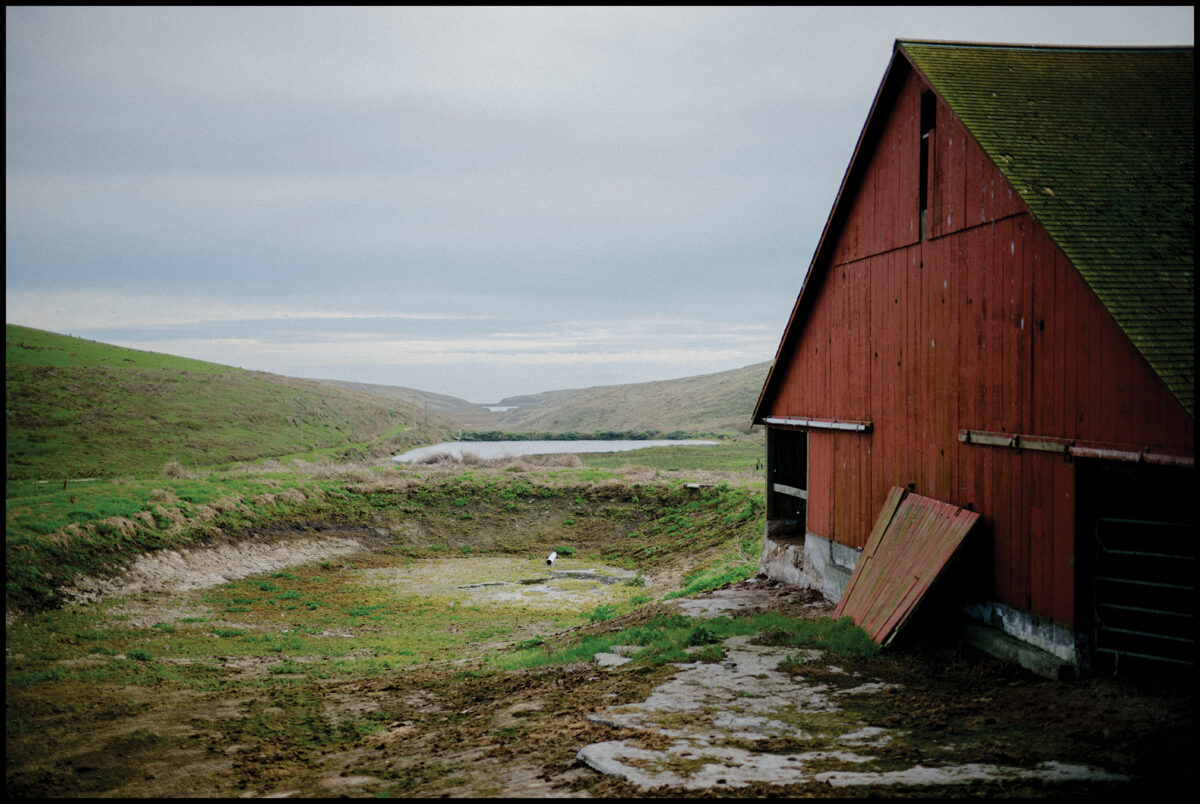
At the former Nunes Dairy, on the far edge of the Point Reyes National Seashore, the barn floors have been stripped down to bare concrete. One manure pond has been emptied to its earthen bottom; another holds a shallow, glassy pool that reflects the late November sky. The acrid smell that once hung over the place has dissipated.
William Nunes, who operated the dairy until this fall, said the final cleanup took weeks. “We washed the cement, pressure-washed the holding areas, cleaned out every pit,” he said. “Now there’s no manure anywhere—even in the creases of the concrete.”
This winter, the Marin Resource Conservation District will begin the next phase of that work, decommissioning three manure ponds at A, B and C Ranches, whose drainages flow into the Drakes Bay watershed. The effort, funded by a federal Clean Water Act grant administered by the San Francisco Bay Regional Water Quality Control Board, marks one of the first tangible steps in dismantling century-old dairy infrastructure after a legal settlement ended most ranching in the park this year.
A manure management system is designed as a closed system, one that ensures runoff does not reach nearby waterways, said Gerhard Epke, the conservation district’s water-quality program manager. Each day, a skid-steer loader would scrape a slurry of water, cow excrement and anaerobic bacteria from animal holding areas into a pond, where it was eventually pumped out and spread on fields as fertilizer.
Under the settlement, the dairies are tasked with emptying the ponds and closing out their permits with the regional water board. After that, their responsibility ends.
“If no one pays attention to these ponds after the dairies close, they can fill up, overtop and fail,” Mr. Epke said. “The soil that forms the berm could erode, sending significant sediment downstream. We are trying to make sure that does not happen.”
If the chugging drone of a milking parlor is a dairy’s beating heart, manure ponds are its kidneys, filtering waste and toxins. A lactating cow can produce 150 pounds of manure a day. In 2023, the roughly 4,200 cattle in the park produced an estimated 79,000 tons of manure.
Because dairies maintain higher animal densities and cows that are constantly lactating, their manure is more concentrated than that from beef operations. A truism in the trade holds that, some days, the real business is manure; milk is merely a byproduct.
Emptying manure basins before the winter rains is on the checklist of requirements for ranchers to receive their buyouts—generally between $2 million and $3 million—from the Nature Conservancy. Mr. Nunes said he followed standard protocol, hauling liquid waste in tankers and excavating solids, but that he “cleaned a little deeper around the edges” because it was his final season.
The water board inspected each dairy as it wound down. “They let us know when they’re ready, and we inspect to make sure manure piles are gone, ponds are cleaned out, animals are removed and outdoor areas are cleaned and stabilized,” said Laurie Taul, a senior environmental scientist with the water board.
Staff completed the last of those inspections last week, though it will continue to oversee water quality as the Nature Conservancy takes over management of the former ranchlands.
For the R.C.D., pond decommissioning wasn’t the original plan. The agency applied for a grant for water-quality enhancement projects at the park’s dairies about three years ago, when the future was still uncertain. That work could have included fencing livestock out of creeks, rehabilitating eroding gullies, hardening heavily used corrals and modernizing manure systems.
But the settlement rendered much of that moot. After the park approved its new management plan in January, “we circled around with the park and the water board and looked at the terms of the agreement for the grant and thought there was a way that we could still do something beneficial for water quality,” Mr. Epke said.
Instead of upgrading the ponds, the district is now using the funds to retire them.
The grant, which also supports six projects in the Stemple Creek watershed, totals $1 million. The work in the seashore is modest and expected to cost about $150,000, but it carries symbolic weight.
Water quality was a focal point in the battle over ranching in the seashore, in no small part because the park service did not regularly monitor drainages and streams from 2013 until 2022. In their 2022 lawsuit, environmental groups argued that the impacts from ranching violated the Clean Water Act.
“Water quality gets used as a weapon, and, in the lead-up to the settlement, some organizations did their own water-quality monitoring and pointed out how bad it was,” Mr. Epke said. “But in the grand scheme, Drakes Bay is really pretty clean water.”
The problem, he said, is that “downstream from a dairy or any farm, you can test after one storm when one particular cow pie lands upstream, and you get a really hot reading.”
At the same time, he said, the dairies were not beyond reproach. “They were having a hard time upgrading to modern manure-management standards,” he said.
The grant was originally intended to help those dairies modernize. Clean Water Act funding is typically reserved for watersheds listed as impaired, such as Tomales Bay, where bacterial contamination has been documented for decades.
Over two decades ago, the state created an enhancement plan for the bay, a program the R.C.D. has used to carry out more than 100 water-quality projects on at least 30 farms and ranches. “Ranches in the park have wanted to apply but never qualified for the program,” said Nancy Scolari, the R.C.D.’s executive director.
That’s because Drakes Bay, where many of the seashore’s ranches and dairies drain, is not impaired. Still, several years of sampling have documented occasional exceedances of fecal indicator bacteria downstream of dairies, especially after storms. Both private testing by environmental groups and the park’s renewed sampling show high variability, and neither has isolated the sources of the bacteria.
Years of scrutiny helped persuade the water board to create a “high-quality waters” designation for Drakes Bay in 2021, a category meant not for waters that are polluted but for places that simply warrant protection.
“We were out there inspecting all the dairies with the park service,” Ms. Taul said. “We saw improvements that were needed, and the funding was not there. Adding the category was a way to make money available.”
The manure ponds will remain as water features that can provide habitat for birds and amphibians but will be redesigned to fill and spill in a controlled way. Instead of operating as tightly managed waste lagoons, they will function as ordinary ponds.
Surveyors are mapping each pond and its drainage area and an engineering firm is preparing plans using standard conservation practices—such as grassed waterways and lined channels to control outflow—developed by the U.S. Natural Resources Conservation Service.
“It is not a huge construction program,” Mr. Epke said. “But it is a chance to do this carefully and create a model.”
The Kehoe and McClure Dairies also have manure ponds, but they fall outside the grant’s watershed boundary. The park service will need its own plan for retiring them.
The projects underscore a tension that defined the past decade of ranching on Point Reyes. Operators were caught in a catch-22: lawsuits targeted water quality, but they also led to short-term ranch leases that shut out financing for the infrastructure upgrades that could have mitigated the problems they decried.
“Historically, the park ranches were in a difficult position,” Ms. Scolari said. “Our grants are competitive and require matching funds. Private ranchers can justify those investments as long-term improvements on land they own. In the seashore, leases were short, the outlook was uncertain and the park did not have money to match, so a lot of good projects never happened.”
When ranchers expressed interest in manure management improvements and carbon farm plans, the park demurred, Ms. Scolari. The R.C.D. sent the park service a sweeping plan of carbon farming practices that would have improved conditions at the dairies, but Ms. Scolari said it agreed to only consider individual practices, such as erosion control or riparian plantings.
Mr. Nunes said he would have pursued several projects, including a carbon farm plan, if he had been able.
“There were a bunch of projects I would have been interested in doing,” he said from his new home in Myrtle Point, Ore. “But we didn’t have a long-term lease. Most grants want you to show three or five or 10 years. You’re not going to put your own money in if you don’t know whether you’ll be allowed to stay.”