

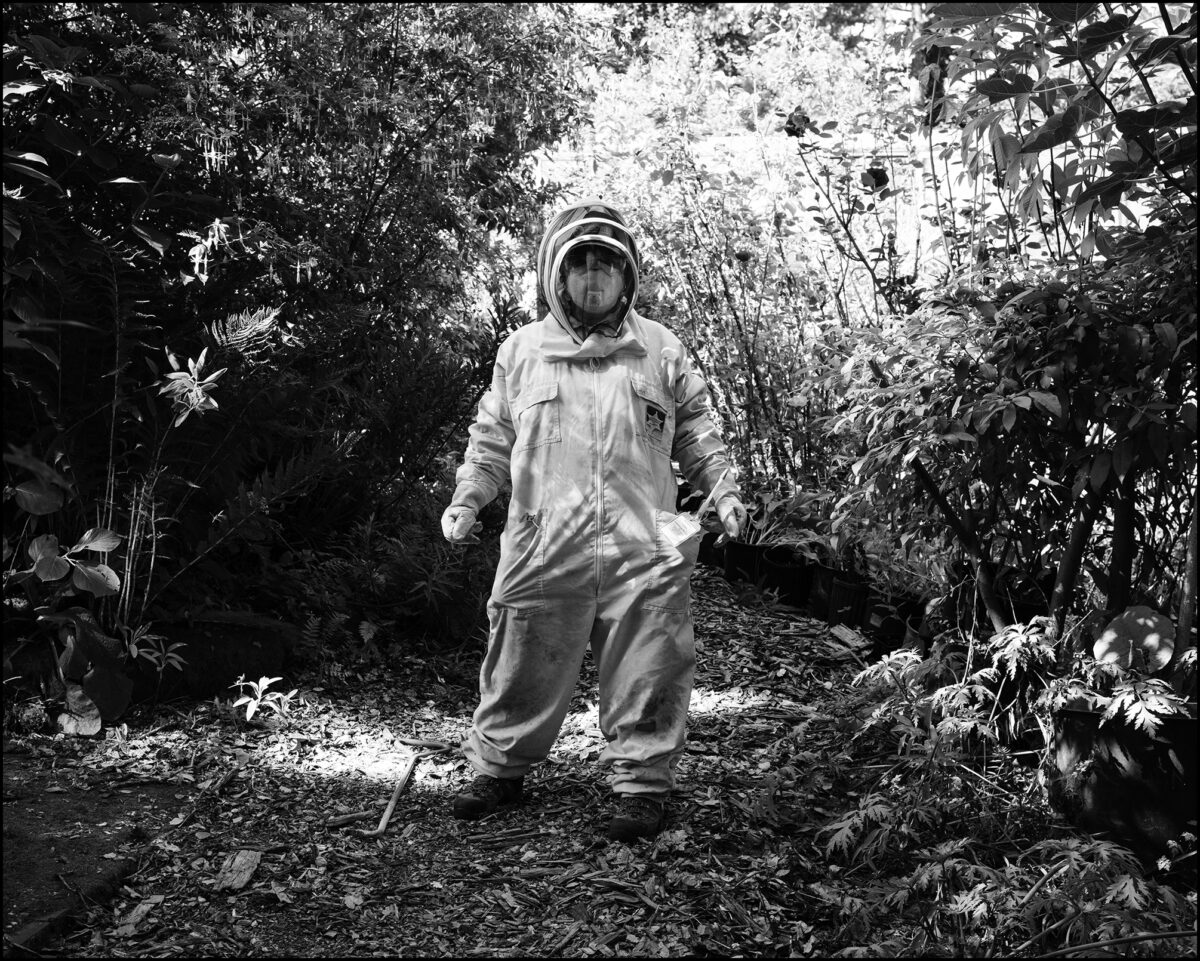
When Teresa Thomas-Nett dresses for work, it appears as if she’s heading to outer space. She dons a white jumpsuit, gloves and boots. She covers her head with a hood and attaches facial netting to the front.
In her puffy attire, she may look peculiar, but she doesn’t look intimidating.
If you’re a wasp or a mosquito, however, be warned: Don’t mess with this woman. She’s a vector control specialist, and she’s out to get you.
Her ensemble is designed to protect her from the yellowjackets she eradicates from gardens, parks, trails and ranches across West Marin.
Ms. Thomas-Nett had a very busy summer.
The district received a record number of calls from residents who stumbled upon underground yellowjacket nests. Some clients reached out after fleeing from a buzzing horde. Others were fortunate enough to spot the unwanted guests from afar, without getting bitten or stung.
Either way, people are happy when Ms. Thomas-Nett arrives. She comes in a truck with a blue mosquito painted on the side, along with the name of her employer: Marin/Sonoma Mosquito and Vector Control.
She arrives bearing stacks of pamphlets stuffed with fun facts and advice, including this key admonition: Don’t try to eliminate underground nests yourself. Call vector control.
Michael McCutcheon ignored that advice this summer, much to his everlasting regret.
Mr. McCutcheon maintains a shaded fuel break on his Seahaven property, which requires keeping grasses trimmed. When his landscapers discovered a couple of underground nests this summer, he was cavalier. While the workers had the good sense to keep their distance, he marched right up to the nests with a can of insecticide and let it rip.
“I sprayed a lot of stuff and made a big foaming mess in the front of each of the holes,” Mr. McCutcheon recalled. “I did not know what I was doing.”
At first, all seemed well. No angry wasps emerged. But two weeks later, he returned to the scene with a weed eater, assuming they were gone.
Oops.
“Suddenly they came after me and chased me all over the yard,” he said. “They got up inside my pants and inside my jacket and stung me on the head and legs and chest. They stung me half a dozen times. I had no idea how painful it was.”
Having learned his lesson, he summoned Ms. Thomas-Nett, who took care of the nest with dispatch, finishing up in just a few minutes.
“Thank you,” Mr. McCutcheon said as she departed for an assignment in Stinson Beach, one of many stops on her crowded schedule that day. “You’re our hero.”
A vector is a math term, but it’s also an epidemiological term denoting any living agent that carries and transmits an infectious pathogen such as a parasite or a microbe to another living organism. Typically, vectors like to suck your blood. And they sometimes carry diseases, such as the West Nile virus or Lyme.
A Missouri native, Ms. Thomas-Nett, who is 46, grew up in the Ozarks before moving with her family to southern California in high school. She has worked for vector control for two and a half decades. She started as a summer employee while still a student at Sonoma State, where she graduated with a liberal arts degree and intended to go into teaching.
But vector control won her heart, and she approaches her job with unflagging good cheer. “Working for the district has really satisfied my passion for science and helping the community,” she said. “The district’s mission is to protect public health. I really, really love what I do. And everybody I work with has that same strong passion.”
On a recent day, Ms. Thomas-Nett was accompanied by Nizza Sequeira, the district’s public information officer and a walking repository of vector control history.
“I’m gonna go way back,” she began. “We were actually the very first mosquito abatement district in the State of California.”
The district was formed in 1915, after the state legislature passed the Mosquito Abatement Act. Now one of 64 California districts, it grew out of the San Rafael Women’s Improvement Club, which originally had two missions: controlling mosquitos and planting trees. One of its annual fundraisers was a Wild West pony show.
“Over 100 years later, here we are,” Ms. Sequeira said.
The district is funded by property taxes, with the average homeowner paying $27 a year. There’s no additional charge when a vector control specialist shows up.
The district fields 6,000 to 8,000 calls a year, and this year a record number were for in-ground yellowjacket nests.
“We believe it’s because of a mild winter,” Ms. Sequeira said. “We did have rain, so there’s more vegetation and more insects. There’s an abundance of food for the yellow jackets.”
Unlike bees, which are pollinators, yellowjackets and other wasps feed off dead insects or animals such as birds and squirrels. Of course, they also enjoy snarfing down sweet drinks and whatever meats you’re eating at a barbecue.
Yellowjackets can both sting and bite. Unlike honeybees, which die after they sting, wasps can bite multiple times. (The district does not treat aerial wasp nests or bee colonies.)
Ms. Thomas-Nett has held a wide array of jobs at vector control. At first, she set mosquito traps for disease surveillance and took care of mosquito fish, or gambusia affinis, guppy-sized creatures that can eat up to 500 mosquito larvae a day. They thrive in water at least 18 inches deep and are an effective tool for eliminating mosquitoes from neglected swimming pools, wine casks, rain barrels and other containers.
Nowadays, as a field technician, she spends half her time eliminating mosquitoes and half dealing with in-ground yellowjackets.
After locating a nest, she gives a squeeze to a tool that looks like the puffer brush used to clean a camera lens. The device blows a white powder called Delta Dust into the nest that eliminates the wasps within a day or two. It’s an E.P.A.-approved insecticide that is low in toxicity to humans, pets and wildlife.
Of course, humans can co-exist with yellowjackets if they keep their distance.
“If they’re way out in the woods and they’re not bothering you, then leave them be,” Ms. Thomas-Nett said. “They do have their purpose in the food web. They are the cleanup crew of the insect world. But they do pose a public health concern, because some people are allergic to their venom and can go into anaphylactic shock. If they are bothering you, call us.”
For more information or to make an appointment, go to https://www.msmosquito.org