
The developer behind what could become West Marin’s largest housing development has doubled down on his plans, asking county officials to approve more than twice as many homes as initially proposed.

In April, Yan Cui, a San Diego businessman, submitted a proposal to subdivide an 82-acre property on the edge of Point Reyes Station into 37 lots, five of them earmarked for affordable housing and 32 for market-rate homes.

But in a revised application filed late last month, Mr. Cui supersized his development, dubbed “Rancho Los Reyes,” citing a state law that allows residential developers to build more units in exchange for greater affordability. 

His project now proposes 69 parcels and 84 homes—62 houses at market rate and 22 affordable units clustered on four parcels. 

“The newest proposal is baffling,” Point Reyes Station resident Kirk Marckwald said. “It allegedly trumpets the need for affordable housing but fails to describe in any way how those 22 units would come about. It is at the very least an incomplete application.” 

At issue is how to calculate a property’s maximum allowable density. Mr. Cui’s project leans heavily on the California Density Bonus law, enacted in 1979 to spur below-market housing by allowing developers to exceed local unit caps if they make a larger percentage of those homes affordable. The law permits up to a 50 percent increase in units when at least 20 percent are set aside as low-income.

A 2023 amendment to the law instructs agencies to determine maximum allowable density using whichever figure is highest among the applicable zoning.

The property’s zoning allows one dwelling per three acres, meaning the site would yield about 27 homes. But Mr. Cui argues that planners must instead apply another zoning standard attached to the property, a Countywide Plan designation, that allows one unit per acre. That would permit about 83 homes before any bonus. His submittal seeks 84, while contending that setting aside 22 for low-income households could entitle him to as many as 125 units.

County planners are circulating the application for agency review and weighing whether the state housing law overrides the Local Coastal Program’s stricter zoning limits. “That’s something we’re continuing to evaluate,” said Michelle Levenson, the county’s principal planner. “The local coastal agricultural zoning sets one density, but the Countywide Plan sets another. For a qualifying state density bonus project, the law says the density is determined by the Countywide Plan’s land use designation.”

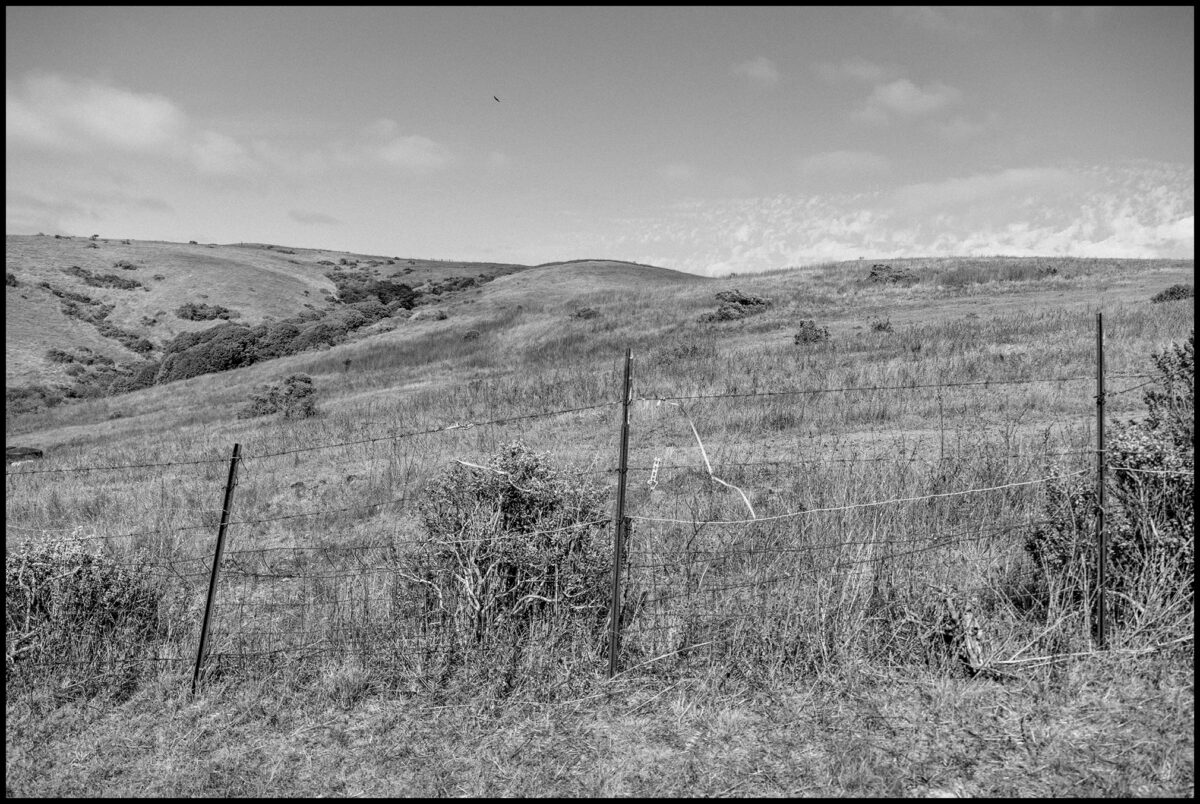
Consisting of four contiguous parcels, Mr. Cui’s land is bounded by Point Reyes-Petaluma Road and Lagunitas Creek to the south, Highway 1 to the west, rural housing to the north and open pasture to the east. While most of the acreage is undeveloped grassland, there is a farmhouse near the southwestern end.

California’s Department of Housing and Community Development has said that unincorporated Marin should add 3,569 new homes by 2031, including 1,734 affordable units. Meeting those goals will require communities to accommodate far more residents than they do today.

To some neighbors, Mr. Cui’s project conjures the epithet “sprawl”—pastureland carved into lollipop cul-de-sacs of near-identical homes. “The first plan was outrageous; this one is incredibly outrageous,” said Ron Elliott, who lives down the road from the site. “In the name of a few affordable units, it feels like the county is willing to do anything.” 

Mr. Cui proposes to build in phases, starting with the 22 affordable units. “He is willing to build the affordable units first, entitle them, get them occupied before he builds even one market-rate house,” said his attorney, Andrew Giacomini, a managing partner at the San Francisco law firm Hanson Bridgett. “I’ve never heard a developer do that. I can’t see how the county doesn’t embrace this.”

Mr. Cui, who emigrated to the United States from China a decade ago, purchased the property from the family of Toby Giacomini, Andrew’s cousin, for about $3.5 million in 2023. He previously retained former county supervisor Steve Kinsey as a consultant, but Mr. Kinsey resigned last month, citing irreconcilable differences over how to interpret county policies.

In Marin, subdivisions must set aside 20 percent of units as affordable, with 10 percent for very low-income, 5 percent for low-income and 5 percent for moderate-income households. Mr. Cui asserts the density-bonus law entitles him to three “concessions or incentives,” which can include relief from local standards that drive up costs, and he plans to use one to bypass that requirement and instead set aside all of the affordable homes for low-income households. His plan also seeks relief from county standards that require larger unit sizes; the affordable homes would all be two-bedroom dwellings.

“People want more houses; they just don’t want to see them,” Mr. Giacomini said. “There’s no doubt we need more housing in Point Reyes. And we’re going to need far more than this proposed development.”