
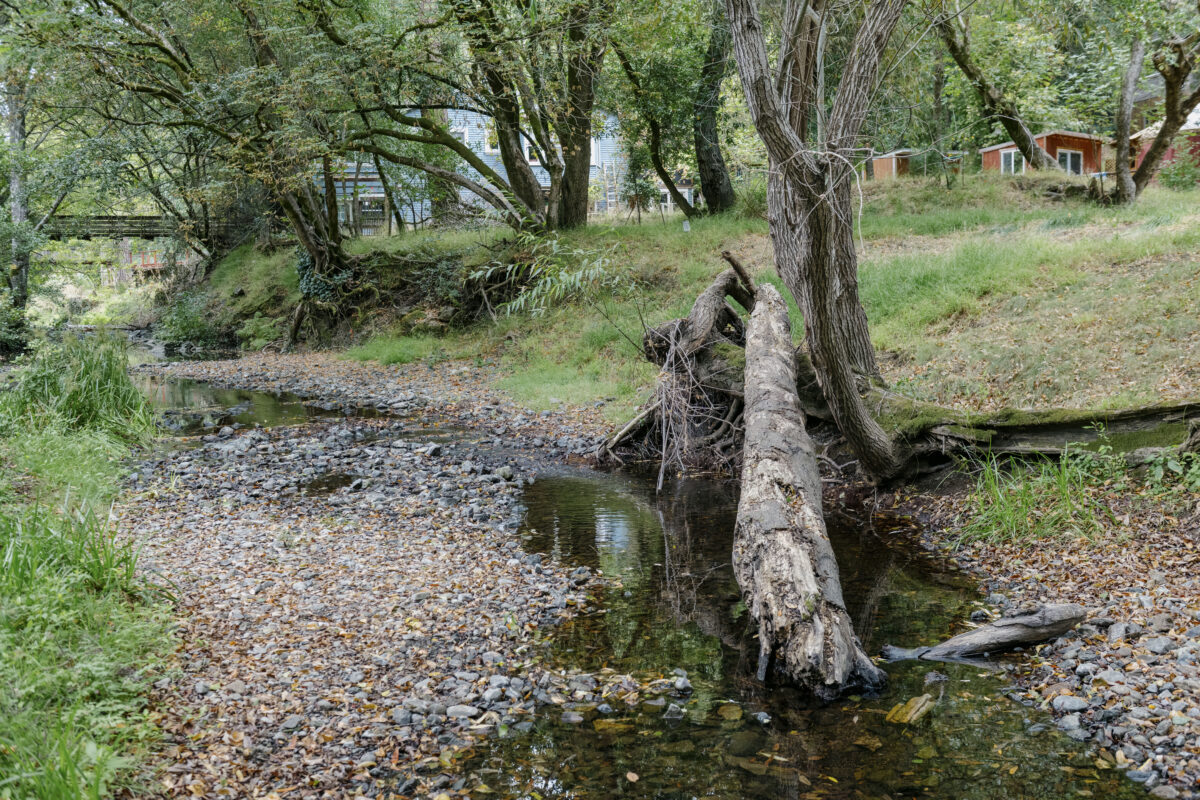
Lagunitas Creek winds through West Marin, its shifting channel constantly reshaping its banks in a natural process of erosion and deposition. For property owners living along the creek and its tributaries, the changes can threaten structures and home values, setting up a clash between development and nature.
Enter the Marin Resource Conservation District’s Urban Streams Coordination Program, a countywide service that helps property owners navigate the challenges of living beside creeks. The program serves residents throughout Marin, but most of its work is carried out in West Marin, where county funding supports one-on-one site visits.
“Land in Marin is so valuable and very expensive,” said Sarah Phillips, who has managed the program since it was launched in 2014. “When a large creek bank falls into the stream, a lot of your property value has literally just washed away and gone downstream.”
The program, renewed this summer with a five-year, $1.5 million county contract, seeks to balance property protection with creek health. It’s one prong of the Marin R.C.D.’s conservation, restoration, and natural resource protection work with private landowners. Despite its name, the program isn’t limited to cities. Instead, it focuses on streams affected by development, such as roads, culverts, and bridges.
Restoration work often involves complex regulations and a permitting process that can overwhelm residents suddenly facing creekbank failure or property loss. Some may be hesitant to contact the county for fear of reprimand or regulatory enforcement. But Ms. Phillips emphasized that the program is there to help navigate compliance as a supportive partner, not an enforcer.
“We don’t report violations—that’s not our job,” she said. “We’re here to help landowners.”
The program offers free technical support and education about creek ecology, including the benefits of leaving wood in streams for endangered coho salmon. Ms. Phillips visits properties to evaluate erosion, explain permit requirements, and connect landowners with engineers, hydrologists, and other specialists when needed. She also reviews project designs with an eye for what regulators prefer. She encourages landowners to call her if a tree falls; she’ll assess whether it should be left, moved, or trimmed.
The work remains in steady demand. Over the past two months, the program educated 88 residents, consulted with 24 property owners, and conducted four site visits.
When erosion threatens homes or structures, the program tries to steer people toward creek-sensitive approaches. Although some erosion is natural and beneficial, fine sediment from bank collapse, often during heavy winter rains when salmon are spawning, can harm fish eggs and habitat.
Where a creek channel has eroded the bank to the bedrock, a bank can become overly high and steep. An ecological solution is to grade the bank back to a gentler slope and replant it with native riparian species. Willow is often chosen for sunny stretches, while ash, dogwood, and lower shrubs thrive in shadier spots.
Riprap is used as a last resort, when there’s no room to lay back the bank. Large, rocky boulders are not environmentally friendly because when water hits the hard surfaces, it speeds up, causing further erosion to opposite banks downstream—sometimes on a neighbor’s property. Riprap also lacks the habitat benefits that plants provide. But when there is no alternative, it can be placed at the lowest point of the bank, with willow stakes and other native vegetation planted above it.
Ms. Phillips has worked in the watershed for more than a decade, building relationships with engineers and hydrologists who can sometimes offer discount rates for projects. One accomplishment she is especially proud of is helping neighboring landowners secure grants for collaborative habitat restoration projects in the San Geronimo Valley through the county’s Landowner Assistance Program.
She was drawn to Marin in part because of her interest in protecting the region’s coho salmon—the largest wild population on the central California coast—and she has a separate contract with Marin Water to monitor fish in Lagunitas Creek. Part of restoring salmon habitat is teaching residents about healthy creek function and stewardship. One challenge has been to change the culture around fallen wood in streams.
“In the past, people thought they were doing the right thing by removing wood from the creeks in an effort to clean the creek up,” she said. “But a messy creek is a happy creek.”
Although some residents worry that fallen wood can worsen flooding—an understandable concern given memories of past flood events—Ms. Phillips said that water usually finds the path of least resistance and moves around, underneath, or over fallen trees. Unlike in East Marin, where streams are cleared for flood control, West Marin follows a different protocol.
“In West Marin, for the most part, the history of removing trees has had a direct impact on reducing habitat for endangered salmonid species and changing the stream morphology to a more simplified, less habitat-rich, less complex stream,” she said. “Most of the time, when a tree falls into the creek, it’s fine where it is.”
Wood creates what she calls “prime real estate” for coho. It slows the current and gives salmon refuge to catch their breath rather than constantly fighting high flows. Creek wood provides shelter from predators and creates shade to cool water temperatures, resulting in higher levels of dissolved oxygen for fish. And as wood breaks down, aquatic insects feeding on it become an important food source for fish.
Millions of dollars have been spent on engineered projects to restore wood to Lagunitas Creek. So when a tree falls in naturally, “without needing grants, permits, engineers, hydrologists or biologists, it’s a natural process to super-duper honor and appreciate,” Ms. Phillips said.
In 2007, the Marin R.C.D. signed a memorandum of understanding with the county, the municipal water district, California State Parks, the National Park Service, and the Marin County Open Space District that established a consistent approach to managing woody debris in the Lagunitas Creek watershed.
Building on that approach, the streams program began as a two-year pilot. Each time its funding neared expiration, landowners and agencies submitted letters urging it to continue. Gordon Bennett, an Inverness resident and co-president of the group Save Our Seashore, was among the supporters. He said the program is an important bridge between creekside landowners and the many agencies involved in watershed restoration.
Mr. Bennett is a longtime member of the Lagunitas Creek Technical Advisory Committee, which Ms. Phillips chairs. The group meets quarterly to share fish data and exchange information. Among the participants are Trout Unlimited, the Salmon Protection and Watershed Network, the Environmental Action Committee of West Marin, and the San Geronimo Valley Stewards.
Mr. Bennett said one of the stream program’s strengths is helping homeowners understand why wood belongs in creeks. Contrary to what some might assume, fallen wood does not prevent coho salmon from moving upstream. The long, slender fish are powerful enough to slip through narrow gaps and leap over obstacles.
Before European settlers cleared away debris for navigation by boats and barges, creeks looked very different. “All these creeks used to have so much wood in them,” he said. “You couldn’t even tell there was a creek there until you actually stepped into it. It was covered with woody vegetation, mostly alive, some dead.”
Leaving wood in the creek is so important, given the substantial funds spent adding wood back to creeks, that Mr. Bennett calls a fallen tree “manna from heaven.” “Find a way to leave it in there,” he said.
Fallen trees with intact root balls are especially valuable because they anchor themselves without costly engineering using chains, cables, or metal spikes.
Steve Tognini, another T.A.C. member and co-president of the San Geronimo Valley Stewards, has seen restoration crews anchor trees to large boulders, only to have some float away during high flows. He pointed to a technique called “tipping a tree” that involves dropping the tree while keeping the root ball attached and growing, so the tree remains alive and fixed to the creek bed. Santa Cruz has used the method for 20 years, though “people in Marin, they’d go catatonic if they heard you were doing something like that,” Mr. Tognini said.
Ms. Phillips said the Marin R.C.D. is looking into adapting Santa Cruz County’s homeowner guide about the benefits of stream wood to create a similar educational resource for Marin.
Mr. Tognini walks Lagunitas Creek regularly—at times, all the way from Dickson Ranch to the Inkwells. He checks on just about every stream restoration project that takes place in the watershed, especially in heavy winter storms when high flows test project sites the most. He believes that successful restoration means learning from each project over time.
“They’re trying things, and they’re hoping they work out, and sometimes they do, and sometimes they don’t,” he said.