
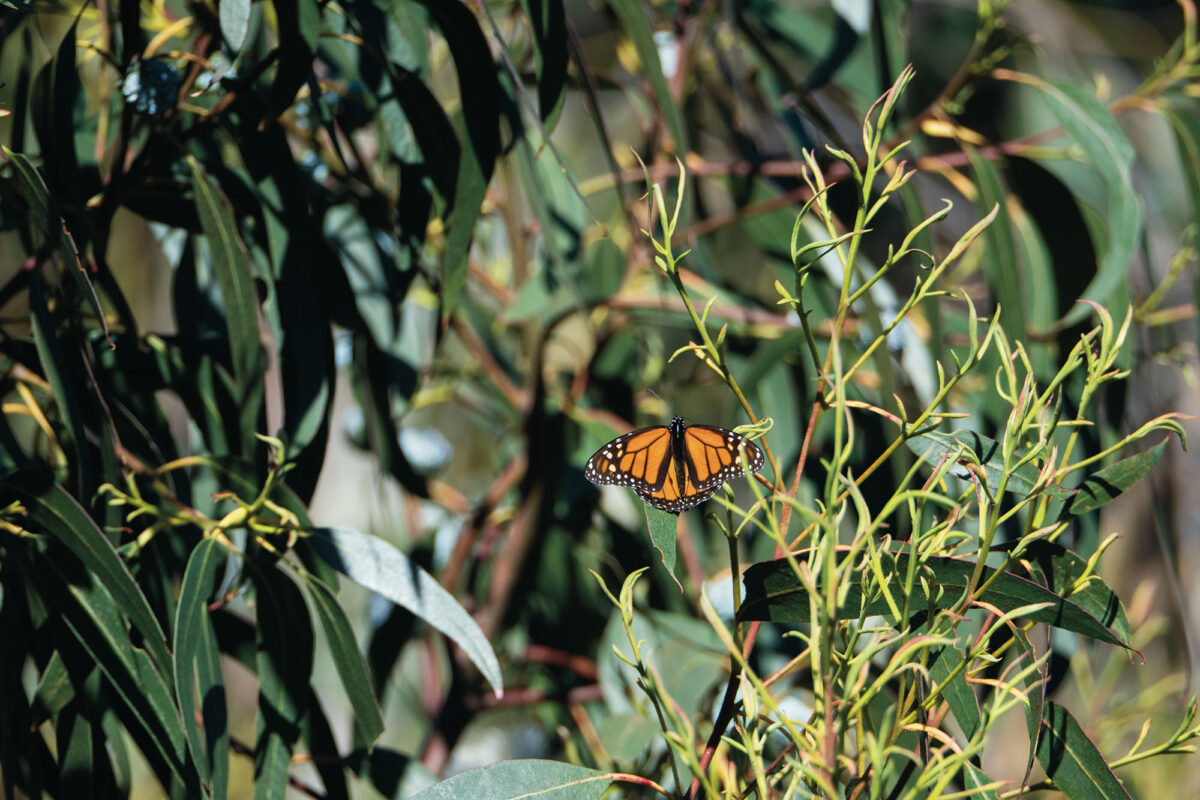
Every autumn, monarch butterflies from west of the Rocky Mountains journey to California to wait out the winter.

Each black-and-orange insect weighs less than a raisin, yet together they traverse thousands of miles over mountains and valleys, across cities and suburbs, toward a shrinking network of coastal groves that provide the right microclimate for their survival. 

Western monarchs’ epic migration spans up to 1,000 miles each way. Monarchs are rare among insects in that they undertake a two-way migration, akin to that of birds. But unlike birds, an individual butterfly never makes it round-trip; instead, a succession of four to five generations must interlink to complete the cycle. 

After roosting in stands of eucalyptus, Monterey pine and cypress over the winter, warmer temperatures trigger sexual maturity. The butterflies mate, then disperse, spreading far and wide in search of milkweed upon which to lay eggs, which will morph into caterpillars and become the next generation. 

How the butterflies manage to locate the same isolated colonies that their great-great grandparents occupied the year before is a longstanding mystery.

In recent decades, the range of suitable overwintering habitat has contracted sharply. A handful of sites in Bolinas now mark the northern edge of the monarch’s winter range. 

The butterflies still arrive, but in far smaller numbers, and there is less certainty about where they will settle and how long they will stay.

Each year, the Xerces Society for Invertebrate Conservation conducts a statewide census of western monarchs. From November to January, volunteers fan out across California’s coastal areas to find and count the population. On Thursday, the society released its mid-season counts, conducted around Thanksgiving at 249 sites statewide. A late-season count, taken in January, will be released next month.

This year’s mid-season estimate put the western monarch population at about 12,260 butterflies, up from roughly 9,100 at the same point last year. Despite the increase, 2025 still ranks as the third-lowest count since monitoring began in 1997. When Xerces started tracking the population, researchers counted more than 1.2 million monarchs. Since then, the population has declined by about 99 percent.

In Bolinas, volunteers counted about 800 monarchs this winter, compared to 274 last year. As recently as 2015, volunteers recorded more than 22,000 monarchs in town. 

“When fall kicked off and monarchs started arriving at the overwintering sites, a lot of us were pretty concerned,” said Isis Howard, a biologist with Xerces. “We could immediately tell we were going to find fewer monarchs during that early season count compared to last year. But then there was a late influx of monarchs arriving at the overwintering sites.”

Between the early-season count, which occurred in October, and the mid-season count, the population increased by about 89 percent, compared with a roughly 9 percent increase over the same period last year. 

Scientists can’t say with certainty why monarch numbers fluctuate so dramatically within a single season and from year to year. But experts cite a host of stressors leading to their decline, all related to human influence: habitat loss both in the overwintering sites and along the migratory pathways; the proliferation of herbicides and insecticides; increased temper-atures due to climate change. 

The question now, in Bolinas and beyond, is if the butterflies are resilient enough to rebound from such a precipitous decline. 

Monarchs were expected to be listed as a federally protected species under the Endangered Species Act by the end of last year, following a years-long review by the U.S. Fish and Wildlife Service. Scientists with the agency estimated that monarchs west of the Rockies face a 95 percent probability of extinction over the next 54 years. A listing decision has since been delayed indefinitely under the Trump administration.

Monarchs are not the only butterflies in trouble. Art Shapiro, a professor emeritus of evolution and ecology at the University of California, Davis, has tracked butterfly populations at 10 sites in north-central California for more than half a century. His monitoring project is considered the longest-running butterfly study in North America. “The entire butterfly fauna is in decline, but the monarch is one of the more conspicuous ones,” he said. “I would say the signs are ominous.” 

On a warm afternoon in early January, Mia Monroe, a field organizer with Xerces, visited one of Bolinas’s remaining overwintering groves. A petite woman and an avowed lepidopterist, Ms. Monroe wore monarch-patterned socks, a beaded butterfly pin on her hat, and binoculars slung around her neck. She stood beneath a mid-sized Monterey pine, where a small cluster of monarchs clung to the branches, their wings, like fragments of stained glass, slowly opened and closed in the sun.

At the center of the grove, a circle of tall blue gum eucalyptus acts as a windbreak, creating a sheltered alcove on its south-facing side. 

“This is a marginal site,” Ms. Monroe said. “It’s historically where they come, but it has deteriorated. Trees have been cut, trees have fallen. Other sites are so degraded that they’re just gone.”

Most of the butterflies counted earlier in the season had departed, likely blown out by the powerful Christmas storm that battered the coast. Only about 20 remained.

Bolinas once supported roughly 30 overwintering locations, Ms. Monroe said, many hosting clusters numbering in the tens of thousands. Today, only three sites consistently attract monarchs.

“In my own lifetime, I have seen species on the brink of extinction become abundant again,” she said. “So that’s what I hope for. I get just as excited seeing one or 20 butterflies now as I used to about 40,000, because that is the path forward.” 

As they search for overwintering spots, monarchs require what biologists describe as a wind-sheltered, sunlit nook. “We need to maintain, create and manage for those conditions,” said Stuart Weiss, an entomologist who has devoted much of his career to monarch conservation. “Sometimes that means planting new trees. Sometimes it means cutting gaps in the forest to let in light.”

Habitat management is a thorny issue because monarchs often roost in eucalyptus, nonnative trees planted around the time of the Gold Rush and now feared for the fire dangers they pose and for their tendency to topple in storms. The trees, and their benefit to local monarchs, have been hotly debated in Bolinas, where a falling eucalyptus caused major injuries to one resident in a 2023 storm.  

“These eucalyptus trees have outgrown their usefulness for butterflies,” said David Ainley, an ecologist and a member of the Bolinas Eucalyptus Project, a group formed after the 2020 Woodward fire to advocate for tree removal amid fears that the groves could fuel future blazes. “Butterflies roost from about 10 to 40 feet off the ground. These big eucs are all the same vintage. They shed their lower branches while competing with one another for sunlight.” 

It’s somewhat incidental that monarchs ended up favoring eucalyptus; what the butterflies are responding to, Dr. Weiss said, is not the tree itself but the “Goldilocks zone” of temperature, light and wind protection the trees can help create.

“The monarchs made their choice,” he said. “If we want monarch butterflies—and I think everybody does—we have to work with that reality and honor it. That means managing select groves that have supported monarchs in the past or still support them now. We have to manage for fire. We have to manage for tree hazards, which is a big issue in Bolinas.”

A grove near Kale Road has been the focus of an intensive restoration effort over the past year. Ole Schell, founder of the West Marin Monarch Sanctuary, has worked with Ms. Monroe, Dr. Weiss and others to plant more than 200 native nectar plants and groundcovers, along with Monterey cypress to close wind gaps left by felled trees.

Dr. Weiss conducts detailed structural assessments of groves using hemispheric and Li-DAR photography to determine where to plant trees and where to thin vegetation, creating what he calls “designer habitat.”

“I’m still amazed by the fact that the western monarch has made it as far as it has,” he said. “It’s a tribute to its resilience. But we’ve got to give them every chance. Conserving and managing monarch habitat in Bolinas is part of the puzzle.” 

Mr. Schell, who grew up in Bolinas in the 1980s, remembers when the trees were festooned with butterfly clusters. When sunlight hit a branch, they would lift off at once, filling the air with the sound of wings and an undulating ribbon of orange and black. That spectacle has grown rare.

“It’s tragic,” he said. “We’re counting butterflies that were once uncountable.”