

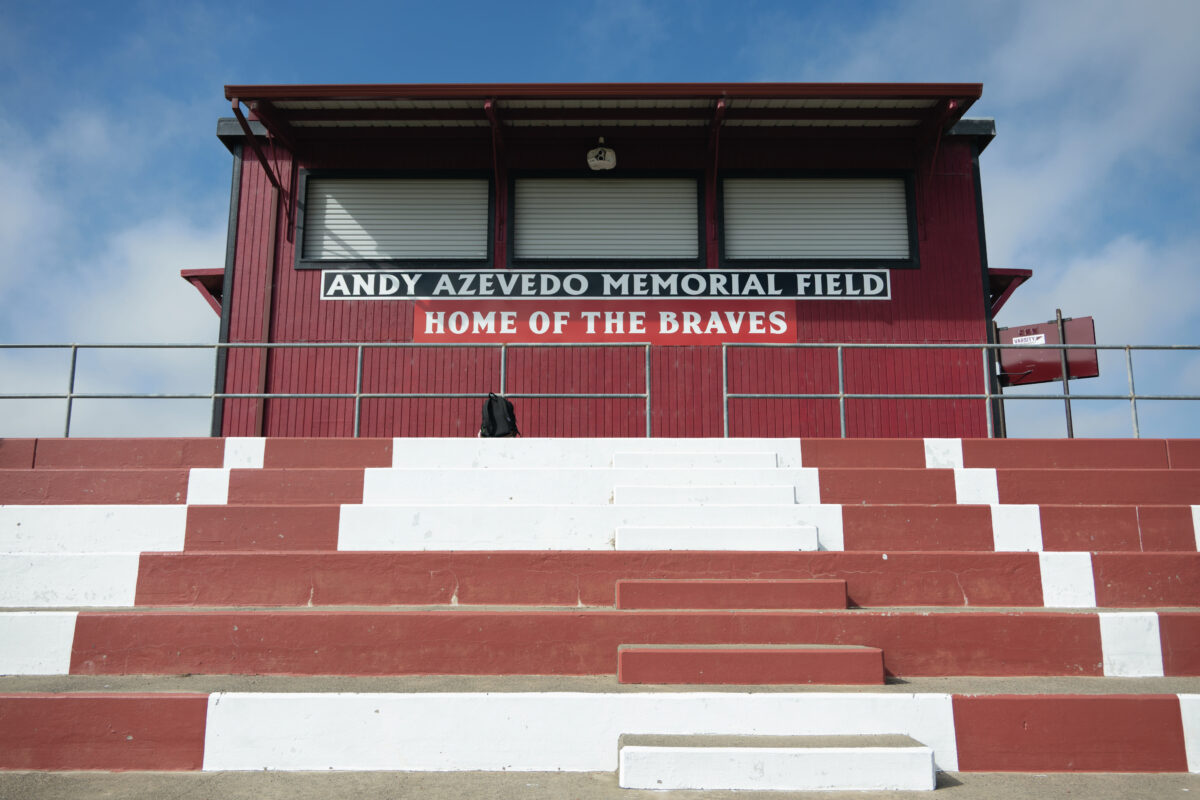
Twenty-five years ago, West Marin engaged in an impassioned debate about whether to change the name of Tomales High School’s sports teams—the Braves—and abandon its mascot, a Native American in a feathered headband.
After 18 months of debate and discussion, the Shoreline Unified School District board settled on a compromise: The name would stay, but the mascot would go. Now, a quarter of a century later, the name is finally poised to change.
A 2024 update to a California law that forbid high schools from naming their teams “the Redskins” added a longer list of forbidden monikers, including the Apaches, Big Reds, Chiefs, Chieftains, Chippewa, Comanches, Indians, Savages, Squaw, Tribe, and Braves.
The amendment was co-authored by Assemblymember James Ramos, the first California Native American elected to the state legislature.
Shoreline has already missed the July 1 deadline for implementing the change and is scrambling to do so by year’s end.
Last week, it announced it would hold a public meeting this fall before choosing a new name in December.
“Tomales is a school with tremendous pride, tradition, and spirit, and we want the process of choosing a new mascot to reflect those qualities and the values of our community,” the district wrote to parents. “Students, staff, families, alumni, and members of the broader Shoreline community will all have the opportunity to contribute ideas and provide input.”
At last week’s board meeting, Shoreline superintendent Matt Dunkle laid out several criteria for selecting a new mascot, including the need to reflect the school’s identity and values, be inclusive and respectful, connect to the region’s history and character, create a strong visual impact, and build school spirit.
The Racial Mascots Act, passed in 2015, allows the district to request an exemption from the Federated Indians of Graton Rancheria, but it has not done so. Several Central Valley schools have received exemptions for their teams—including the Sanger High Apaches, the Modoc High Braves, and the Ripon High Indians—from other federally recognized tribes.
Heidi Koenig, Shoreline’s board chair, said the district does not plan to ask for an exemption, but she encouraged community members who wished to keep the name to approach the tribe themselves. If the rancheria seemed amenable, they could return to the board and ask for its support.
Jolynn McClelland, a member of the Tomales Booster Club, asked why the board itself wouldn’t make such a request. “I just sort of assume they would want to hear from our school board, not from some random group of people in the community,” she said. “It would have much more power coming board to board.”
In contrast to last week’s sparsely attended meeting, which drew about a dozen attendees and a dozen more online, nearly 350 people packed the 2001 school board meeting when trustees weighed whether to dispense with the Braves mascot. Students skipped class to protest. But after voting to get rid of both the name and the mascot, a week later the board changed its mind, citing community pressure.
Then, as now, one side saw the name as racist and demeaning, while the other felt it was nothing more than a symbol of school pride. Similar debates have unfolded across a nation riven by culture wars, and many teams, like the Washington Redskins—now the Commanders—and the Cleveland Indians—now the Guardians—have dispensed with their old monikers.
During the debate in Tomales 25 years ago, Native Americans from as far away as Los Angeles lobbied in favor of the name change. But the opposition among Indigenous people was not monolithic. Some local Coast Miwok, the people native to Marin, said the name inspired pride.
Those arguments began to replay themselves on social media this month.
“We are in a world where everyone is offended by everything,” one alumni wrote on Facebook. “So sad. I was proud of being a Tomales High School Brave.”
“The liberals and their Woke policies that came from the city have absolutely ruined West Marin,” another person wrote.
But Julie Cassel, a Tomales High alum and a longtime Shoreline teacher, said it was time to embrace change. “Tomales High School has some exciting new programs and is a good contemporary high school,” she wrote. “Let’s let it continue to evolve and change to meet the 21st century and not hold it back by holding onto a divisive mascot.”
Ms. Cassel shared similar thoughts at last week’s meeting, and she cautioned trustees against making a decision that doesn’t enjoy broad community support. “I just want to be assured that it’s not going to be a small number of people that direct this thing,” she said.
This is not first time Tomales High will have adoptd a new mascot. For a few years in the 1940s, the teams were called the Wolves. The school said some attendees at sporting events, inspired by the rakish-looking mascot, directed “wolf whistles” and other rude behavior toward women.