
Standing on the beach nearly 30 years ago, Marialidia Marcotulli watched surfers emerge from the water with what she could only describe as a glow. They had gained something out there beyond the break that remained, for her, a mystery—until she became one of them.
She began at a surfing school for women, then spent months in the brisk and unforgiving Pacific. Eventually, she made her way to the swells of Bolinas Bay.
“After a year and a half, one day it all came together,” she said. “I got to feel the sensation of being put into a state of grace, of being put on a wave. And it wasn’t about me; it was about the beauty of the ocean. After that, I fell in love with surfing, and it took over my life for the next 20 years.”
Today, Ms. Marcotulli describes the sea as a teacher of patience. Surfing asks a person to bring all that they are to the water and, in the creative act that is surfing, the ocean becomes a great revealer.
In Bolinas, she found a place among like-minded people. She began working under Eric “Buzz” Besozzi, whose surf shop is believed to be the first one north of the Golden Gate Bridge. Mr. Besozzi welcomed her to a generation of surfers whose stories were mostly unrecorded.
In 2016, Ms. Marcotulli co-curated an exhibition, titled “SEAPEOPLE: The Bolinas Surf Shop, est. 1963.” With stories splayed across the Bolinas Museum’s main gallery, it was an ode to the town’s first surf shop and the community that flowed from it.
Ms. Marcotulli said that people can compartmentalize surfers and their sport, flattening a culture that has long encompassed craftspeople, stewards, rebels, and more. Mr. Besozzi and his comrades filled their time with innovation, designing surfboards and skateboards, and making prints. The unwritten surf etiquette they forged in Bolinas can often distinguish a local from a visitor. Although Mr. Besozzi has retired from crafting boards, his surf shop still operates on Wharf Road, marked by a red Dutch door.
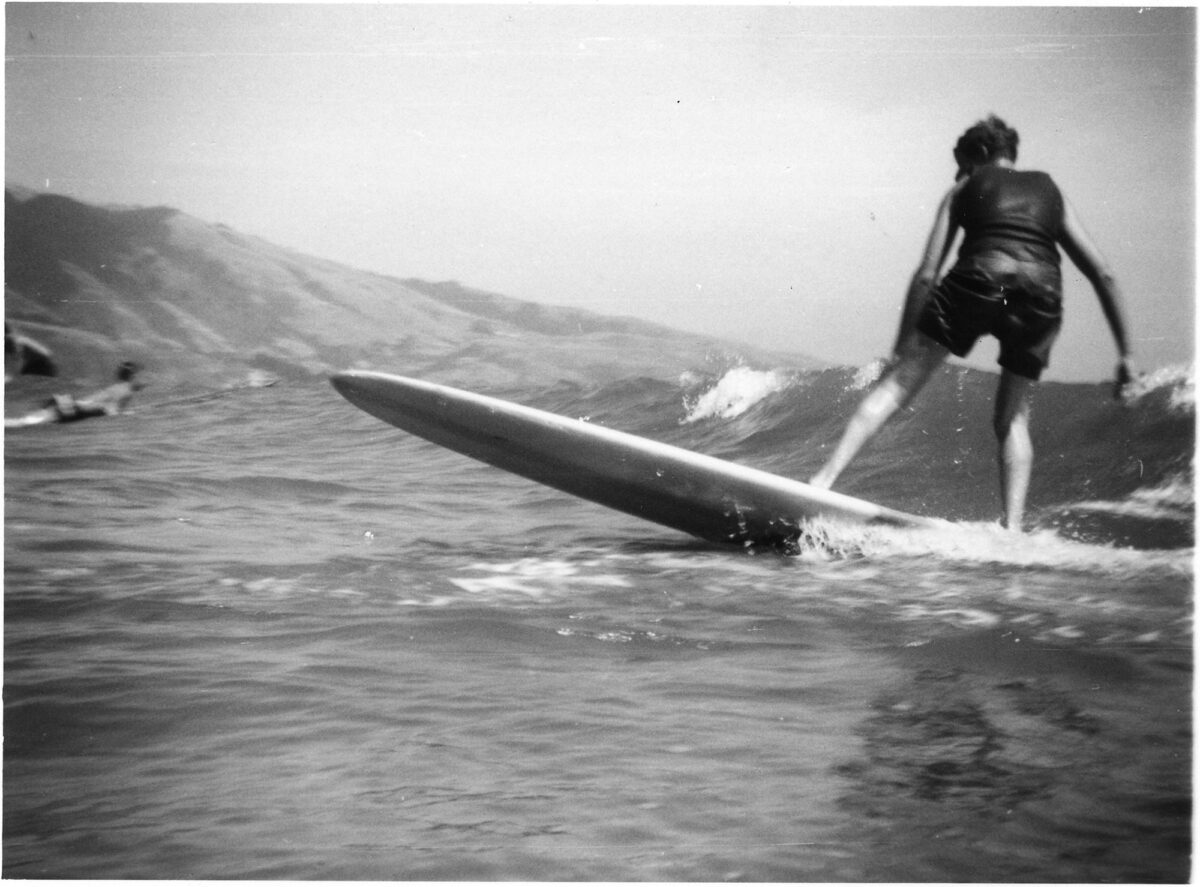
A decade after Ms. Marcotulli’s first archival exhibition, she has co-curated a new one. A retrospective at the Bolinas Museum, “Catching Waves: Surfing in Bolinas Since 1909,” opened for International Surfing Day on June 20, co-curated by the museum’s curator of history and collections, Elia Haworth.
A film screening that accompanied it last weekend was organized by the Bolinas Film Festival and Surfrider Foundation Marin County.
In their exhibition, Ms. Haworth and Ms. Marcotulli write about the ways in which surfing culture has been sustained by acts of reciprocity. That reciprocity is visible in a Hawaiian tradition adopted in Bolinas to honor those who have died, both through enshrinement and paddle-outs. In a paddle-out, surfers and even people who have never surfed enter the water to pay respects to the departed. Experts help novices get past the breaking waves, and they eventually form a giant circle.
The community’s relationship with the sea is also expressed in what it builds for those who will come next. In creating the Bolinas Mesa Skatepark, Mark Butler, a local woodworker, and a multitude of volunteers spent nine years building a place where generations of young people could skate, gather, and find their own path.
The surf film festival became another way to carry knowledge forward and to share stories. Last Saturday night, the exterior of the Borg Barn hosted a seaside bazaar. Attendees and neighbors trickled in to grab tamales and poke, eventually gathering under the roof of the dimly lit barn to watch the program.
Most of the films were produced locally; one was even made by Iggy Samuels, a 12-year-old. The schedule featured Jack Johnson’s most recent documentary, “SURFILMUSIC,” a film that resonated in a community where the lines between surfer, storyteller, and artist are regularly blurred.
In his documentary, Johnson reflects on surfing as the throughline of his creative life. His earliest memories are on the North Shore of O’ahu, but his path shifted after he collided with a reef, leaving him temporarily landbound. His injury spurred a creative redirection, and he picked up a guitar.
In introspective footage, Johnson discusses the friendships he formed through surfing. The final moments are a compilation of clips from his adventures with a childhood friend, Tamayo Perry, who passed away in 2024.
A local short by Beth O’Rourke and Jeff den Broeder, “Underground Legends: ‘Odd Todd,’” featured a character that the sold-out crowd knew well. In the six-minute film, people offer recollections of Odd Todd, a thrifty, humble, and renegade soul. Most local surfers have seen him at one time or another ripping a wave on a patched-together board. Poignantly, the opening interview is with his brother, the late Pete Smith, who was honored in a Bolinas paddle-out less than two years ago. He was a community factotum: firefighter, surfer, carpenter, who worked alongside Mr. Besozzi.
Before his passing, Mr. Smith sold some of his shaping tools to Malcolm Bunting, who co-directed a documentary with Solomon Fragakis that also ran at the festival. Mr. Bunting and Mr. Fragakis, Marin natives in their early 20s, belong to a younger generation with a deep passion for their craft. The idea for their documentary, “Don de Dios,” came to them on a trip in El Zonte, El Salvador. At sunset, they spotted a surfer in the waves who was deftly manuevering a tiny bodyboard. Two weeks later, they flew back to document his story.
The surfing culture of El Zonte differs greatly from that of Bolinas: The waters are warm, and the rural town carries generational remnants of the Salvadoran Civil War. The surfer, called Zancudo, who is in his 40s, grew up amid that conflict. When he first started surfing, the war made it difficult to access a surfboard, so he learned the art on a bodyboard. The filmmakers say that despite their differences, they felt bound by a shared understanding.
“There was a part in the interview where Zancudo was talking about seeing water droplets and everything happening in slow motion,” Mr. Fragakis said. “I think that goes to show the presence you can have while surfing—when you can see all these things happening in slow motion around you. It’s the best feeling ever, and I feel it too. Any surfer can feel it.”
“Catching Waves: Surfing in Bolinas Since 1909” shows in the Bolinas Museum’s history room through Sept. 26. The museum is open Fridays from 1 to 5 p.m. and Saturdays and Sundays from 12 to 5 p.m.