

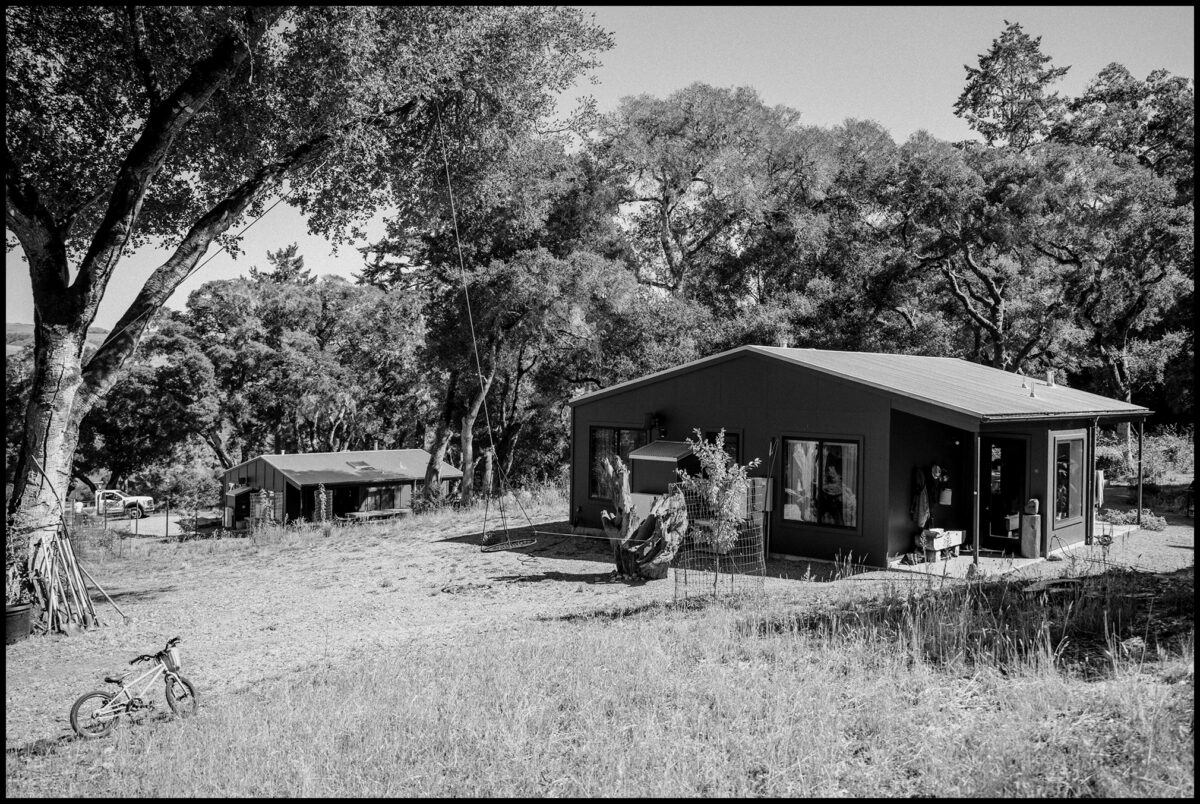
At the bottom of a driveway leading to two identical houses standing at opposite ends of a three-acre tract, four friends faced a consequential coin flip.
Which couple would live in which home, still filled with the smell of paint and finally ready for move-in?
A mutual friend pulled a coin from her pocket. She flung it into the air. When it settled into her palm, Kristina and Ido walked up the hill; Jay and Taylor walked down.
“A coin flip was the only way we could do it,” said Kristina Holey, a 42-year-old product designer who moved into her Inverness Park home in August 2025. “Every time we tried to pick houses by having an adult, mature conversation, we both wanted the same house.”
For three years, Ms. Holey and her husband, Ido Yoshimoto, had searched for a home in West Marin, only to be beaten out by wealthier, all-cash buyers. Their friends Jay and Taylor Palmer were renting in Inverness and stuck in the same limbo.
Eventually, the two couples decided to place a joint offer on a house in Mendocino. It didn’t work out—a tech millionaire paid in cash, over the asking price—but it sparked an idea: Could they purchase land together?
Co-ownership became a real possibility after a chance encounter. On a walk, Mr. Palmer’s neighbor mentioned that he wanted to sell his property on Fox Drive off market, to someone in the community.
He called Kristina and Ido right away, and the four soon pooled their savings for an all-cash offer, $100,000 under asking.
When their offer was accepted, the couples drafted an agreement to co-own the land in a tenancy-in-common agreement—or T.I.C. for short. A T.I.C. is a form of co-ownership allowing two or more parties to pool their resources and purchase property. They inhabit their portion in line with a flexible contract, which can carve out distinct lots or stipulate that everyone owns the whole parcel, commune-style.
The couples divided the Fox Drive lot in two. They cut costs by drawing one set of plans, used for both houses and built to meet county rules.
“We could have pushed a little bit, gotten a little more creative,” Ms. Holey said. “But everyone told us the same thing: so hard, so expensive. So we were like, ‘Okay, path of least resistance.’”
They skipped a general contractor and ran the build themselves. “Me and Taylor are both alpha entrepreneur types,” Ms. Holey explained. “So we said, ‘Alright, owner-builder, no contractor, we’ll power through.’”
This collaborative approach helped them through a permitting process that intimidates many would-be builders. Marin County requires a battery of studies and sign-offs. Ms. Holey and her partners hired a county environmental scientist to survey the land, brought in engineers, and moved through the county’s multi-step review one requirement at a time.
“It’s a headache because it’s rigorous,” Ms. Holey said. “But if you zoom out, we just went step by step.”
The four split the work by temperament and expertise. Ms. Holey handled the county paperwork, while Mr. Palmer, a firefighter, dealt with the fire department. They cleared the county in under a year, faster than they’d expected.
“Everyone said the same consistent thing: It’s really hard to work with the County of Marin. So I was expecting the worst,” she said. Instead, she found the county straightforward.
The real ordeal was PG&E, which left them in the utility’s connection queue for about two and a half years.
The Light interviewed three West Marin residents who co-own their properties—Ms. Holey, Martha Howard, and Daniel Cordrey. Each emphasized that affording a house would have been out of reach without T.I.C.
Out here, exorbitant home prices are partially due to a constrained supply. “A lot of the easy lots have been built on in West Marin,” said Scott Alber, Marin County’s fire marshal. “Most of the remaining lots could be called marginal in terms of fire department access.”
The fire department’s main requirement is simple: A truck must be able to reach the house. Driveways generally must be at least 16 feet wide to facilitate this, and wider still if they serve more than two homes. Most of West Marin lacks hydrants, so rural lots on well water must store a minimum of 5,000 gallons for firefighting.
Those standards, Mr. Alber said, are what rule out many of the steep or hard-to-reach parcels that remain.
But beyond fire access, 11 percent of residential properties in West Marin are short-term vacation rentals, while more than half the properties are second homes, according to the county’s Community Development Agency.
These factors limit what’s available for first-time buyers, driving prices up and squeezing full-time locals out of property ownership. Mr. Cordrey, a contractor who lives in a T.I.C. in Inverness Park, said the lack of affordable homes has changed the fabric of the community.
“The price point to buy or build has escalated so much that fewer young families can stay,” he said. “It’s mostly older wealthy folks or tech money. Unless we create community-backed mechanisms for affordability, the fabric changes.”
There aren’t older wealthy folks living at Ms. Holey’s property. There’s definitely no tech money. “Jay’s a firefighter, Taylor’s a landscape designer, my husband Ido’s an artist, and I work in the skincare industry,” she said. “We’re all kind of, like, entrepreneurs, self-employed… We work hard but don’t have a ton of money.”
Their property, tucked at the end of a long gravel drive, reflects this ethos. Two simple, modern houses sit roughly 200 feet apart on a sloping lot dotted with coast live oaks. Inside his home, Mr. Yoshimoto built everything from the cabinetry, counters, and bookshelves to the bathhouse and sauna. He and his wife designed their sofa, and a friend constructed it.
Despite their successes, tenancies-in-common can also bring difficulties. Ms. Howard, an attorney in Inverness, knows them well. In 1989, the cottage she rented, and the two neighboring ones, were listed for sale by their owner. She wrote up a T.I.C. agreement with the neighboring residents, and they co-purchased the property.
For years, their agreement ran smoothly. But in 2015, one of them wanted to sell her cottage, and the other two parties couldn’t afford to buy her out. “The value of the property had appreciated so enormously that a buyout was very expensive,” Ms. Howard said.
Then they struggled to find someone who would purchase the share. “No third party is going to buy into a co-ownership arrangement where they may or may not even know the people, when they can take that same amount of money and probably buy a house just on their own,” Ms. Howard said.
Ms. Howard’s T.I.C. persists—her son ended up buying the cottage—but her difficulties underscore the fragility of these arrangements.
“You are in a binding joint arrangement with other people for your primary home. It works—I’m a living example that it works—but it’s not like owning your own standalone property,” Ms. Howard said.
For Mr. Cordrey, “the true core of a T.I.C. is the interpersonal relationship between the partners. If that isn’t solid, you’ll hit snags.”
What has carried his own arrangement is a shared purpose from the outset. “[My partner] and I both knew we weren’t buying as an investment—we were buying a permanent home, with no intention to sell. That shared mindset built a lot of initial trust.”
Institutions like the Community Land Trust Association of West Marin may also help make T.I.C.s more viable. It has done so before. When Mr. Cordrey and his partners moved to buy their Laurel Street property in 2006, CLAM used its local standing to get the parcel into escrow—holding it off the market while the group arranged financing.
“CLAM was a key player in helping us secure it before someone else bought it,” said Mr. Cordrey, who sits on the nonprofit’s board.
Jarrod Russell, CLAM’s executive director, sees tenancies-in-common as “one tool in the toolkit.” He also imagines a deeper role CLAM could play: owning the ground beneath a T.I.C. with a deed restriction, so the homes stay affordable even after the original owners are gone.
“That’s where the land trust model could actually overlay with even a T.I.C.,” Mr. Russell said. “We can help with deed restrictions, so that the community knows it will be affordable in perpetuity.”
For now, he said, CLAM is “pretty maxed” responding to the displacement of some 40 ranch families. But “these are exactly the types of pilots that we could learn from,” he said.