
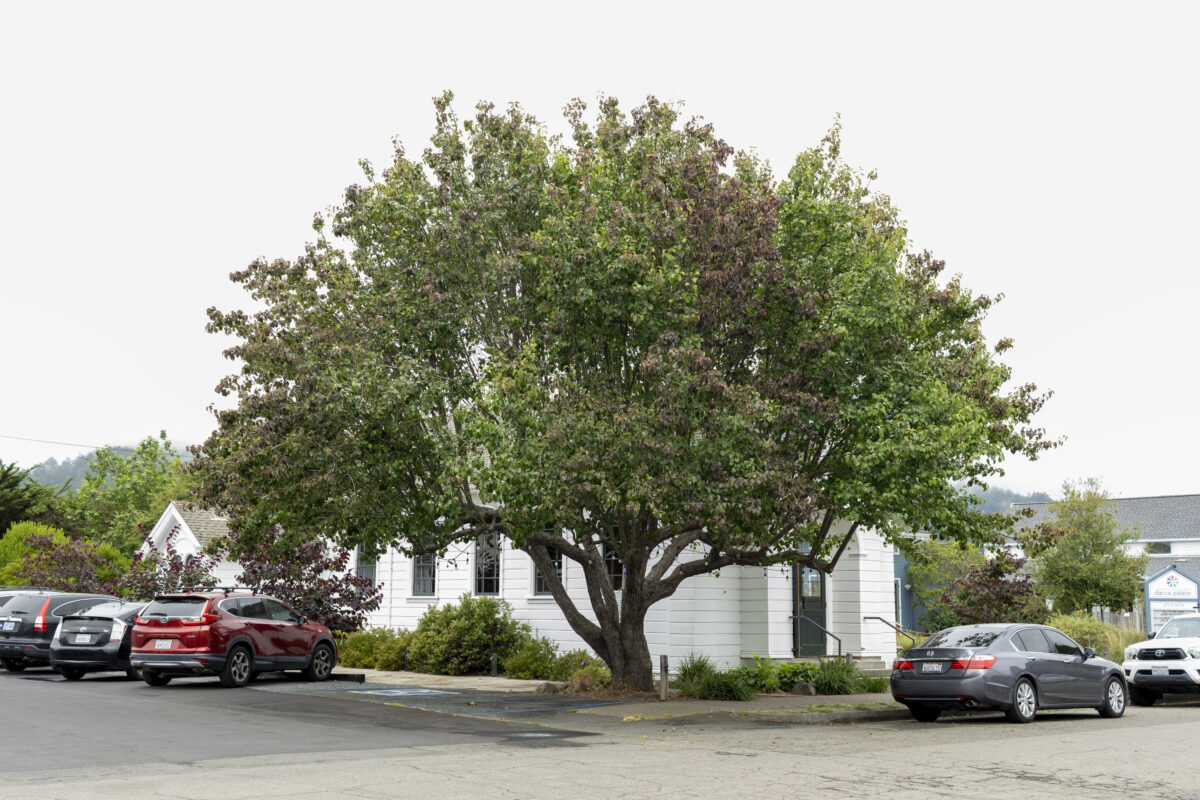
On the corner of Fifth and B Streets, in front of the Dance Palace Church Space, stands an ornamental pear with a sprawling canopy. It’s a tree that legions of local children have climbed. But this summer, the community center’s director, Claire Burns, noticed that its leaves had begun to blacken and curl.
She had heard about fire blight just days earlier, in her own Inverness Park neighborhood. “I went from never hearing about it to hearing multiple stories, all within a few days,” she said.
A bacterial disease named for its most striking symptom—infected shoots and leaves that appear charred—fire blight attacks plants in the rose family, chiefly apples and pears. Some say it’s unusually widespread this year. Though the infection isn’t uncommon in West Marin, it has killed backyard trees and devastated a commercial orchard in Chileno Valley.
The Erwinia amylovora bacterium overwinters in cankers on tree branches until warm, wet spring weather wakes it. Then it enters through the blossoms, killing branches from the tip down. Left untreated, the infection reaches the trunk and usually kills the tree. The only remedy is to cut ahead of it—pruning a foot and a half or more below the visible damage, and disinfecting tools between cuts.
At the Dance Palace, the infection was caught early. Ms. Burns brought in a local arborist, who removed one badly affected branch and is working back from the damage. “Visually, the tree doesn’t look like it’s so far gone that it can’t be saved,” she said.
Still, it landed hard. “I feel responsible for caring for this whole property in a way that I take seriously,” she said.
Rich Clarke, who chairs the Dance Palace’s art committee, has fought the disease in his own Point Reyes Station backyard for years. This year, he watched all seven of his pears come down with fire blight, and he counted it in at least a half-dozen other trees around his neighborhood. “It’s all over the place here,” he said.
Doug Haner, another Point Reyes Station resident, has trimmed at least a third of his green Bartlett to stave off infection.
Perhaps nowhere has the blight hit harder than at Chileno Valley Ranch, where Sally Gale tends some 400 apple trees and two dozen pears for a public U-pick season. Though she has fought it for years, this year was the worst. “It is devastating,” she said.
The pears have borne the brunt. She’s cut some of them back to a tenth of their size and pulled others out entirely. But the disease keeps reappearing.
Apples have fared better, according to growers, and the picture isn’t uniform. Ida Severson, a landscaper who tends four apple orchards in West Marin, hasn’t seen a surge. Jerry Hudgins, who grows apples in Point Reyes Station, said the strange weather brought fungal problems, but no fire blight.
Vince Trotter, the sustainable agriculture coordinator at the U.C. Cooperative Extension Marin and himself a Sonoma County grower, said many commercial growers are reporting the infection.
“I don’t think what you’re hearing from backyard fruit growers and home gardeners—I don’t think they’re alone,” he said. “I’m seeing it and hearing it in commercial spaces.”
Temperatures around Point Reyes were slightly warmer than average in the first part of 2026, before turning cooler than average during the summer. The developing El Niño and an unprecedented marine heatwave in the Pacific were the driving factors.
Mr. Trotter said the patterns over the last 10 years—often leading to damp, warm weather—have increasingly lent themselves to fire blight infection. “The springs have been warmer, and the rains have continued later,” he said.
The same warming pattern works against apple and pear trees in a second way. Those trees need winter “chill hours” to go dormant and bloom with vigor. As cold snaps give way to warm spells, that gets “harder and harder,” Mr. Trotter said. He said growers may need to start planting varieties bred for warmer places.
For now, the ornamental pear at the Dance Palace, which has never borne fruit, is being nursed branch by branch through a bad year. “I’m feeling hopeful about it,” Ms. Burns said.