
A defamation lawsuit filed against the Bolinas Hearsay News and several of its contributors was dismissed this week by a Marin County Superior Court judge, who ruled that a poem published in the paper amounted to protected speech.
Last Friday, Judge Stephen Freccero granted the defendants’ motion to strike Cheryl Ruggiero’s claims under California’s anti-SLAPP law. The law, which stands for Strategic Lawsuits Against Public Participation, applies to meritless suits aimed at suppressing free speech.
Ms. Ruggiero’s claims against the Hearsay centered on a 12-word poem written by Jessie McCollum and printed this winter in Bolinas’s twice-weekly, iconoclastic bulletin whose motto is “Everyone is a reporter.”
At a hearing last week, Judge Freccero read the poem aloud from the bench.
“Here we got a haiku,” he said. “Five syllables, seven syllables, five syllables, in which the poet writes: ‘For the record/ José was 100 percent right/ it’s him you owe apology.’”
The poem was not, strictly speaking, a haiku.
The ruling came as a relief for the Hearsay’s tiny volunteer crew, but it does not end its legal troubles.
Another defamation suit, filed last year by Ms. Ruggiero, a lawyer who has lived in town for over two decades, remains active. That suit centers on two screeds written by former Bolinas resident José Leyva and published in 2024. Judge Freccero declined to dismiss that case under the anti-SLAPP law, and the Hearsay’s legal team has appealed his ruling.
Ms. Ruggiero argued that Mr. McCollum’s poem effectively republished allegedly defamatory statements made by Mr. Leyva. In two excoriating letters published in August 2024, Mr. Leyva criticized Ms. Ruggiero’s stance on Israel and Gaza and her opposition to an emergency R.V. park that sheltered dozens of Latino residents displaced from substandard housing.
The pieces accused her of supporting genocide and called her a “faithful representative” of “racism and white supremacism in Bolinas.”
Ms. Ruggiero has said those characterizations were false. The paper issued three retractions in the weeks after the letters appeared, but she said none satisfied California’s retraction statute.
Ms. Ruggiero threatened legal action soon after the pieces appeared but did not file her first defamation suit until August 2025, just before the statute of limitations expired.
The second lawsuit, filed in February, focused on Mr. McCollum’s poem, which appeared in the Hearsay’s Dec. 1 issue. Ms. Ruggiero’s attorney, Paul Levine, argued the poem amounted to a republication of previous defamatory statements.
Judge Freccero pressed Mr. Levine on how a poem that did not explicitly repeat any of Mr. Leyva’s words could nonetheless amount to republication. Mr. Levine responded that Hearsay readers, a small but loyal readership in a town of about 1,500, would have understood the poem as referring to the earlier missives.
“In the context of where it was published, how it was published, and when it was published, that is enough to establish in the mind of an average reader of the Bolinas Hearsay News—a very small publication with a limited readership, who reads every single issue—that they knew exactly what the haiku was talking about,” Mr. Levine said.
Mr. Levine pointed to a section of tort law stating that a person who repeats or republishes defamatory material can be as liable as if he had originally published it. But Judge Freccero drew a distinction between repeating a defamatory statement and merely agreeing, in general terms, with someone who had made one.
“The statement itself is not republishing any defamatory statement,” he said.
In his written ruling, Judge Freccero said Ms. Ruggiero’s legal team had not pointed to any case showing that a person could be held liable for defamation merely for endorsing someone else’s allegedly defamatory statements.
Sam Abrams, an attorney with Arnold & Porter Kaye Scholer, a prominent international law firm representing the Hearsay pro bono, said the defense was also unable to find such a case. Earlier this year, Arnold & Porter joined Bolinas lawyer Jack Siedman in the paper’s defense after learning of the case in the pages of the Light.
Judge Freccero emphasized that he was not deciding whether Mr. Leyva’s original pieces were defamatory. Rather, the question was whether Mr. McCollum’s poem could itself be actionable. It could not, he found.
Ms. Ruggiero has appealed the ruling.
For the Hearsay, the ruling marked a significant victory in a legal fight that has tested the limits of Bolinas’s freewheeling newspaper. Founded in 1974, the Hearsay has long chronicled the town’s civic life with a countercultural sensibility and a loose editorial hand. It has a circulation of a few hundred and no full-time staff, only a rotating group of unpaid volunteers who cut, glue, print, and collate submissions into irregular, densely populated pages assembled on a risograph machine.
The product belongs less to the staid realm of newspapers than to the feral world of the internet: a place for announcements and classifieds, meeting notices and reports, poems and musings, birthdays and deaths, manifestos and neighborhood disputes, often printed with little editorial interference. Most of the time, it is a mundane reflection of everyday life.
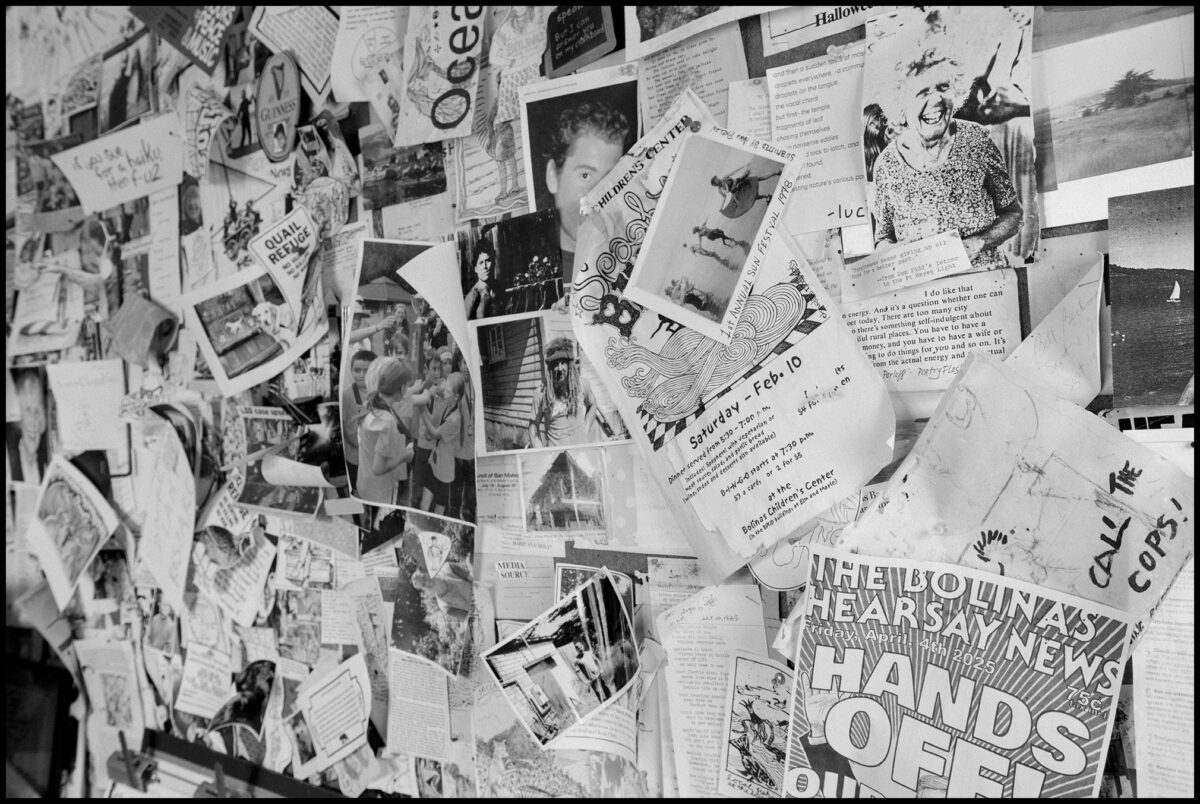
Last Friday morning, at the Hearsay’s shoebox-sized office inside the Bolinas Community Public Utility District building, the editor for the day had yet to arrive. Boxed archives lined one wall. A hulking risograph machine sat beside a bookcase. A wall-length bulletin board was layered with the flotsam of many decades, a stratified archive of town life.
Buried under a few layers, just poking through, was a song written in 1980 by StuArt Chapman, a town troubadour and onetime Hearsay News editor, that seemed prescient:
“When trouble brews/ it’s the Hearsay News/ that helps suffuse all the clues/ to the puzzle that is Bolinas./ So if a letter (or column) is rude/ in the Hearsay News,/ don’t file suit, send a refute/ Box three twenty-seven, 94924.”