

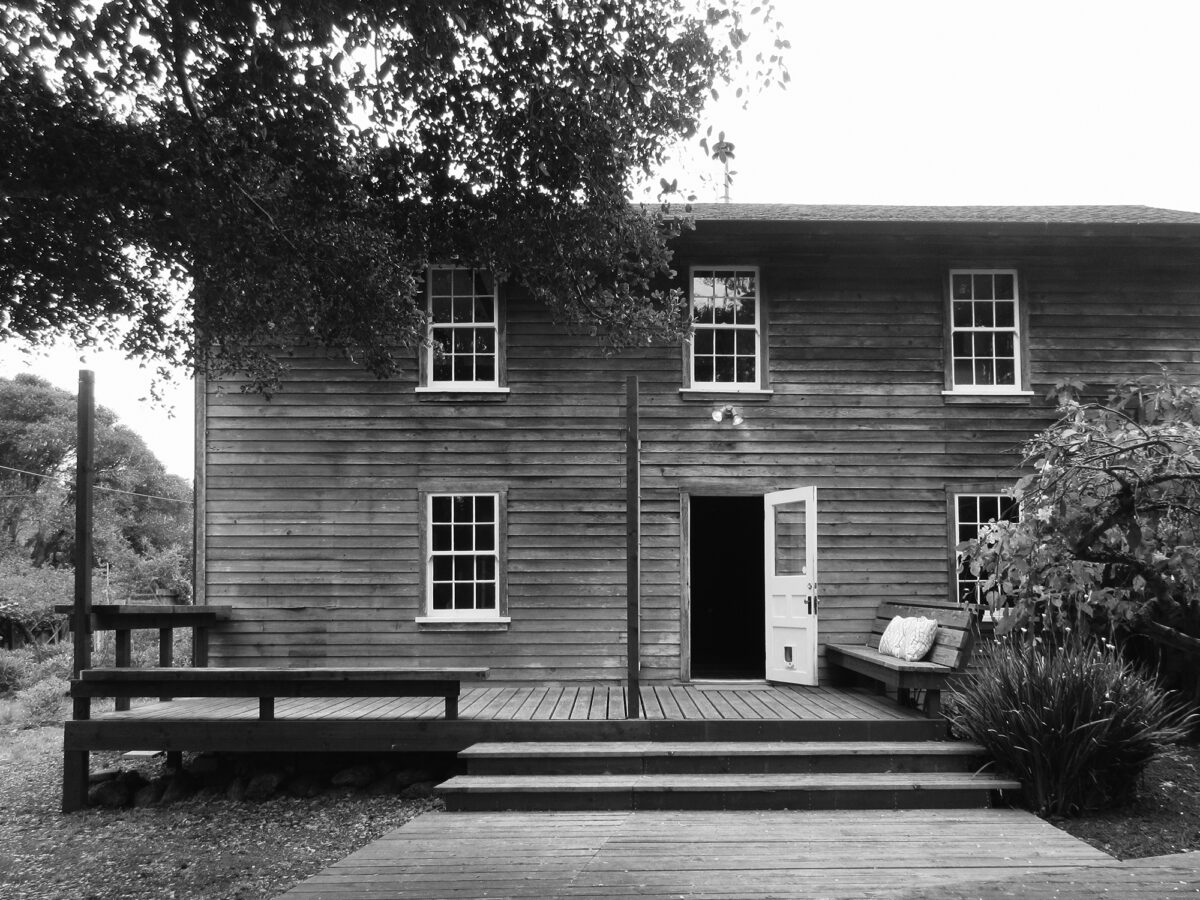
What is likely the oldest house in coastal Marin is for sale, and with it comes nearly two centuries’ worth of stories. The property, which sits at the entrance to Bolinas, has lived many lives, from an Indigenous Coast Miwok village to a Gold Rush sawmill and the home of the late Judith “Hawk” Weston.
Although B.G. Bates, the real estate agent listing the land, is no stranger to selling properties with historical charm, she was at a loss for how to abbreviate this one’s history.
“They say write 1,000 characters about it, but people don’t have the attention span,” she said. “But I found myself doing it for this one. Bullet points were just not telling the story.”
Much of the history of what’s known as the Briones House has been unearthed and preserved through the archival research of Elia Haworth, the curator of history and collections at the Bolinas Museum. Her work traces the 175-year-old house’s past through various forms of ownership and cultural change.
Before Bolinas even had its name, the Coast Miwok established a village in the lush valley surrounding Pine Gulch Creek. Its proximity to the coast allowed the village to thrive on fish and mollusks, while the dense forests offered fruitful foraging grounds and game.
In 1834, the Garcia family acquired Rancho Tomales y Baulinas, stretching from Olema Valley to Stinson Beach, through a land grant. They were among the first non-Indigenous settlers in Bolinas. But after three years, the family moved, leaving Rancho Las Baulinas to Rafael Garcia’s sister, Ramona, and her husband, Gregorio Briones. At the time, the rancho had chickens and ducks running through the grassy fields, water wells, and likely a Catholic chapel.
Northern California was on the cusp of the Gold Rush, and as migrants and settlers began flooding in, they turned to largely untapped lands to fill the growing demand for lumber and agricultural goods. So, in 1849, during a lumber surge, loggers arrived on the rancho, intending to strike a deal with the Briones family.
In the end, the family allowed the logging of a swath of redwood forest. The loggers acquired the easternmost section of the Bolinas Lagoon and used it as a port, shipping out lumber from burgeoning sawmills in modern Dogtown. In return, the loggers built a house on the Briones property.
As trade routes expanded, further connecting West Marin to the rest of California, the Briones family stood at the center of a region in transition. Alongside these broader shifts, a singular love story unfolded on the land.
“I just love the Briones and Lauff love story,” Ms. Bates said. “There was love lost, and love found again.”
In the early 1840s, the daughter of Gregorio and Ramona Briones, Maria, fell in love with Charles Lauff, an early pioneer of present-day San Francisco. They were set to be married, but their engagement was broken off when Charles left for the Mexican-American War. Although the two stayed acquainted, Maria married another man. But after her husband’s passing, she and Charles reunited.
“The love story of Maria and Charles came full circle in 1862 when they married and settled in Bolinas,” Ms. Haworth wrote in a historical account. “They raised eleven children and helped the town develop. Charles lived to be 95 and loved telling tales about the early days in Marin, his many friendships and his wife Maria.”
After Charles died, the house sat abandoned, despite the growth of neighborhoods, churches, and a school in the area around it. The house now sits on Lauff Ranch Road—named after Charles and his family.
Inside the two-story house, the original broad-paneled redwood walls still stand, and the staircase remains firmly planted in the center. Metal beams run across the first-floor ceiling to reinforce a once-sagging roof, and the wood tones of the floor shift subtly from room to room, having been replaced over time.
The two most recent owners of the house, the Millers and the Westons, were artists. Ms. Haworth wrote that the Millers’ son, George Scott Miller, worked in the museum’s permanent collection. Ms. Weston was a musician and artist who served on the Bolinas Community Center’s board of directors.
Over time, owners reshaped the home to fit their lives—building an additional cottage and treehouse, modifying the kitchen and leaving behind traces of their own sensibilities. Yet each owner managed to do so while preserving the spirit of the house.
The same winding Pine Gulch Creek still flows through the land, which Ms. Bates said is strewn with arrowheads and chunks of obsidian. The house possesses equal elements of history and change.
In many ways, Ms. Bates said, the property embodies a tension at the heart of historical preservation: a desire to suspend places at some moment in their past, and an appreciation of the inevitable changes wrought by inhabitants over time.
Now, as the Briones House enters the market once again, it stands on the precipice of a new chapter. Soon, new owners will walk its creaking floors, taking in a breath of sweet wood and wondering how they will make the house their own.