
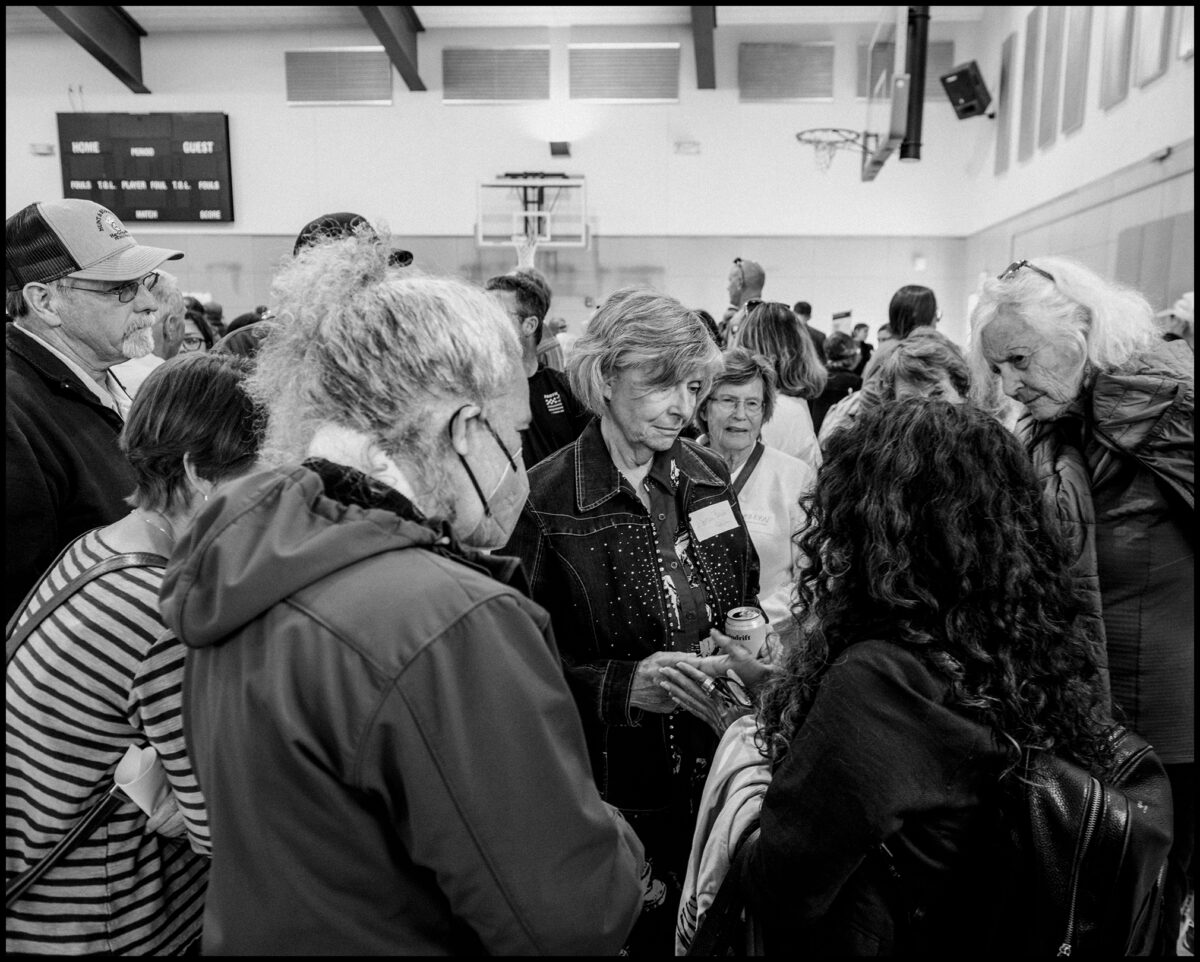
In the West Marin School gymnasium last Thursday evening, Karen Budd-Falen, a high-ranking official in the Trump administration, planted herself in one corner of the room, fielding an unyielding stream of questions from whoever managed to find her in the crowd.

Ms. Budd-Falen, the associate deputy secretary of the United States Department of the Interior, the agency’s third highest-ranking position, had come to Point Reyes for what federal officials billed as a community open house about the future of nearly 17,000 acres of former ranchland in the Point Reyes National Seashore. More than 600 people, from both sides of the yearslong conflict over agriculture on the peninsula, filed into the school that day to glean new information and weigh in on what should happen next.

It was the first time since the January 2025 settlement that ended dairy farming and most ranching in the seashore that federal officials and the Nature Conservancy, which brokered the deal and signed a long-term cooperative agreement to manage the former ranchlands, had faced the broader community. And for many in attendance, the evening underscored a central unresolved fact: Although the deal settled the fate of most of the seashore’s historic ranching families, it produced no articulated blueprint for the land they left behind. 

“The court decision and the settlement are not changeable,” Ms. Budd-Falen said. “The ranchers’ decision to take a buyout—that’s done. All of that happened before I showed up in Washington, and we couldn’t even change that if we wanted to. My goal is to solicit people’s opinions on how things ought to be managed into the future within those confines.”

She said that the gathering was just the beginning of a larger planning process. A self-described “cowboy lawyer” from Wyoming, Ms. Budd-Falen wore a jean jacket and a horse-patterned dress and was flanked by Interior Department solicitor Lance Wenger, a bespeckled man who occasionally jotted notes into a manila folder tucked under his arm.

“I grew up in a very rural community in the middle of nowhere and I saw how national decisions affected local people the most, no matter what side of the fence you are on,” Ms. Budd-Falen said. “I think we need to spend more time listening to local communities. I’ve got to consider the federal statutes, and I can’t ignore Congress, and I can’t ignore the courts, but we take public input very seriously.” 

If some had come expecting a final faceoff between friends and foes of ranching, the event did not deliver. There was no dais and no microphone, and no one presented to the crowd. Instead, attendees drifted among stations devoted to topics such as grassland ecology, trails and the future of ranch buildings. 

Representatives from the National Park Service, Interior, the Nature Conservancy, the Federated Indians of Graton Rancheria and the Point Reyes National Seashore Association were present. The Niman and Evans families, who continue to lease lands but are suing the park and Interior over the rezoning of the peninsula, handed out materials about their case. In Defense of Animals, an animal rights group, shared stats on water quality and trumpeted the tule elk. Comment cards were available throughout the gym, with a collection box set in the center. 

Jodi Stevens, who works at Hog Island Oyster Company, said in an interview immediately after speaking with Ms. Budd-Falen that she had hoped for something closer to a collective conversation that would bridge both sides of the schism. 

“I was disappointed that the opportunity for community dialogue wasn’t provided,” she said. “It feels strange that we’re being told to write something, fold it up and put it in a box. How do we work through an issue as a community? We talk about it, we find things in common, we work through the things we disagree on.” 

Part theater, part dirge, part circus, the meeting unfolded amid the deafening acoustics of the cavernous gym. Some attendees called the scene chaotic or said it felt like wading into a morass. Others said they were unsure where to direct their questions or doubted how much influence their comments would ultimately have.

“There has been no introductory speech by anyone,” said Bruce Mitchell, who lives in Inverness. “You’re just kind of left to fend for yourself. How much of what people are saying is going to filter up to the people who make the actual decisions?”   

Donna Faure, director of the Point Reyes National Seashore Association, oversaw a table on future projects, including a trails initiative that has already been in planning for two years behind the scenes. She said she was struck not only by the turnout but also by who wasn’t there. 

“I think it’s interesting when you look at the negative space—what isn’t in the picture—to see who isn’t present,” she said. “In general, as far as I could see, the Latino community wasn’t as much there.” 

Only one attendee requested the services of Spanish-language interpreters hired by the Nature Conservancy, despite the settlement’s disproportionate impact on Latino farmworkers and tenants. 

In the days leading up to the open house, both sides of the ranching debate held preparatory meetings, circulated talking points and urged their factions to turn out either in support or against the continued use of the peninsula for agriculture. 

Inside the gym, the full spectrum of opinion was on display, along with many areas of overlap borne out by conversation. Some attendees wanted to see the return of dairies. Some wanted grazing but no dairies. Some derided the Nature Conservancy’s use of conservation grazing and wished cattle were gone for good. Some asked about public access, when the fences would come down, and whether new parts of the park might be opened to hikers and bikers. Some raised concern about wildfire risk and pressed for more prescribed burning. Others worried about the fate of the old ranch structures and asked whether volunteers might be allowed to help restore them.

Mickey Allison, of Sausalito, said she did not believe cattle belonged in the seashore but objected to such a sweeping change in land use resulting from a closed mediation rather than a transparent public process.

At one point, ranchers David Evans and Bill Niman were deep in conversation with Gordon Bennett, president of Save Our Seashore, and Neal Desai, regional director of the National Parks Conservation Association. Mr. Evans later said they had found at least some common ground.

“We firmly believe that elk and cattle should coexist,” he said. “They benefit each other, and they aren’t these mutually exclusive creatures that should never comingle. There’s been this huge divide in the past over elk versus cows. I think there’s a sensible way to have cattle here and benefit the wildlife of Point Reyes.”

One man who traveled more than three hours for the meeting said he had implored officials to make greater use of prescribed fire to maintain the grasslands. “There was a natural system that functioned long before there was cattle grazing,” said Craig Thomas, director of the Fire Restoration Group, a nonprofit that advocates for returning fire to its pre-settlement ecological role. “We need to reestablish the ecological process of this landscape with prescribed fire.”

Chance Cutrano, director of programs at the Resource Renewal Institute, one of the plaintiffs in the lawsuit that triggered the settlement, said the open-house format had at least one virtue: it allowed neighbors, ranchers and environmentalists to speak to one another without the rigidity of a microphone line. 

But, he said, the event left basic questions unanswered, including what exactly would become of the written comments collected in the room. “I think the public deserves to know ahead of time that there’s going to be a public-comment process, who’s taking the comments and what they’re being used for,” he said.