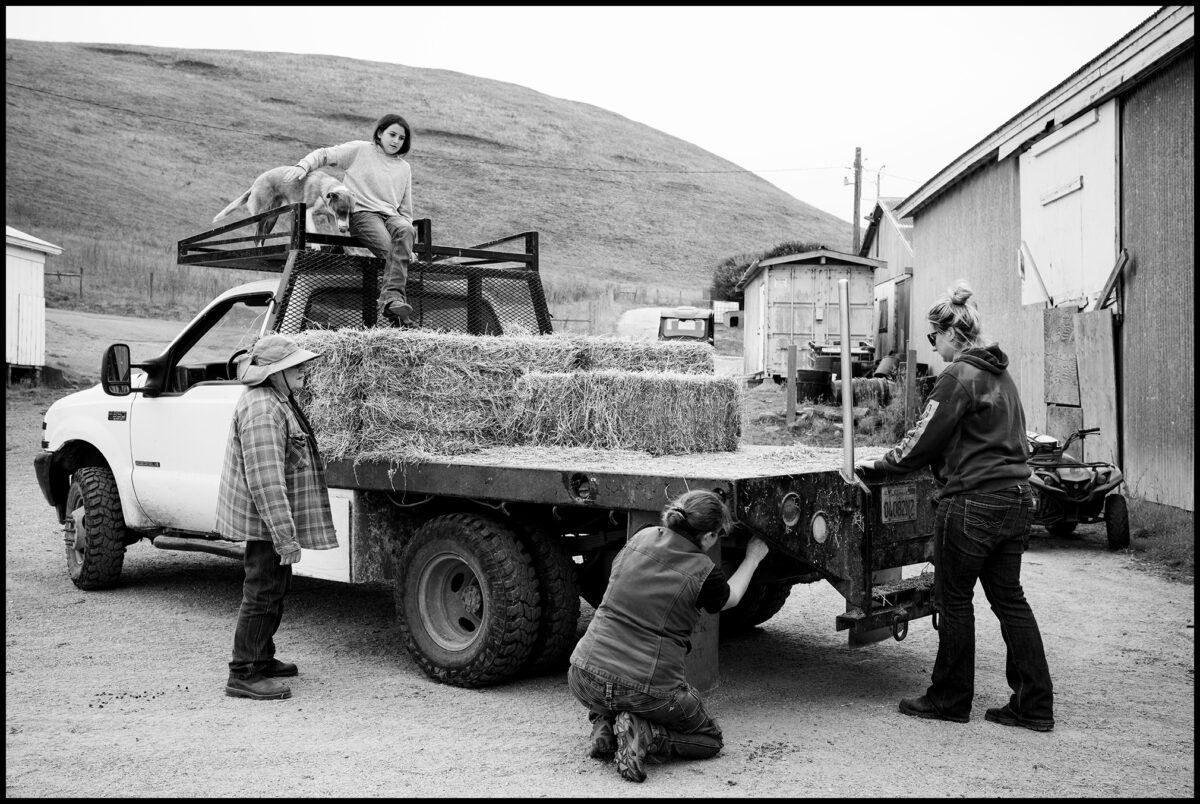
At the end of a long dirt road through dun-colored hills, past a gateway adorned with a steer skull, lies the Grossi Ranch, where, on a recent afternoon, four generations of women set about their daily chores. Arriving there in the waning days of second summer, it would be easy to mistake the scene as timeless, to believe this way of life on this patch of Point Reyes would carry on as it has rather than stand at the fulcrum of an unknown future.
M Ranch, some 1,200 acres tucked in a long, narrow swale between sloping hillsides, is one of the historic operations originally named for letters of the alphabet, from A to Z, that have defined the Point Reyes peninsula for more than 150 years. A row of modest ranch houses—one brick, one clapboard, one shingled—runs along a cracked paved road before giving way to a smattering of weathered barns and pastures that stretch toward the horizon.
Six decades ago, this working landscape was folded into the Point Reyes National Seashore, forming an unusual “pastoral zone,” one of the only places in the national park system where the preservation of nature coexisted with commercial agriculture.
In January, the Grossis and 10 other families agreed to give up their ranches and dairies in exchange for a share of a reported $30 million buyout financed by the Nature Conservancy, the world’s largest environmental nonprofit. The settlement ended years of litigation by environmental groups critical of the ecological toll of private farming within the public park. The deal placed the conservancy at the center of a new collaboration with the National Park Service—one that will reshape the seashore’s identity and management through the rewilding of lands that have long been modified.
Now, as most of the farms have sold off or relocated their herds—some as far as 500 miles away in Myrtle Point, Ore.—the Grossis are left to reckon with what comes next.
“If our families hadn’t been here for so long, perhaps it wouldn’t be so difficult,” Jackie Grossi, the family’s elder stateswoman, said in her matter-of-fact manner. Jackie, 80, keeps her grey hair cropped short, and on a recent Monday wore blue jeans, hiking boots and a sunhat. “It makes me laugh when they say we can just relocate somewhere else in Marin or Sonoma. They have no idea what it takes.”
The early-October sun beat through a canopy of trees, dappling the dried grass as the six women—Jackie, her daughters Joyce and Diane, her granddaughters Ashley and Katie, and her great-granddaughter, Emma, all alike in gesture more than feature—divided the work. A horse grazed nearby, dogs were underfoot, a menagerie of sheep and hens bleated and clucked, and about 150 perambulating heifers dotted the surrounding hills.
All of them work off-ranch, too: Ashley and Katie at Bovine Bakery, Diane in health care, Joyce as a bookkeeper. Emma attends fifth grade at the Nicasio School. None think twice about the fact that they’re a cadre of women running the place, a job long mythologized as the province of weather-beaten men.
Ashley Arndt, easygoing and talkative at 31, navigated her all-terrain vehicle around a series of sharp turns, while her daughter, Emma, a self-possessed 11-year-old, balanced in the back and tossed hay to the cows. As the vehicle trundled over the pasture’s dried thistles, its tires crushed wild lavender and yerba buena, perfuming the air with their essential oils. Every few minutes, Ashley stopped to commune with cattle or jot down notes on a newborn calf.
She reminisced about the halcyon days of her childhood when the family would herd cattle on horseback.
“This is the way I feel every child should be raised,” she said, glancing toward her daughter. “To be wild and run in the grass. Most kids can’t say that they’ve grown up with their grandparents and great-grandparents, let alone in the same house their mother and grandmother were raised in.”
A moment later, Emma leapt from the flatbed. “I’ll race you back in!” she shouted, taking off toward a cattle fence in the distance.

Growing up out on the point, Ashley sensed how the world was always in motion beneath her feet. Winter rains would turn the tawny hillsides a vivid green, wildflowers would bloom and die, heifers would gestate and give birth. Hay prices would fluctuate, as would the market for beef. Life on a ranch meant living with both order and flux, persistence and succession, the daily rounds and the long view at once.
When asked to put a straight line to it all (“When did things change?” as a simple-minded journalist might ask), Ashley’s mother, Joyce, said simply, “It was just always changing.”
For over 10 months now, the Grossi family has been searching for a new place to call home. In the evenings, they pore over listings, speak to real-estate agents and chase tips from friends. At this point, they’ve toured about 20 properties in Marin and Sonoma, but, for one reason or another, none has worked out.
“There’s lots of stomachaches, sleeplessness, middle-of-the-night waking, 24-hour migraines from the stress,” Jackie said. “The worst part is the deadline we have to keep.” By April 7, all families must be gone.
For a while, they clung to a hope that they would be able to find some semblance of preservation—a place nearby for all of them and a bunch of cows. But even with roughly $2 million in hand, the prospect of finding enough land to sustain a ranching operation anywhere in California, let alone Marin, is grim.
“We’ll stay as close as we can, but we’ll go as far as we have to,” Jackie said.

In a surreal twist, a few promising properties they were looking at were snapped up by Rosemary Casarotti, a local woman who won a $1.2 billion jackpot in the Mega Millions lottery last year and has since been buying ranches across the North Bay.
“I was happy for her when I heard she won,” Diane, 59, said. “They’re a deserving family. But the timing sucks.”
When asked what their dream home might be, each woman had their answer:
“Something like here,” Ashley said.
“Just somewhere with enough houses for everybody to live in,” Jackie said.
“Four houses, all the necessary outbuildings, 1,500 to 2,000 acres, plenty of water, and in an area where we don’t have to fry or freeze,” Diane said. “And no wolves to eat all of our calves.” She knew it was an $8 million to $12 million fantasy.
Jackie moved to Point Reyes in 1964, a bright-eyed 19-year-old from San Rafael who met her husband, Richard, at a birthday party on the ranch. He was five years older and part of a sprawling Swiss Italian ranching family whose roots in Point Reyes stretch back nearly a century. Domenico Grossi, Richard’s grandfather, bought M Ranch in 1939, along with nearby H Ranch, and parceled the land among three of his 10 children. Many of Point Reyes’s ranching families—the Evanses, Gallaghers and Spalettas—descend from that same lineage.
The Grossis closed their dairy in 1971, switching to beef the same year they sold the land to the National Park Service. Like other ranchers on the point, they accepted a reduced price in exchange for the right to remain as operators for a limited term—typically 20 to 30 years. In 1978, legislation expanded the seashore’s boundaries and explicitly authorized continued agricultural leasebacks, even to tenants unrelated to the original families.
When the first leases began expiring in the 1990s and early 2000s, many ranchers sought to renew them, hoping for long-term stability. Instead, they found themselves cycling through short-term agreements that offered little security and made it nearly impossible to invest in infrastructure.
Environmental scrutiny mounted during that period and eventually reached the courts in 2016, when a settlement required the park service to update its general management plan and prepare an environmental impact statement on ranching’s effects. In 2022, the same three environmental groups—organizations known for using litigation as a cudgel to tighten oversight of livestock grazing on public lands across the West—returned to court, this time challenging the agency’s decision to grant 20-year lease extensions, alleging damage to water quality and wildlife habitat.
Richard Grossi died two years ago, amid the uncertainty of what would come next. “He was having a difficult time knowing that what he had spent a lifetime perfecting was going to be gone,” Jackie said.
For the Grossis, as for about a dozen other Point Reyes ranchers who have spoken to the Light, the buyout felt less like a choice than an inevitability. Bound by non-disclosure agreements that cloaked three years of negotiations, they describe the decision to accept the settlement neither as a victory nor even as a surrender. Rather, it was the end of a long siege, one in which their agency had been steadily stripped away.
“There are a lot of things that we’re not allowed to divulge,” Jackie said. “But people ask, ‘Why did you agree to that?’ We didn’t want to do that, we didn’t want to leave,” Jackie said.
Her 28-year-old granddaughter Katie added, “Even though it was technically our decision, we got backed into a corner to make that decision.”
Later, at suppertime, Jackie sat with her progeny in her small kitchen, with its 1960s brown-patterned linoleum floor and crocheted cloth spread across the table, and ate an artichoke, leaf by leaf. The conversation was punctuated by the caws of a sulfur-crested cockatoo, belonging to Katie, bobbing its citrine mohawk in the next room. Through the back window, they watched the sun set over their little kingdom, and for a moment the room fell quiet as darkness entered.
“For us,” Jackie said, “it feels like we’re losing everything we have worked for our entire life—our land, our home, everything. It’s gone.”